Why Cathédrale Saint-Pierre matters.
Cathédrale Saint-Pierre is a historic Protestant cathedral where Vieille Ville's medieval religious heritage meets the architectural legacy of Geneva's prince-bishops and the theological revolution led by John Calvin during the Protestant Reformation.
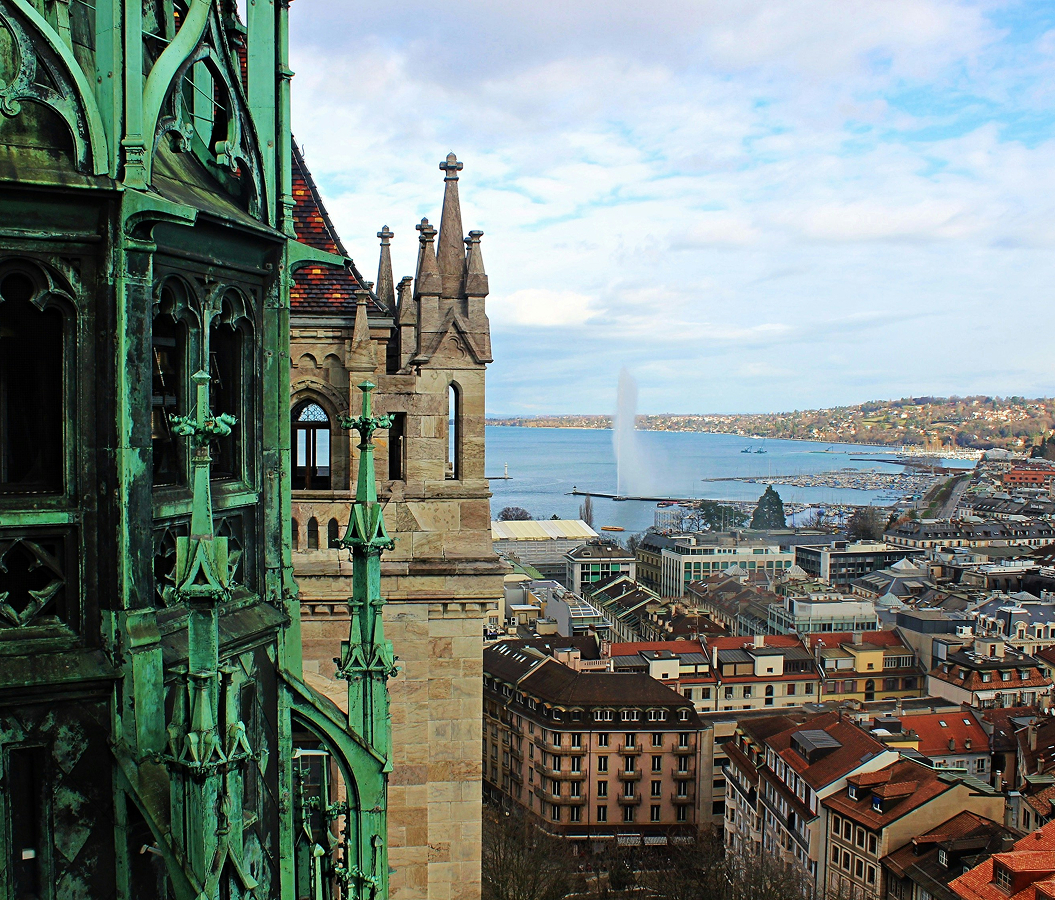
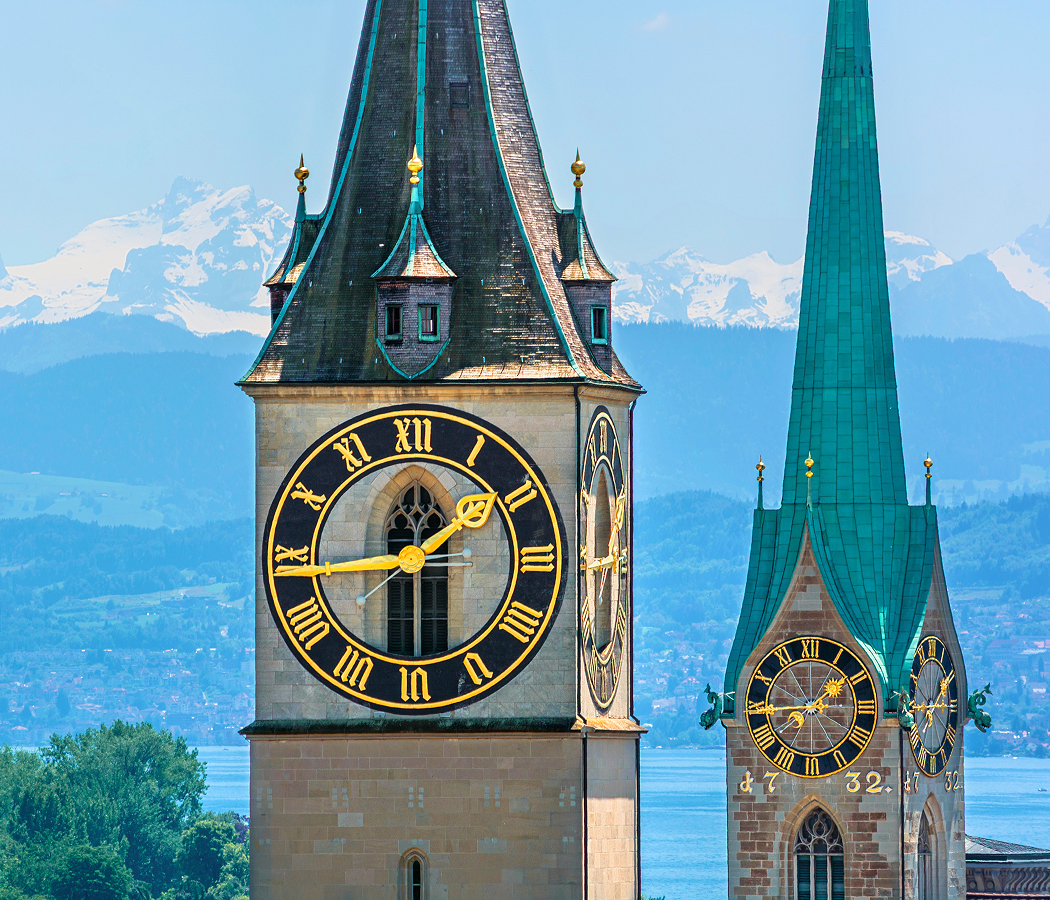
Occupying the summit of Geneva's historic upper town, the cathedral rises above the surrounding medieval streets between Place du Bourg-de-Four and the Rhône, with its towers overlooking the rooftops of the old city, Lake Geneva and the distant Alpine landscape. Its architectural composition combines Romanesque masonry, Gothic vaulting and an expansive neoclassical entrance, preserving successive building campaigns within a structure whose exterior has evolved across many centuries. The principal nave extends beneath soaring ribbed vaults supported by massive stone piers, with pointed arches and tall windows organizing the interior around a clear central axis. An elevated northern tower provides expansive views across the historic city, complemented by a richly decorated chapel and an extensive archaeological complex beneath the cathedral's foundations. The result is an expansive religious landmark whose layered architecture, elevated urban position and surviving medieval fabric preserve the physical history of Geneva's transformation from episcopal city to Protestant republic.
What defines Cathédrale Saint-Pierre.
Cathédrale Saint-Pierre is best known for becoming the principal church of John Calvin's Geneva during the Protestant Reformation, transforming a medieval episcopal cathedral into one of the most influential centers of Reformed Christianity. The site had served as a Christian religious center since late antiquity, when Geneva occupied a strategically important position within the Burgundian and Frankish worlds. Archaeological excavations beneath the cathedral uncovered the foundations of several early Christian buildings, including a fourth-century episcopal complex whose development established the hilltop as the religious center of the ancient city. The earliest cathedral belonged to an arrangement of multiple churches associated with the bishop's residence, baptismal facilities and surrounding ecclesiastical buildings. Successive rebuilding campaigns expanded the complex through the early Middle Ages, reflecting Geneva's growing importance as a bishopric controlling territory around the western end of Lake Geneva. Construction of the surviving cathedral began 1160 under the authority of Bishop Arducius de Faucigny, whose position within the Holy Roman Empire gave the episcopal establishment substantial political influence. The project developed through Romanesque foundations and increasingly Gothic architectural forms, with the choir, transept and nave completed across successive building campaigns. Pope Innocent IV consecrated the cathedral in 1232, marking a major stage in its development as Geneva's principal Catholic church. Its later medieval history became closely connected with the political struggles between the city's bishops, the counts of Geneva and the House of Savoy. The cathedral served as a setting for major religious ceremonies and civic assemblies, giving the building a political importance extending beyond its ecclesiastical function. The decisive transformation arrived during the 1530s as Geneva's Protestant movement challenged the authority of the Catholic bishop and the city's traditional religious institutions. Guillaume Farel emerged as a leading preacher of reform, attracting supporters through his opposition to Catholic doctrine and the established ecclesiastical hierarchy. Iconoclastic disturbances in August 1535 stripped the cathedral of many of its medieval religious images and furnishings, transforming the interior into a space suited to Protestant worship. Geneva formally adopted the Reformation on May 21, 1536, establishing a new religious and political order that would shape the city's subsequent development. John Calvin arrived in Geneva that summer and was persuaded by Farel to remain, beginning an association with the city that would make the cathedral internationally influential. Calvin and Farel were expelled in 1538 following conflicts with Geneva's governing councils, and Calvin spent the following three years ministering to French-speaking refugees in Strasbourg. His return in September 1541 began the period most closely associated with Geneva's emergence as a center of Reformed theology. Calvin preached regularly at Saint-Pierre, developing a religious program centered on scriptural interpretation, moral discipline and the organization of the Christian community. The Ecclesiastical Ordinances adopted in November 1541 established a new institutional structure involving pastors, teachers, elders and deacons, giving Geneva's Reformed church a model that influenced Protestant communities across Europe. The cathedral became a principal setting for sermons that drew citizens, students and visitors into Calvin's theological world. His influence extended through the Geneva Academy, founded in 1559 under the leadership of Theodore Beza, which educated ministers who carried Reformed teachings into France, Scotland, the Netherlands and other European territories. Calvin died in 1564, but Saint-Pierre retained its importance as a symbolic center of the international Calvinist tradition. The cathedral's historical significance rests on the extraordinary transformation of a medieval episcopal institution into a place associated with one of the defining religious movements of early modern Europe.
Jean de Brogny's Chapel of the Maccabees preserves a striking architectural and artistic chapter within the cathedral, connecting Geneva's medieval ecclesiastical wealth with the nineteenth-century rediscovery of Gothic decoration. The chapel originated in the early fifteenth century through the patronage of Brogny, a Geneva-born cardinal whose career brought him into the highest levels of the Catholic Church during the Western Schism. Brogny served as vice-chancellor of the Roman Church and participated in the Council of Constance, where the resolution of the papal schism helped restore institutional unity to western Christianity. His commission created an elaborate funerary chapel beside the cathedral's southern transept, introducing a highly decorated architectural space whose proportions and ornamental treatment distinguished it from the principal nave. The chapel's dedication to the Maccabees connected its religious purpose with the biblical figures associated with martyrdom and fidelity to religious law. Its original decoration suffered during the Reformation, and the building subsequently served a succession of functions that altered its medieval character. The chapel became a storage space and later accommodated educational and ecclesiastical activities, illustrating the changing practical uses of former Catholic devotional spaces within Protestant Geneva. A major restoration between 1878 and 1888 transformed the interior under architect Louis Viollier, whose work reflected the nineteenth-century Gothic Revival and its renewed interest in medieval craftsmanship. Viollier introduced an elaborate decorative program combining painted vaults, sculptural ornament and richly colored architectural surfaces. Geneva painter Charles Joseph Moïse Duval contributed to the restoration's artistic development, helping establish the chapel's distinctive polychromatic character. The resulting interior presents a striking contrast with the cathedral's restrained Protestant nave, preserving the decorative ambitions of medieval Catholic patronage through a substantial nineteenth-century reinterpretation. The cathedral's archaeological investigations subsequently introduced another major chapter in the understanding of the site. Excavations directed by cantonal archaeologist Charles Bonnet began in 1976, revealing extensive remains beneath the existing church and surrounding precinct. The discoveries included early Christian worship spaces, episcopal residences, baptismal installations and architectural fragments extending across more than a millennium of occupation. One particularly significant find was the grave of an Allobrogian chieftain beneath the northern nave, dating to the first century BCE and establishing the site's importance before the emergence of Christianity in Geneva. The excavations also uncovered mosaic floors, foundations and evidence of successive religious buildings, allowing the evolution of the cathedral precinct to be reconstructed through its surviving physical remains. The archaeological site opened to the public in 1986, introducing an extensive underground route through the successive foundations and religious structures. A major renewal completed in 2006 improved the presentation of the remains and strengthened the relationship between the archaeological evidence and the standing cathedral. The cathedral's significance extends through these distinct layers of patronage, religious transformation, nineteenth-century restoration and archaeological discovery, preserving an unusually comprehensive physical record of Geneva's religious and architectural development.
How Cathédrale Saint-Pierre fits.
Cathédrale Saint-Pierre works as the anchor for a historic Geneva exploration connecting the surviving institutions of the medieval republic, the political memory of the Protestant Reformation and the architectural history of the city's oldest public square.
Begin at Maison Tavel, Geneva's oldest surviving private residence, occupying a medieval townhouse whose origins reach the twelfth century. The Tavel family acquired the property during the thirteenth century, establishing a substantial urban residence within the city's wealthy merchant district. A destructive fire in 1334 prompted extensive rebuilding, producing the fortified stone structure whose distinctive façade and corner turrets preserve the character of late-medieval domestic architecture. The City of Geneva acquired the building in 1963 and subsequently undertook a major restoration before opening the Maison Tavel museum in 1986. Its collections examine Geneva's urban history through furniture, paintings, maps and historical objects, including the expansive Magnin relief, a detailed nineteenth-century model depicting the city before the demolition of its fortifications. Continue to Musée international de la Réforme, housed within the historic Maison Mallet beside the cathedral precinct. The mansion was constructed between 1721 and 1723 for Gédéon Mallet, a wealthy banker whose family belonged to Geneva's prominent Protestant merchant society. Architect Jean-François Blondel developed the building on the former site of the cathedral cloister, introducing a refined eighteenth-century residence into a location closely associated with the city's religious transformation. The museum opened in 2005 through an initiative led by Olivier Fatio, presenting the history of the Protestant Reformation through manuscripts, printed books, portraits, artworks and audiovisual installations. A substantial renovation completed in 2023 reorganized the exhibition around the international development of Protestantism, connecting Geneva's sixteenth-century religious history with the movement's subsequent expansion across Europe and other continents. Conclude at Place du Bourg-de-Four, the historic square whose origins reach the Roman period, when the location served as a market area outside the ancient city's principal settlement. The square developed into a commercial center during the Middle Ages, accommodating merchants, travelers and religious institutions within a dense network of surrounding streets. Its name preserves the memory of the Latin forum, reflecting the area's longstanding function as a place of trade and public assembly. During the sixteenth century, the surrounding district became associated with Protestant refugees arriving from France and other European territories, whose presence contributed to Geneva's economic and intellectual development. The square subsequently acquired an important civic character through its proximity to the Hôtel de Ville and the institutions governing the republic. Its central fountain, installed in the eighteenth century, preserves a distinctive element of the square's historical urban composition. The progression moves from Maison Tavel's preservation of medieval domestic life through Musée international de la Réforme's account of Geneva's theological transformation and culminates at Place du Bourg-de-Four, where the city's ancient commercial origins and Protestant civic history remain embedded in its historic public landscape.
Where your story begins.
Foresyte Travel reveals places that feel extraordinary long before you arrive.
Enjoy editorial crafted for luxury travelers.
Foresyte may earn a commission when you book.