Why City Hall matters.
Philadelphia City Hall is the beating civic heart of the city, a grand marriage of art, architecture, and ambition that defines the skyline.
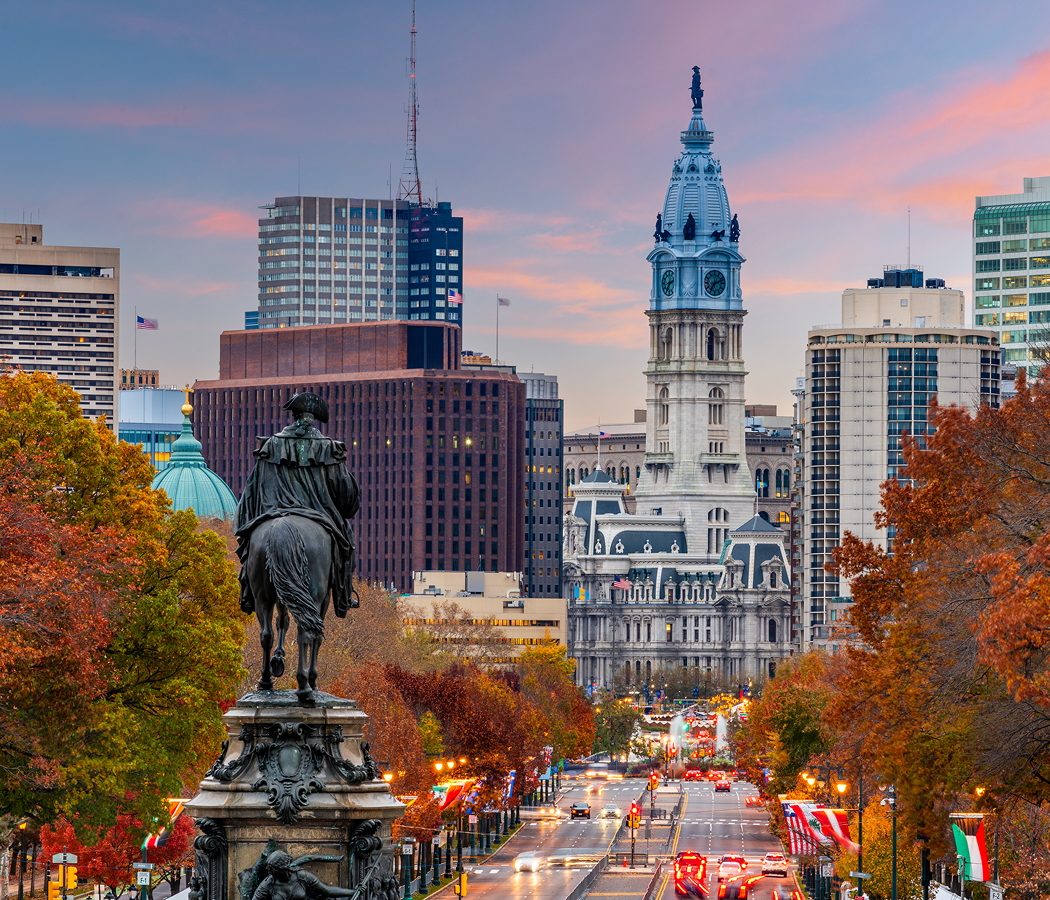
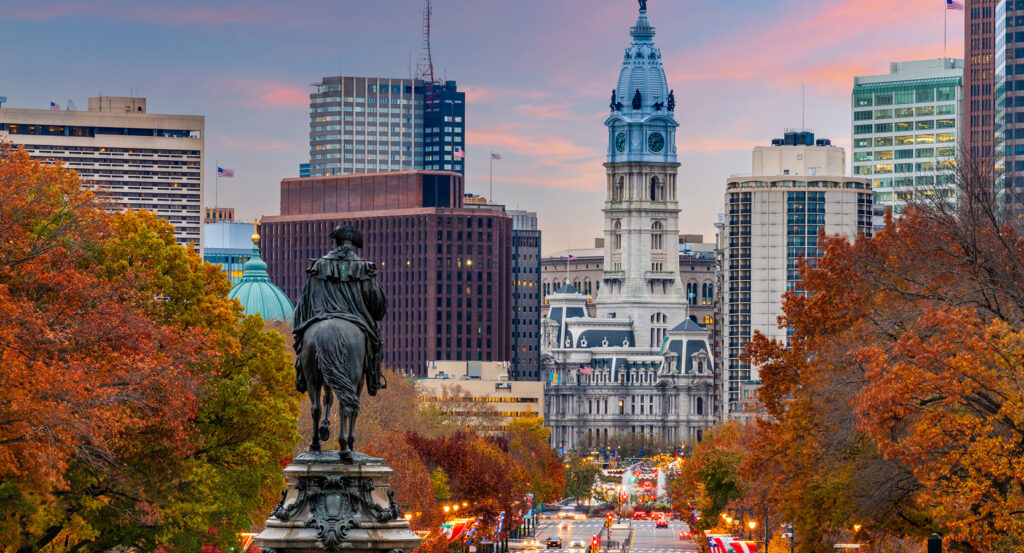
Completed in 1901 after more than 30 years of construction, City Hall stands as one of the greatest expressions of French Second Empire architecture in the world. Designed by Scottish-born architect John McArthur Jr., the structure stretches across an entire city block and rises 548 feet to the tip of its clock tower, making it, for a time, the tallest habitable building on Earth. Its exterior is a masterpiece of ornate sculptural storytelling: over 250 marble figures carved by Alexander Milne Calder adorn its façades, representing allegories of justice, wisdom, and industry, as well as historical figures that chart the evolution of civilization. Above them all, the 37-foot bronze statue of William Penn, founder of Pennsylvania, watches over the city from his perch atop the tower, his outstretched hand symbolizing protection and goodwill. Step inside, and the experience feels like stepping back into a gilded age of craftsmanship and civic pride. Marble columns, stained glass, and hand-carved woodwork line the corridors, while light filters through grand atriums with cathedral-like grace. City Hall isn't merely an administrative center, it's Philadelphia's soul cast in stone, the architectural example of a city that has always dared to build something larger than life.
What defines City Hall.
Beneath its grandeur lies a story of audacity, controversy, and resilience, a mirror of Philadelphia itself.
When construction began in 1871, the city was still recovering from the Civil War, yet its leaders sought to create a symbol of rebirth and permanence. John McArthur Jr.'s design was chosen from among two dozen submissions, and his vision was as daring as it was ambitious: a colossal masonry structure built entirely. Every inch of its 700 rooms and 22-foot-thick walls is supported by stone, granite, marble, and limestone stacked in perfect balance. At the time, it was the most expensive municipal building ever constructed, costing more than $24 million, a staggering sum that sparked debate for decades. Yet the craftsmanship was unparalleled. Alexander Milne Calder's sculptural program alone took 30 years to complete, involving three generations of the Calder family, a dynasty that would later shape American art well into the 20th century. The tower's massive clock faces, each 26 feet in diameter, rival those of Big Ben, and the William Penn statue at its crown remains the largest atop any building in the world. For nearly a century, an informal “gentleman's agreement” forbade any structure in Philadelphia from rising higher than Penn's hat, preserving the city's horizontal skyline as a mark of respect. That tradition was broken in 1987 with the construction of One Liberty Place, an act many Philadelphians jokingly blamed for the city's ensuing sports drought, known as the “Curse of Billy Penn.” In 2007, when the Comcast Center was completed, workers placed a small figurine of William Penn at its top, a gesture of goodwill that, coincidentally or not, preceded the city's long-awaited World Series victory in 2008. Beyond myth and superstition, City Hall endures as an icon of civic artistry. Restorations completed in the 2010s have restored its brilliance, from the clock tower's glow to the polished marble floors that echo the footsteps of generations. Few buildings so vividly express a city's history, pride, and eccentricity all at once.
How City Hall fits.
To truly experience City Hall, don't just pass it on your way through Center City, walk it, circle it, and climb it.
Begin at Dilworth Park on the building's west side, where fountains, sculptures, and café seating frame the massive white façade in a setting that feels equal parts civic and social. As you approach, look up at the intricate stonework, every façade tells a different story through its carvings. Step through the archways into the central courtyard, where the city's hum softens into an echo of footsteps and distant bells. From here, take the guided tower tour, among Philadelphia's most underrated experiences. An elevator ascends 500 feet to the observation deck beneath William Penn's statue, offering panoramic views of the city's grid and skyline, a breathtaking vantage point that reveals how the city unfurls like a map from Penn's original design. Inside, explore the grand staircases and corridors, where every balustrade and ceiling medallion reflects turn-of-the-century opulence. Don't miss the Council Chambers, where stained glass windows and hand-carved oak evoke a sense of gravitas rare in modern civic spaces. Step outside again at sunset, when the building's façade turns a soft rose under the fading light, and the tower clock begins to glow, a beacon of timelessness above the rush of Market and Broad Streets. In winter, the plaza transforms into a skating rink framed by lights and laughter, while in summer, outdoor concerts fill the square with energy. No matter the season, City Hall stands at the city's literal and symbolic center, a meeting point of art, politics, and daily life. Philadelphia City Hall isn't merely a government building, it's a living monument to the city's ambition, eccentricity, and endurance. Beneath William Penn's watchful gaze, history and humanity converge, not as relics, but as reminders that greatness, like the city itself, is always a work in progress.
Where your story begins.
Foresyte Travel reveals places that feel extraordinary long before you arrive.
Enjoy editorial crafted for luxury travelers.
Foresyte may earn a commission when you book.