Why Common Thread matters.
Common Thread is an inventive American restaurant where Thomas Square's Victorian architecture meets chef Brandon Carter's farm-driven cooking, the agricultural traditions of the Lowcountry and the restoration of a nineteenth-century Savannah residence into one of the city's most accomplished contemporary dining destinations.
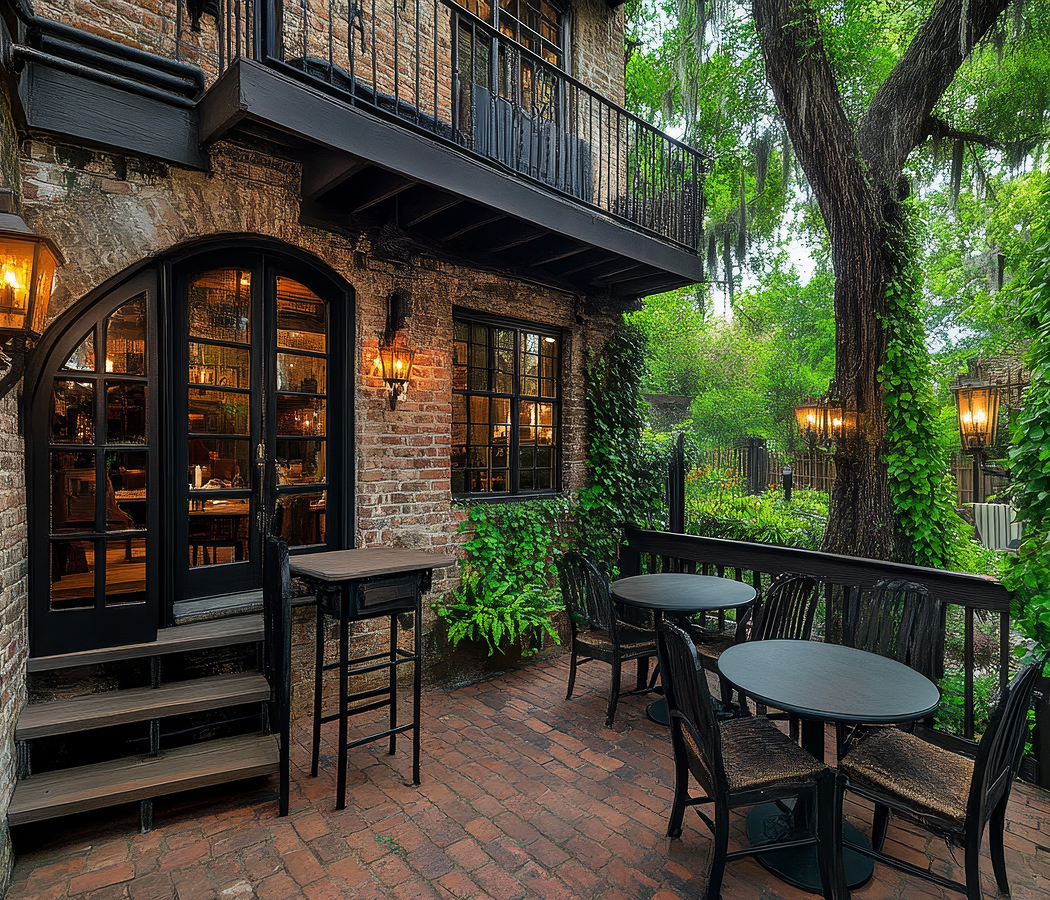
Situated on East 37th Street between Drayton and Abercorn Streets, the restaurant occupies a residential corridor distinguished by historic houses, mature trees and the architectural character of Savannah's southern streetcar suburbs. Its restored Victorian exterior introduces a substantial two-story residence with a broad porch, decorative woodwork and a welcoming entrance. Inside, intimate dining rooms retain the proportions of a private home, with fireplaces, tall windows and carefully arranged tables creating distinct spaces for dinner. A central bar, warm lighting and contemporary furnishings introduce a restrained modern character that complements the historic interiors. The result is a sophisticated neighborhood restaurant whose residential setting gives ambitious contemporary cooking the intimacy of a dinner party.
What defines Common Thread.
Common Thread is best known for chef Brandon Carter and restaurateur Ryan Williamson extending their farm-centered partnership from Bluffton, South Carolina, into a historic Savannah residence whose preservation became integral to the restaurant's character. Their collaboration began after Williamson and his wife, Joanne, purchased a five-acre farm near Bluffton in 2013. Williamson started selling produce to restaurants at Palmetto Bluff, establishing a relationship with Carter, then the resort's executive chef. Their shared interest in connecting professional kitchens directly with regional agriculture led to the opening of FARM in Old Town Bluffton in 2016. The restaurant's success attracted longtime guests Alan and Karen Sheriff, who encouraged the partners to develop a Savannah venture. Their search led to the Krouskoff House, a Victorian residence built in 1897 by Solomon Krouskoff as a wedding present for his second wife, Matilda. Born in Prussia in 1840, Krouskoff immigrated to New York before establishing a successful Savannah millinery business with operations on Broughton and Drayton Streets. His commercial success supported investments in the developing Thomas Square neighborhood, and he served as a Savannah alderman from 1897 to 1899. The residence survived the twentieth century largely intact, escaping the subdivision into apartments that altered numerous neighboring properties during the Depression. Antique dealer Albert L. Cobb Sr. and his wife, Lila, acquired the house in 2001, continuing its commercial life through Cobb's Galleries. The restaurant partnership purchased the property in 2018 and began adapting the historic rooms for contemporary dining. Carter recruited chef John Benhase, whose experience developing Savannah's Starland Yard brought complementary culinary interests to the opening team. Construction and the pandemic delayed the project before Common Thread welcomed its first diners in January 2021. Benhase departed a year later, and Joseph Harrison advanced from line cook into a leading culinary role alongside Carter. Their collaboration received national recognition in January 2025 when the James Beard Foundation named Carter and Harrison semifinalists for Best Chef: Southeast. The restaurant's development connects a nineteenth-century merchant's residence with a modern culinary enterprise built on the relationships between regional farmers, accomplished chefs and the preservation of Savannah's architectural heritage.
Brandon Carter's cooking begins with the seasonal harvest, using relationships with Lowcountry farmers and fishermen to determine the ingredients that guide the kitchen's creative decisions. Produce arriving from small growers establishes the foundation for preparations that draw on Southern traditions and the broader culinary histories of Italy, West Africa and Southeast Asia. The kitchen develops these influences through shared techniques of fermentation, preservation and concentrated seasoning, allowing familiar regional ingredients to acquire unexpected dimensions. Collard greens demonstrate that approach through a preparation informed by Southern cooking and West African traditions, with fermented peppers and peanut sauce introducing depth, acidity and richness. The relationship between the greens and their seasoning gives a familiar vegetable a different culinary character, preserving its earthy flavor within a more complex preparation. Seafood receives similarly attentive treatment, with local fish and shellfish paired with ingredients selected to emphasize freshness, salinity and delicate texture. Raw preparations establish a lighter opening to the meal, allowing citrus, herbs and carefully balanced acidity to frame the natural character of the catch. More substantial cooking develops through controlled roasting and dry aging, techniques that concentrate flavor and introduce richer textures as the meal advances. The menu's organization supports that movement, arranging dishes from lighter preparations toward deeper, more substantial flavors within a flexible à la carte format. Diners assemble their own progression, drawing on the structure of a tasting menu through dishes selected for sharing. Carter's collaboration with regional producers also creates opportunities to incorporate ingredients from small farms whose harvests change throughout the year. Wine and cocktails extend the kitchen's interest in balance, pairing acidity, aromatic complexity and restrained sweetness with the evolving character of the food. Common Thread ultimately defines its culinary approach through the relationship between agricultural seasonality, international cooking traditions and the careful development of flavor across a shared meal.
How Common Thread fits.
Common Thread works as the anchor for an outing connecting Savannah's streetcar-era residential expansion, the preservation of historic neighborhood architecture and the creative institutions that have shaped the city's contemporary cultural landscape.
Begin at Thomas Square Park, the neighborhood green space established during Savannah's southern expansion in the late nineteenth century. The city's 1883 boundary extension and subsequent subdivision of former agricultural land created the structure for a new residential district beyond the older downtown squares. Electric streetcars reached the area in 1888, accelerating development along the routes that connected emerging neighborhoods with Savannah's commercial center. The park became a defining element of the district, surrounded by Victorian houses, civic buildings and neighborhood businesses that reflected the growing importance of the city's southern suburbs. Its continued preservation anchors the Thomas Square Streetcar Historic District, which received National Register recognition in 1997. Continue to Savannah African Art Museum, the nonprofit institution devoted to the artistic traditions of West and Central Africa. Founded in 2016 and opened to the public in 2017, the museum developed around a collection of ceremonial objects, sculptures and cultural artifacts assembled over several decades. Its holdings include nineteenth- and twentieth-century works created from wood, metal, ceramics, glass and fiber, representing diverse communities across the African continent. The institution relocated into a substantial 1922 residence on East 37th Street following an architectural adaptation by Felder & Associates. Exhibitions and educational programming examine the spiritual, ceremonial and social functions of African art, extending Savannah's cultural landscape beyond its familiar architectural and colonial history. Conclude at Starland District, the creative neighborhood whose revival began around the former Starland Dairy on Bull Street. The dairy originated 1909 through a cooperative effort by regional farmers and developed into a major neighborhood employer supplying milk to Savannah households. Its closure during the late 1980s contributed to the deterioration of surrounding commercial properties, leaving a substantial industrial complex vacant. Savannah College of Art and Design graduates John Deaderick and Greg Jacobs began planning its rehabilitation in the late 1990s, purchasing the property in 2001 and developing studios, shops and creative workspaces. Their project helped establish a broader arts district that subsequently attracted independent galleries, restaurants and cultural businesses. The progression moves from Savannah's nineteenth-century suburban planning through the preservation of African artistic traditions and concludes with the adaptive reuse of a former industrial neighborhood, connecting the architectural and cultural transformations surrounding Common Thread.
Where your story begins.
Foresyte Travel reveals places that feel extraordinary long before you arrive.
Enjoy editorial crafted for luxury travelers.
Foresyte may earn a commission when you book.