Why Fairmont Makati matters.
Fairmont Makati is a modern luxury hotel where Makati's financial district meets Philippine hospitality, international business travel and the cultural institutions developed around Ayala Center.
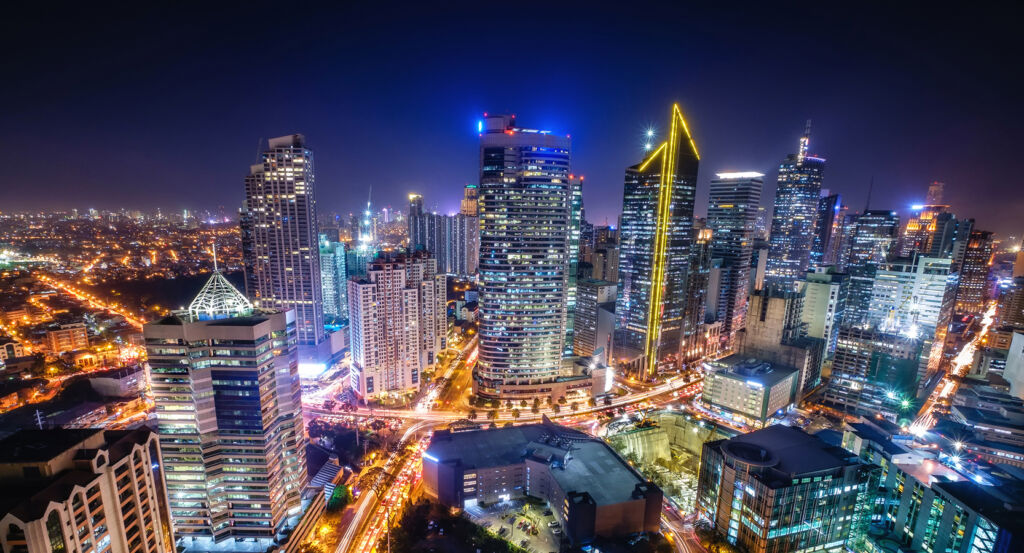
Occupying 1 Raffles Drive at the intersection of Makati Avenue and the Central Makati commercial grid, Fairmont Makati stands between Glorietta, Greenbelt and the Makati central business district, with Ayala Avenue, Paseo de Roxas and the streets leading toward Legazpi Village surrounding the property. The hotel rises within a dense urban district shaped by office towers, retail complexes, residences, cultural institutions and landscaped public spaces. Makati Avenue directs movement north toward the older commercial streets of Poblacion and the wider metropolitan core, while Ayala Avenue runs east and west through the financial center. Paseo de Roxas creates a major business corridor lined with corporate towers, banks and institutional buildings. The hotel's position places it within walking distance of shopping, dining, public transport and the headquarters of major Philippine companies. Its glass tower overlooks a cityscape where high-rise construction, tropical vegetation and intense traffic coexist within a compact central district. The surrounding streets form one of Metro Manila's most concentrated examples of planned commercial development, with elevated walkways and interconnected retail areas helping pedestrians move through the heat and density of the city. The result is a hotel positioned at the center of Makati's business, retail and cultural geography.
What defines Fairmont Makati.
Fairmont Makati originated in Ayala Land's expansion of luxury hospitality within the Philippines' principal financial district, bringing an internationally recognized hotel brand into a major mixed-use development conceived during a period of renewed economic confidence. The project emerged through a partnership between Ayala Land and Kingdom Hotel Investments, the international hospitality investment company associated with Saudi businessman Prince Alwaleed bin Talal. Their joint venture, KHI-ALI Manila, pursued a development combining Fairmont Hotels & Resorts, Raffles Hotels & Resorts and privately owned residences within a single architectural complex. The arrangement brought together two established international luxury brands under Fairmont Raffles Hotels International, extending their presence in Southeast Asia through a coordinated investment in the Philippine capital. Miami-based architectural practice Arquitectonica designed the tower, establishing a contemporary composition whose glazed elevations and metropolitan proportions reflected Makati's expanding commercial identity. Singapore-based Bent Severin International developed the interiors, introducing Filipino decorative traditions through coco-twig resin, crushed mahogany seeds, laminated abaca glass and pearl-inlaid mahogany handles. These elements connected international hotel design with Philippine craftsmanship and the country's established traditions of working with tropical timber, plant fibers and decorative shell. The development incorporated Fairmont Makati, the all-suite Raffles Makati and Raffles Residences, whose privately owned apartments extended the project into the luxury residential market. Its completion represented a significant addition to Ayala Center's commercial environment during a period when Philippine economic growth was attracting renewed international investment and business travel. A consequential ownership transition occurred on October 2, 2012, when Ayala Land's hospitality subsidiary agreed to acquire Kingdom Hotel Investments' interests in the development companies. The transaction, valued at ₱2.43 billion, increased Ayala Land's economic ownership from 20 percent to full control of the project, consolidating the development within the Philippine property group before its public debut. Fairmont Makati and Raffles Makati officially opened on December 3, 2012, through simultaneous ribbon-cutting ceremonies attended by Tourism Secretary Ramon Jimenez Jr., Makati Mayor Jejomar Erwin Binay Jr. and senior Ayala executives. The opening marked Fairmont's entry into the Philippines and Raffles' return to the country's luxury hotel market, strengthening Makati's international hospitality infrastructure after a lengthy interval between major upscale hotel developments. Ayala Corporation chairman Jaime Augusto Zobel de Ayala participated in the inauguration, reflecting the project's importance to the group's broader investment strategy and the capital's commercial development. The shared complex also introduced an extensive collection of Filipino artworks, with the residential component incorporating original paintings by emerging Philippine artists into its interior corridors. The artistic program extended the development's relationship with local craftsmanship into contemporary visual culture, establishing a connection between private residential architecture and the country's creative community. Fairmont Makati occupies a distinctive position in Philippine hospitality history through its combination of international hotel investment, Filipino architectural expression, luxury residential development and the continued evolution of Ayala Center as a major metropolitan destination.
Fairmont Makati's culinary character develops through the relationship between Filipino hospitality, international restaurant traditions and the distinctive social culture of Metro Manila's commercial center. The property's principal restaurant, Spectrum, approaches all-day dining through a collection of open culinary stations that bring preparation and service into direct contact with guests. Its original concept incorporated five culinary theaters, establishing a format in which different cooking traditions share a coordinated dining environment. Filipino culinary influences contribute a foundation of savory depth, acidity and aromatic complexity, reflecting the archipelago's longstanding relationships with Southeast Asian ingredients, Chinese cooking and Spanish colonial food traditions. The kitchen's international program extends this foundation through European and Asian preparations, creating a dining format shaped by the cosmopolitan character of Makati's business community. Live cooking introduces a distinctive physical dimension through the movement of chefs, the aromas of freshly prepared food and the changing rhythms of breakfast, lunch and evening service. Spectrum's themed dinners develop the restaurant's international character through focused culinary programs, connecting familiar regional flavors with the generous social traditions of hotel buffet dining. Café Macaron contributes a complementary expression of European pastry craftsmanship through carefully prepared cakes, laminated pastries, chocolates and delicate confections. Its approach to presentation emphasizes precision, texture and balanced sweetness, connecting the French pâtisserie tradition with Manila's established culture of celebratory desserts and afternoon refreshments. The Fairmont Lounge extends the property's social character through classic cocktails, contemporary mixology and the attentive service associated with international grand hotels. Its Classics Perfected program develops familiar cocktail compositions through carefully selected spirits, controlled dilution and balanced aromatic elements, preserving the recognizable character of established drinks through precise preparation. The adjoining Raffles hospitality venues introduce another dimension through the Long Bar, whose character descends from the celebrated cocktail traditions of Raffles Singapore. The Writers Bar contributes a quieter interpretation of literary hospitality, extending the cultural associations of the Raffles brand into the Philippine capital. These shared dining and drinking environments establish a distinctive relationship between Fairmont's metropolitan hospitality and Raffles' longstanding traditions of social entertaining. Beyond the restaurants, the property's wellness program incorporates therapeutic treatments and personalized restorative services, providing a complementary expression of hospitality within the commercial intensity of Central Makati. The combined operation also supports formal celebrations and corporate gatherings, sustaining the relationship between international hotel service and the social conventions of the Philippine business establishment. Together, these culinary and social traditions establish Fairmont Makati as a distinctive expression of Filipino hospitality, international gastronomy and the cosmopolitan culture of Manila's principal financial district.
How Fairmont Makati fits.
Fairmont Makati works as a base for an outing connecting Makati's landscaped business district, Philippine cultural history and the public garden spaces embedded within Ayala Center.
Begin at Ayala Triangle Gardens, a landscaped public space occupying more than 20,000 square meters in the heart of Makati's central business district. The site was once Nielson Field, the country's first airport, before becoming part of the land that shaped Ayala's modern financial center. Its transformation from an airfield into a planted urban courtyard reflects Makati's movement from transport infrastructure toward commercial and civic development. More than 100 trees, including rain trees, golden palms, fire trees, kamuning and podo carpus, establish a tropical landscape within the surrounding towers. Public artworks and open paths create a civic setting that contrasts with the office blocks and traffic corridors around it. Continue to Ayala Museum, occupying a glass and granite building at the corner of Makati Avenue and de la Rosa Street. Leandro V. Locsin Partners designed the museum under the direction of Leandro Y. Locsin Jr., giving the institution a modern architectural presence within the redeveloped commercial district. The museum contains the Crossroads of Civilizations exhibition, Philippine pre-colonial treasures, works by Fernando Amorsolo, Fernando Zobel and Juan Luna, and the Diorama Experience of Philippine History. Its collections connect archaeological, colonial, artistic and national narratives within a single cultural institution. The museum's origins reach back to Fernando Zobel's vision of making Philippine history and art accessible to a broad public, giving Makati a cultural anchor alongside its financial institutions. Conclude at Greenbelt Park, the landscaped center of the Greenbelt complex within Ayala Center. The park surrounds the Santo Niño de Paz Greenbelt Chapel and connects five retail wings through gardens, walkways, water features and open-air spaces. Its design places commercial buildings around a planted public environment rather than treating shopping as an enclosed interior activity. The chapel introduces a religious structure into the center of the retail district, creating a distinct relationship between commerce, landscape and devotion. Greenbelt's development also preserves the wider history of Ayala Center, whose earlier commercial forms grew from the Makati master plan and the transformation of former estate and airport land. The progression moves from Ayala Triangle Gardens' conversion of an airfield into public landscape through Ayala Museum's preservation of Philippine cultural memory and culminates at Greenbelt Park, connecting Makati's business development, national history and public urban life.
Where your story begins.
Foresyte Travel reveals places that feel extraordinary long before you arrive.
Enjoy editorial crafted for luxury travelers.
Foresyte may earn a commission when you book.