Why Fort Moultrie matters.
Fort Moultrie isn't just a fortress, it's a chronicle of American defense, a sentinel that has watched over Charleston Harbor for more than two centuries.
Perched on Sullivan's Island, this storied site is where the story of coastal resilience begins. Before Fort Sumter ever drew the first shots of the Civil War, Fort Moultrie had already cemented its place in the nation's history. On June 28, 1776, as British warships advanced toward Charleston, Colonel William Moultrie and his small band of patriots held their ground inside a fort built from palmetto logs and sand. The spongy wood absorbed cannon fire rather than shattering, an act of ingenuity that turned the tide of battle and saved Charleston from capture. That victory was so symbolic that South Carolina later adopted the palmetto tree on its state flag. Standing on the same ground today, with the salt breeze in your face and the sound of waves lapping the shore, it's easy to imagine the thundering guns, the smell of gunpowder, and the courage it must have taken to hold the line. Yet beyond its revolutionary legacy, Fort Moultrie tells a broader story, among evolution, adaptation, and endurance across every major conflict in U.S. history.
What defines Fort Moultrie.
Fort Moultrie is among the few sites in America that physically showcases the evolution of coastal defense from the 18th through the 20th century.
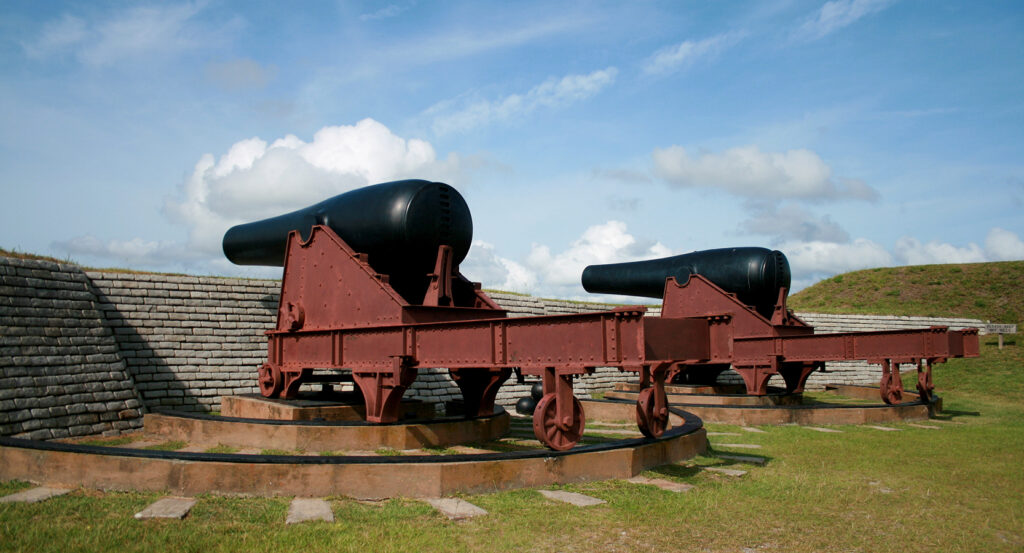
After the Revolution, the original palmetto fort fell into ruin, but new versions soon replaced it, brick by brick, decade by decade. The second fort, completed in 1798, succumbed to hurricane damage, leading to the construction of a third version in 1809 that still stands today. During the Civil War, Fort Moultrie once again found itself at the heart of conflict. It was here that Confederate forces first fired upon Fort Sumter across the harbor in 1861, signaling the start of a divided nation's struggle. After the war, the site continued to evolve: reinforced concrete batteries, modern artillery, and underground bunkers were added as technology advanced. During World War II, Fort Moultrie even served as a critical observation post, monitoring submarine activity off the coast. Walking through its layered architecture feels like stepping through a living timeline, the palmetto log beginnings giving way to brick bastions and finally to steel and concrete. The fort's museum displays uniforms, weaponry, and historic maps that trace this transformation, revealing how every generation left its mark. Yet what makes Fort Moultrie unique isn't just its military history, it's the way it mirrors the nation's growth, from colonial survival to modern strength. The views from its ramparts stretch across the water to Fort Sumter and beyond, connecting the dots between moments that shaped America's identity.
How Fort Moultrie fits.
Visiting Fort Moultrie offers a quieter, more contemplative counterpart to the drama of Fort Sumter, and it's easily one of Charleston's most rewarding historical stops.
Start the visit at the Fort Moultrie Visitor Center, where an engaging film and well-curated exhibits introduce the fort's layered past. From there, walk the grounds at your own pace, the self-guided tour is designed chronologically, letting you move through centuries of military design in a single stroll. Begin at the reconstructed palmetto log walls that evoke the Revolutionary War fort, then continue toward the later brick ramparts and concrete gun emplacements that guarded the harbor during World War II. Along the way, interpretive signs and artifacts help connect each structure to its moment in history. Climb to the top of the ramparts for panoramic views of Charleston Harbor, the Ravenel Bridge, and Fort Sumter gleaming in the distance. If you visit near sunset, the light reflecting off the water turns the scene golden, a serene contrast to the fort's battle-hardened past. Don't miss the small but fascinating cemetery outside the walls, where generations of soldiers rest beneath live oaks draped in Spanish moss. Afterward, stroll along Sullivan's Island Beach, just steps away, for a chance to absorb the peace of the sea that once carried warships to these shores. For a full day of history, pair your trip with a ferry ride to Fort Sumter or explore the nearby Edgar Allan Poe Library, named after the poet who once served at Fort Moultrie. Fort Moultrie isn't merely a relic of old wars, it's a living narrative of American defense, innovation, and endurance. To stand within its walls is to witness the evolution of an entire nation's spirit, from the palmetto fort that defied an empire to the steel bastions that guarded a world at war. It's Charleston's quieter battlefield, one that speaks not with echoes of gunfire, but with the steady heartbeat of history itself.
Where your story begins.
Foresyte Travel reveals places that feel extraordinary long before you arrive.
Enjoy editorial crafted for luxury travelers.
Foresyte may earn a commission when you book.