Why Garuda Wisnu Kencana Cultural Park matters.
Garuda Wisnu Kencana Cultural Park is a limestone sculpture complex where Ungasan's Bukit Peninsula landscape meets Balinese Hindu cosmology, Nyoman Nuarta's expansive bronze craftsmanship and Indonesia's investment in large-scale public art.
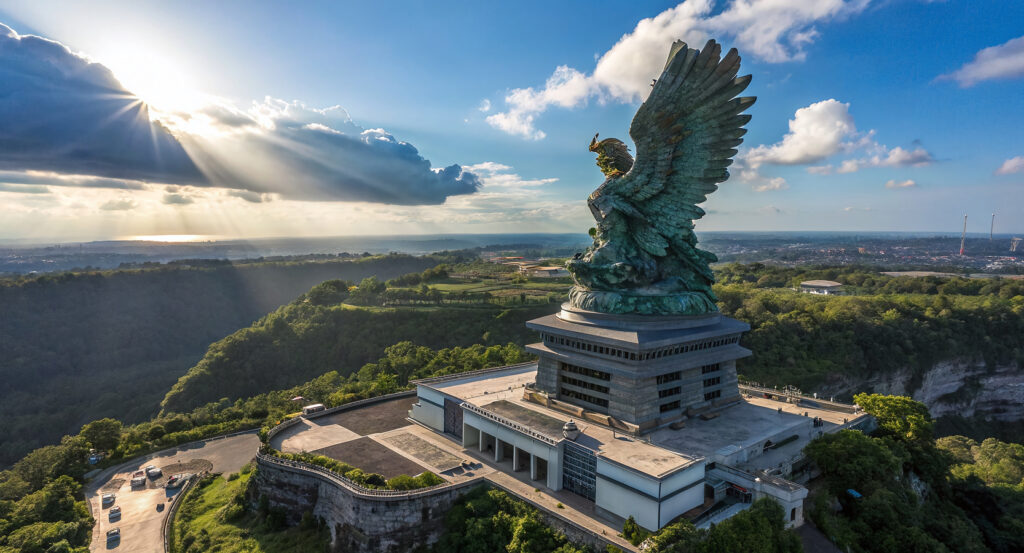
Set along Jalan Raya Uluwatu near Jalan Goa Gong and not far from the Ungasan village center, the cultural park occupies a former limestone quarry on the Bukit Peninsula, where excavated rock corridors, elevated terraces and open plazas extend across the southern highlands above Jimbaran Bay. Vertical limestone walls enclose several pedestrian passages and performance areas. The central statue rises above the quarry's upper terraces, with its copper-colored surfaces visible across the surrounding peninsula. Gardens, exhibition buildings and outdoor stages occupy separate areas connected by paved walkways. The result is a cultural complex whose physical arrangement integrates large-scale sculpture, quarried limestone terrain and Balinese performing arts.
What defines Garuda Wisnu Kencana Cultural Park.
Garuda Wisnu Kencana Cultural Park is best known for its colossal statue of Vishnu riding Garuda, its limestone quarry setting and its role as a center for Balinese cultural performances. The project originated in the late twentieth century through the artistic ambitions of Indonesian sculptor Nyoman Nuarta, who sought to create a major public sculpture based on Hindu religious imagery. Nuarta, born in Tabanan, Bali, in 1951, studied sculpture at the Bandung Institute of Technology and became associated with Indonesia's modern sculptural movement. His work incorporated figurative forms, metal fabrication and large-scale public commissions. The Garuda Wisnu Kencana project developed around the representation of Vishnu, the Hindu deity associated with preservation, mounted upon Garuda, the mythical bird serving as his vehicle. Its iconography connected Balinese Hindu traditions with a national cultural project intended to attract international attention. Construction began in 1997 on a limestone plateau in southern Bali. The Asian financial crisis of 1997-1998 disrupted financing and delayed the completion of the principal statue. During the extended construction period, separate sculptural components were installed within the park, including substantial representations of Vishnu and Garuda. These installations became focal points for visitors and cultural events as work continued on the larger composition. The development subsequently received renewed investment, allowing fabrication and assembly to proceed. The completed statue was inaugurated on 22 September 2018 by Indonesian President Joko Widodo. Its construction required coordination among sculptors, engineers, metalworkers and structural specialists responsible for supporting a large metal sculpture in a coastal environment. The completed work became one of the tallest statues in the world, establishing a major addition to Indonesia's public art infrastructure. The surrounding park developed performance venues, exhibition facilities and cultural programming associated with Balinese dance, music and ceremonial traditions.
Nyoman Nuarta's sculptural composition depicts Vishnu seated upon Garuda, whose extended wings and powerful body form the lower portion of the structure. The completed statue reaches 121 meters in height, including its substantial pedestal. Its exterior incorporates copper and brass panels mounted upon an internal structural structure. The metal surfaces were fabricated in sections and assembled to create the detailed forms of the deity, bird and associated ornamental elements. Vishnu's figure incorporates a crown, elaborate jewelry and ceremonial attributes associated with Hindu iconography. Garuda's wings extend outward through a layered arrangement of feathers developed in metal relief. The sculptural composition required structural engineering capable of accommodating substantial wind loads and seismic conditions. Its location on the Bukit Peninsula exposes the statue to coastal winds and the environmental effects of tropical weather. The internal structure supports the exterior panels through a system designed for the work's substantial height and complex geometry. The statue's pedestal contains exhibition and visitor facilities associated with the artistic development of the project. Elsewhere in the park, the Vishnu Plaza contains an earlier expansive sculpture of the deity positioned above a broad ceremonial terrace. Garuda Plaza contains a separate representation of the mythical bird, allowing visitors to examine the sculptural components at a different scale. Lotus Pond occupies a large outdoor space enclosed by towering limestone walls, creating an amphitheater-like setting for performances and public events. Its name derives from the symbolic importance of the lotus in Hindu religious traditions. The park's cultural programming includes Balinese dance, musical performances and theatrical presentations associated with the island's artistic heritage. Traditional dances such as the Barong and Kecak connect the site's performance activities with religious narratives and communal artistic practices. The complex's arrangement joins modern metal sculpture with Balinese religious imagery and the geological character of the peninsula.
How Garuda Wisnu Kencana Cultural Park fits.
Garuda Wisnu Kencana Cultural Park works as the sculptural centerpiece for a Bukit Peninsula outing connecting Balinese Hindu worship, coastal architecture and the limestone landscapes of southern Bali.
Begin at Uluwatu Temple, the Hindu sanctuary standing on a limestone cliff above the Indian Ocean at the southwestern edge of the peninsula. The temple is associated with the spiritual legacy of the priest Dang Hyang Nirartha, whose travels contributed to the development of important Balinese religious sites during the sixteenth century. Its principal shrines occupy an elevated precinct enclosed by traditional stone walls and gateways. The surrounding cliffs rise sharply above the sea, establishing a coastal setting associated with Balinese religious concepts of sacred geography. Evening Kecak performances take place near the temple, presenting episodes from the Ramayana through rhythmic vocal chanting and choreographed movement. Continue to Balangan Beach, the coastal bay situated beneath the limestone cliffs west of Jimbaran. The beach occupies a curved shoreline bordered by exposed rock formations and elevated headlands. Its offshore reef produces surf breaks associated with the peninsula's recreational coastline. The surrounding cliffs reveal layers of limestone shaped by marine erosion and the geological development of southern Bali. Paths descend from the upper coastal terraces toward the sand, connecting the elevated peninsula with the Indian Ocean shoreline. The beach's physical setting demonstrates the relationship between uplifted limestone terrain and coastal wave action. Conclude at Jimbaran Fish Market, the seafood trading area associated with the fishing communities of Jimbaran Bay. The market operates near the shoreline where fishing boats bring their catches from the surrounding coastal waters. Vendors sell fish, crustaceans and other seafood supplied through local maritime networks. Its trading activities preserve the relationship between coastal settlements and the fishing economy of southern Bali. Nearby cooking establishments prepare seafood using charcoal grilling and Balinese seasoning traditions. The surrounding bay contains fishing vessels, landing areas and coastal infrastructure associated with the region's maritime livelihoods. The progression moves from cliffside Hindu worship through the peninsula's limestone coastline and culminates at a working fishing community, connecting Garuda Wisnu Kencana Cultural Park with the religious and coastal geography of southern Bali.
Where your story begins.
Foresyte Travel reveals places that feel extraordinary long before you arrive.
Enjoy editorial crafted for luxury travelers.
Foresyte may earn a commission when you book.