
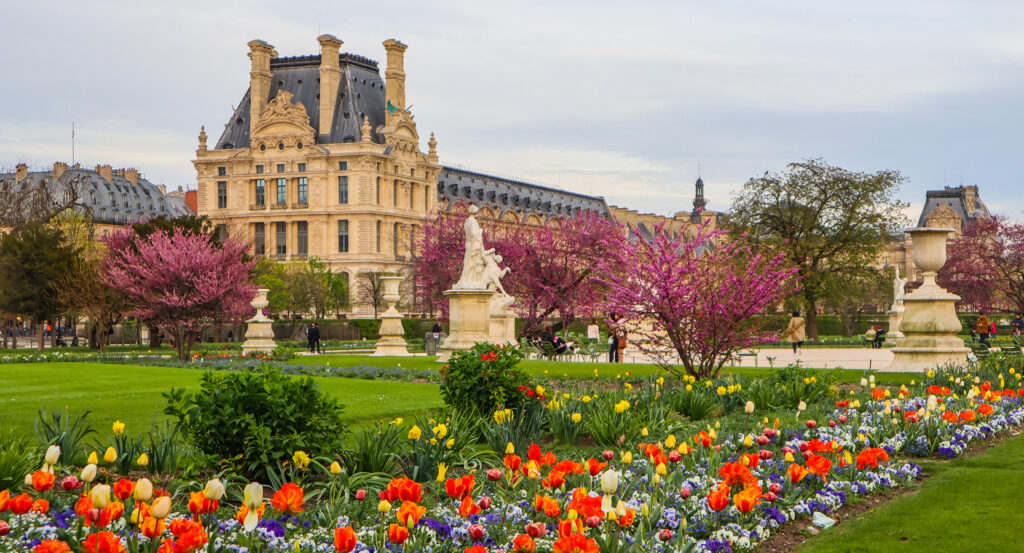
Why you should experience Bassin Octogonal in Paris, France.
Bassin Octogonal is an elegant garden basin where Tuileries' royal landscape heritage, French formal design, optical perspective, and civic promenade culture converge within one of Paris' most precisely composed public spaces.
Set along the Grande Allée near Rue de Rivoli and just steps from Musée de l'Orangerie, this octagonal basin anchors the western end of the Jardin des Tuileries with reflective water, a powerful central jet, eight angled corner jets, and commanding views toward Place de la Concorde, the Champs-Élysées, and the Arc de Triomphe. André Le Nôtre's long axial planning gives the water a role far beyond decoration, using scale, geometry, and perspective to draw the eye across one of the most important ceremonial landscapes in Europe. The result is a garden basin defined by classical order, architectural illusion, and the enduring elegance of Parisian public life.
What you should know about Bassin Octogonal.
Bassin Octogonal is best known for forming the great western basin of the Jardin des Tuileries, whose decisive transformation began in 1664 when Louis XIV and Jean-Baptiste Colbert ordered André Le Nôtre to redesign the former royal garden created after Catherine de' Medici began building the Tuileries Palace and gardens in 1564. Le Nôtre's plan established the garden's enduring French formal structure by extending the main east-west axis, organizing terraces, allées, parterres, and basins into a controlled perspective, and placing a round basin toward the former palace side and the much larger octagonal basin at the western end near what became Place de la Concorde. From the vanished Tuileries Palace, the garden's basins were designed to appear visually balanced, although the octagonal basin is in reality twice the size of the round basin, creating a deliberate optical correction that demonstrates Le Nôtre's mastery of scale, geometry, and theatrical perspective. The basin remains the largest water feature in the Tuileries, distinguished by a central jet rising 12 meters and eight angled jets placed at the corners of the octagon, while the broader fountain system was restored in 1990 during the modern renewal of the garden associated with Pascal Cribier and Louis Benech. Positioned at the hinge between the Jardin des Tuileries and Place de la Concorde, the basin now participates in the extended historic axis running from the Louvre and Arc de Triomphe du Carrousel through the Obélisque de la Concorde, Arc de Triomphe, and Grande Arche de la Défense, preserving a water feature whose geometric clarity connects royal garden design, urban planning, and the grand westward expansion of Paris.
The basin's importance comes from the way it makes landscape architecture visible as a form of power, perception, and civic theater. Chairs gathered around the water, reflections shifting beneath the fountain jets, views opening toward the Louvre in one direction and the Concorde in the other, and the steady movement of pedestrians through the garden all reinforce the same idea: Bassin Octogonal is not an isolated ornament, but the western anchor of a designed perspective that has shaped how Paris presents itself for more than three centuries.
How to fold Bassin Octogonal into your trip
Bassin Octogonal works as the western pause within a carefully paced exploration of the Tuileries' art, garden design, and ceremonial axis.
Begin at Musée de l'Orangerie, where Monet's Water Lilies create an immersive study of reflection, atmosphere, and water before stepping outside toward Bassin Octogonal to see how formal geometry and open sky shape a very different kind of visual experience. Continue to Jeu de Paume, whose photography and image-based exhibitions extend the conversation from painted perception to modern ways of seeing within the same garden landscape. Conclude at Place de la Concorde, where the Luxor Obelisk, grand fountains, and vast urban space expand Le Nôtre's garden perspective into the grand civic axis of Paris. The progression moves from interior water painting to formal garden basin to grand city space, revealing how this corner of the Tuileries turns art, optics, landscape, and power into one continuous Parisian composition.
Where your story begins.
Foresyte Travel reveals places that feel extraordinary long before you arrive.
Experience premium editorial crafted for luxury travelers.














































































































