Why you should experience Grant Park in Chicago, Illinois.
Grant Park is Chicago's grand front lawn, where art, architecture, and open space converge in perfect balance.
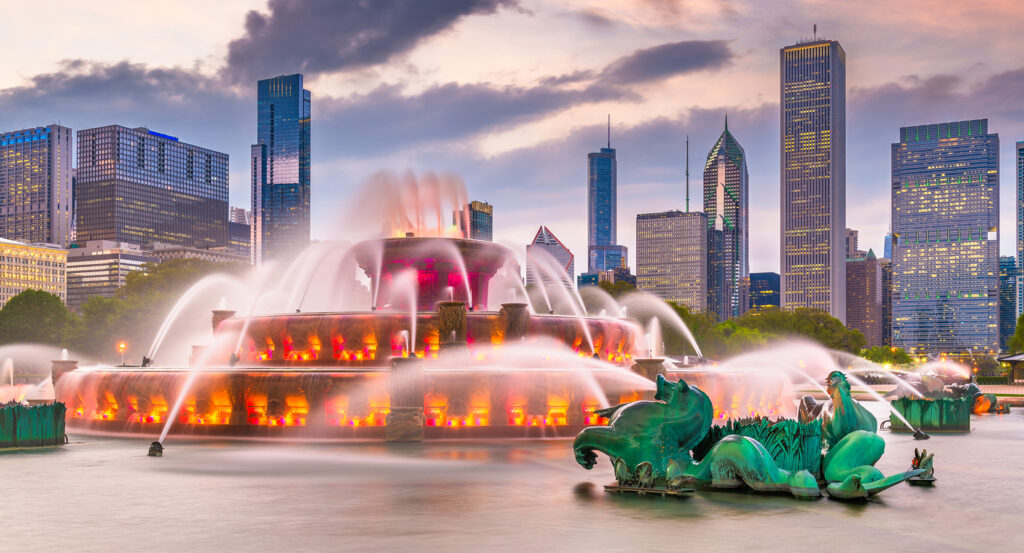
Stretching over 300 acres between Michigan Avenue and Lake Michigan, this iconic expanse is as much a symbol of the city's identity as its skyline itself. Known as “Chicago's front yard,” Grant Park serves as the green soul of downtown, a place where skyscrapers meet gardens, and culture meets calm. Stroll its tree-lined promenades and you'll pass fountains, sculptures, and sweeping lawns alive with joggers, musicians, and picnickers. Buckingham Fountain anchors the park's heart, its towering jets dancing against a backdrop of glass and steel. The lakefront trails beckon cyclists and runners, while Millennium Park, its modern extension, invites you to stand beneath Anish Kapoor's reflective Cloud Gate, affectionately known as “The Bean.” Grant Park embodies Chicago's contrasts, both timeless and forward-thinking, refined yet full of life. It's not just a park; it's the pulse of the city, where the grandeur of design meets the energy of its people.
What you didn’t know about Grant Park.
Behind its sculpted beauty lies more than a century of civic pride, preservation, and transformation.
Grant Park was conceived in the 1830s, when city leaders first declared that Chicago's lakefront should be “forever open, clear, and free”, a radical idea that has since defined the city's landscape. Originally known as Lake Park, it was renamed in 1901 to honor Ulysses S. Grant and has evolved through generations of ambitious design. Daniel Burnham's 1909 Plan of Chicago envisioned the park as the city's cultural centerpiece, a blueprint that guided its expansion into the elegant, Beaux-Arts masterpiece we see today. Over the decades, Grant Park has hosted everything from world fairs and papal visits to presidential election nights and massive music festivals like Lollapalooza. Its landmarks tell the city's story: the Art Institute of Chicago's marble steps, Buckingham Fountain's grand choreography, the modern wave of Pritzker Pavilion and Lurie Garden blending art and ecology. Even beneath the lawns lies innovation, an underground parking and transit network that redefined how cities build vertically. Grant Park's evolution is a living dialogue between tradition and reinvention, proof that a city's soul can thrive in the space between concrete and green.
How to fold Grant Park into your trip.
To experience Grant Park properly, let it unfold like a living museum, one view, one step, one sound at a time.
Begin your morning near Buckingham Fountain, when the air is cool and the fountain's mist catches the early light. From there, walk north toward Millennium Park, where modern masterpieces like Cloud Gate and the Jay Pritzker Pavilion showcase the city's flair for blending art and architecture. Pause at Crown Fountain to watch digital faces ripple and laugh with the flow of water, an unexpectedly human moment in a city of steel. Continue south to the Museum Campus, where the Field Museum, Shedd Aquarium, and Adler Planetarium frame Lake Michigan like jewels of knowledge and wonder. Bring a picnic or coffee and find a spot on the Great Lawn, where the city hums just beyond the trees. If you visit in summer, time your trip around a concert or festival; in autumn, stroll the tree-lined paths as leaves flame against the skyline. Whether you're watching fireworks over the lake, skating in winter's chill, or simply gazing east where the horizon meets the water, Grant Park reveals why Chicago was designed to be both metropolis and masterpiece, a city built to breathe.
Hear it from the Foresyte community.
Just enough life around you not to be overwhelming. Right pace.
Where your story begins.
Start your planning journey with Foresyte Travel.
Experience immersive stories crafted for luxury travelers.