Why Husk matters.
Husk is an influential Southern restaurant where Historic District's colonial streetscape meets Sean Brock's revival of heirloom ingredients, the agricultural traditions of the American South and a defining movement in contemporary American cooking.
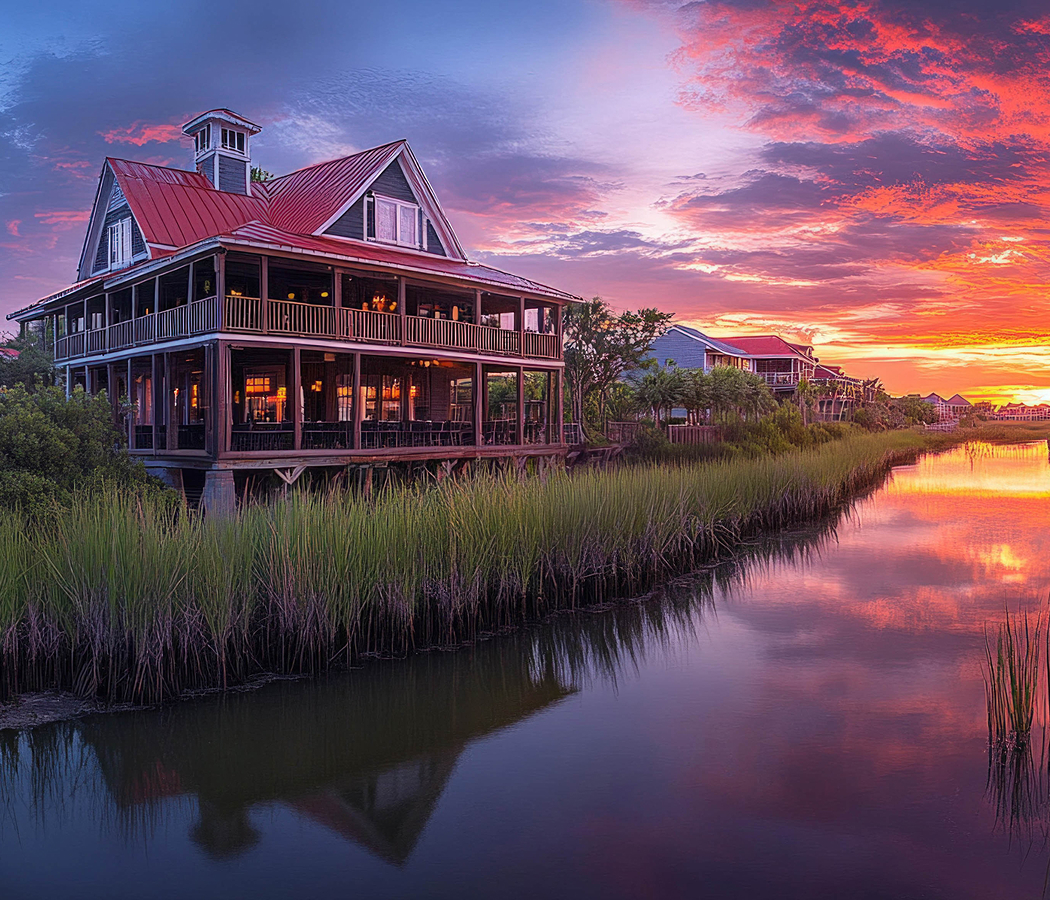
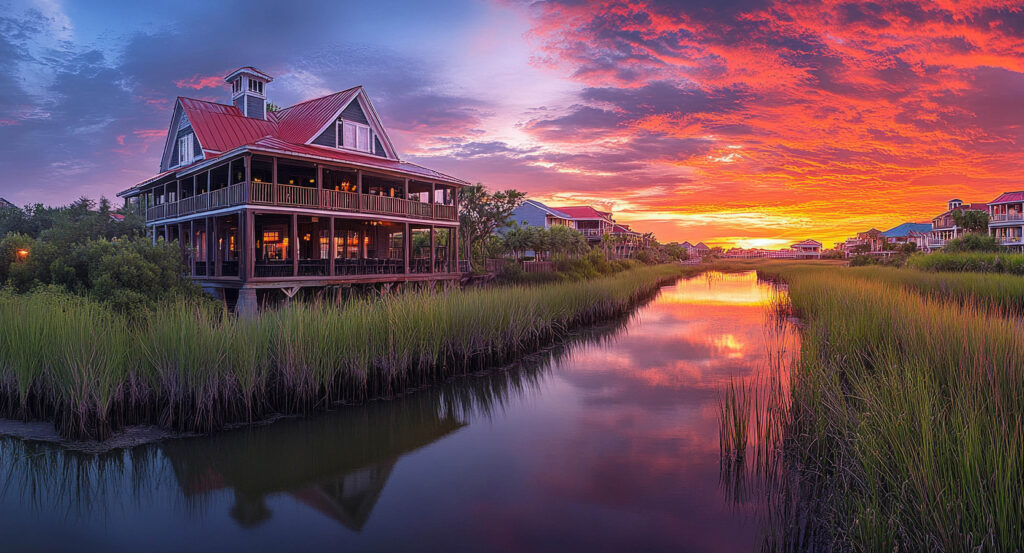
Situated on Queen Street between Meeting and King streets, the restaurant occupies a restored nineteenth-century residence within Charleston's historic peninsula, surrounded by preserved townhouses, cultural institutions and commercial buildings associated with the city's architectural development. Its two-story dining room retains the domestic proportions of the original house, with hardwood floors, substantial windows and fireplaces establishing an intimate setting for dinner. A broad entrance porch and exterior stairways preserve the building's residential character, connecting its interior rooms with the surrounding streetscape. An adjacent nineteenth-century kitchen house accommodates a separate bar, whose brick walls, wooden furnishings and courtyard seating extend the restaurant into a second historic structure. The result is a distinctive architectural setting whose domestic spaces and preserved outbuildings connect Southern cooking with Charleston's longstanding traditions of residential hospitality.
What defines Husk.
Husk is best known for changing the direction of contemporary Southern cooking through its original commitment to ingredients produced within the American South and its investigation of agricultural traditions threatened by industrial food production. Chef Sean Brock grew up in rural Virginia, where his family's gardening, food preservation and Appalachian cooking traditions shaped his early understanding of regional ingredients. He studied at Johnson & Wales University before developing his professional career through restaurants in the Southeast. His appointment as executive chef at McCrady's in Charleston brought national attention to his investigation of Southern culinary history. Brock developed relationships with agricultural historians, seed preservationists and regional producers, including University of South Carolina scholar David S. Shields, whose work helped revive interest in historically significant Southern crops. He received the James Beard Foundation's Best Chef: Southeast Award in 2010, establishing his national standing before opening a second Charleston restaurant. Working with restaurateur David Howard and the Neighborhood Dining Group, Brock opened Husk on November 8, 2010, in a restored Queen Street residence. The restaurant's original sourcing rules required ingredients to originate in the South, encouraging the kitchen to investigate regional grains, vegetables, preserved meats and traditional cooking fats. Bon Appétit named Husk America's Best New Restaurant in 2011, bringing national attention to its unusually rigorous agricultural commitments. The enterprise expanded to Nashville in 2013 and Savannah in 2018, extending its influence into additional Southern cities. Brock's cookbook Heritage, published in 2014, explored the historical and agricultural foundations of his cooking and received a James Beard Book Award the following year. Travis Grimes, an important member of the original kitchen team, assumed executive culinary leadership as the business matured. Brock departed the Charleston restaurant in 2018, beginning a transition that preserved its regional sourcing commitments under successive chefs. Raymond England became executive chef in 2022, bringing professional experience from Craft in Los Angeles and an agricultural upbringing in Idaho. Rick Ohlemacher, who had worked at Chicago's MICHELIN-starred GreenRiver, joined the kitchen that April and subsequently succeeded England as executive chef in 2025. The restaurant marked its fifteenth anniversary that November, recognizing the continuing influence of its founding approach on Southern restaurants. Its inclusion in the inaugural MICHELIN Guide American South established further recognition for a Charleston institution whose significance extends across agricultural preservation, professional cooking and independent restaurant development.
Rick Ohlemacher's cooking develops the relationship between Southern agricultural products, wood-fired preparation and the preservation of familiar regional dishes through carefully controlled heat, acidity and texture. The kitchen draws upon farmers and producers across the Southeast, allowing seasonal availability to shape preparations grounded in the region's cooking traditions. Marsh Hen Mill's stone-ground grits provide a foundation for this approach, preserving the distinctive texture and natural corn flavor of carefully milled grain. Their gentle sweetness supports rich accompaniments, connecting the agricultural character of the corn with the concentrated flavors of meat and seafood. Hearth-baked skillet cornbread develops the grain through a different application, creating a crisp exterior and tender interior beneath a topping of Broadbent bacon crumble. The rendered fat introduces savory concentration, and the cornbread's structure absorbs the accompanying richness. Country ham establishes a complementary relationship through extended curing, whose controlled dehydration concentrates the pork's flavor and produces a firm texture. Served with pimento cheese and biscuits, the ham's salinity balances the cheese's richness, and the biscuits contribute a softer foundation. Wood-fired oysters connect these preserved agricultural traditions with the coastal waters surrounding Charleston. Direct heat concentrates the oysters' briny juices, and accompanying seasonings support their natural sweetness. Fried catfish extends the treatment of regional seafood through a crisp cornmeal coating, accompanied by collard greens, dirty rice and comeback sauce. The coating protects the fish's delicate flesh, and the seasoned rice contributes depth against the sauce's acidity. Vegetable preparations receive comparable attention through smoked Bradford collard greens, whose long cooking develops tenderness and concentrates their earthy character. Wood-fired Blue Lake pole beans accompanied by romesco introduce roasted vegetable sweetness against a sauce built around peppers and nuts. Seared diver scallops with creamed corn, green tomato and pecans develop the relationship between marine ingredients and cultivated produce through contrasting sweetness, acidity and toasted texture. South Carolina tilefish accompanied by watermelon and tomato broth extends that balance through delicate fish, seasonal fruit and pickled watermelon rind. The broth connects the fish's natural flavor with the acidity of tomatoes, and the rind introduces a preserved element associated with Southern summer cooking. More substantial preparations include Keegan-Filion pork chop with mushrooms, banana peppers and black pepper gravy, connecting regional livestock production with careful roasting and concentrated pan sauces. Joyce Farms chicken accompanied by eggplant, aji dulce peppers and spiced cane syrup develops a related balance through roasted poultry, vegetable sweetness and aromatic seasoning. Dessert preserves the kitchen's regional foundations through pies, cakes and seasonal fruit preparations, completing a menu whose composition changes with the harvest. The bar extends the same attention to Southern producers through an extensive bourbon collection and cocktails incorporating regional ingredients. Husk's cooking develops through this sustained relationship between agricultural sourcing, historical food traditions and contemporary preparation, preserving the distinct character of Southern ingredients across an evolving menu.
How Husk fits.
Husk works as the culinary centerpiece for a Charleston itinerary connecting the city's early artistic institutions, the development of professional theater in colonial America and the preservation of a building associated with the domestic slave trade.
Begin at Gibbes Museum of Art, whose institutional origins date to the founding of the Carolina Art Association in 1858. James Shoolbred Gibbes left a substantial bequest in 1888 to establish a permanent exhibition building, leading to the construction of a Beaux-Arts gallery designed by Frank P. Milburn. The museum opened in April 1905, creating a dedicated institution for the collection and exhibition of American art. Its holdings include eighteenth-century portraiture, Charleston Renaissance paintings and contemporary works examining the South's changing cultural history. The museum's restoration and expansion strengthened its educational programs, connecting the city's artistic inheritance with successive generations of regional artists. Continue to Dock Street Theatre, whose original building opened in February 1736 with a performance of George Farquhar's The Recruiting Officer. The colonial playhouse became an important early example of purpose-built theatrical architecture in British North America. After the original structure disappeared, the property developed into Planter's Hotel, whose nineteenth-century facade incorporated sandstone columns and a substantial wrought-iron balcony. A Works Progress Administration restoration directed by Albert Simons and Samuel Lapham created a new auditorium within the historic complex. The theater reopened in November 1937 and underwent a further major renovation completed in 2010. Charleston Stage maintains a professional theatrical program within the restored building. Conclude at Old Slave Mart Museum, housed in the surviving auction gallery of Ryan's Mart on Chalmers Street. Thomas Ryan established the complex in 1856 following a municipal ordinance restricting public slave auctions near the Old Exchange. Its facilities included an enclosed yard, buildings used to confine enslaved people and spaces for conducting sales. Auctions ended in 1863 as Union bombardment disrupted Charleston's commercial activity. Miriam B. Wilson established a museum within the surviving structure in 1938, preserving a building directly associated with the city's slave-trading economy. The municipality acquired the property in 1988 and reopened it as a historical museum in 2007. The progression moves from Charleston's development of permanent artistic institutions through the preservation of colonial theatrical history and culminates in a building confronting the commercial structures of American slavery.
Where your story begins.
Foresyte Travel reveals places that feel extraordinary long before you arrive.
Enjoy editorial crafted for luxury travelers.
Foresyte may earn a commission when you book.