Why Jet d'Eau matters.
Jet d'Eau is an expansive lakeside fountain where Eaux-Vives' historic waterfront meets Geneva's industrial ingenuity, nineteenth-century civic ambition, and the extraordinary transformation of a hydraulic safety mechanism into Switzerland's most recognizable water monument.
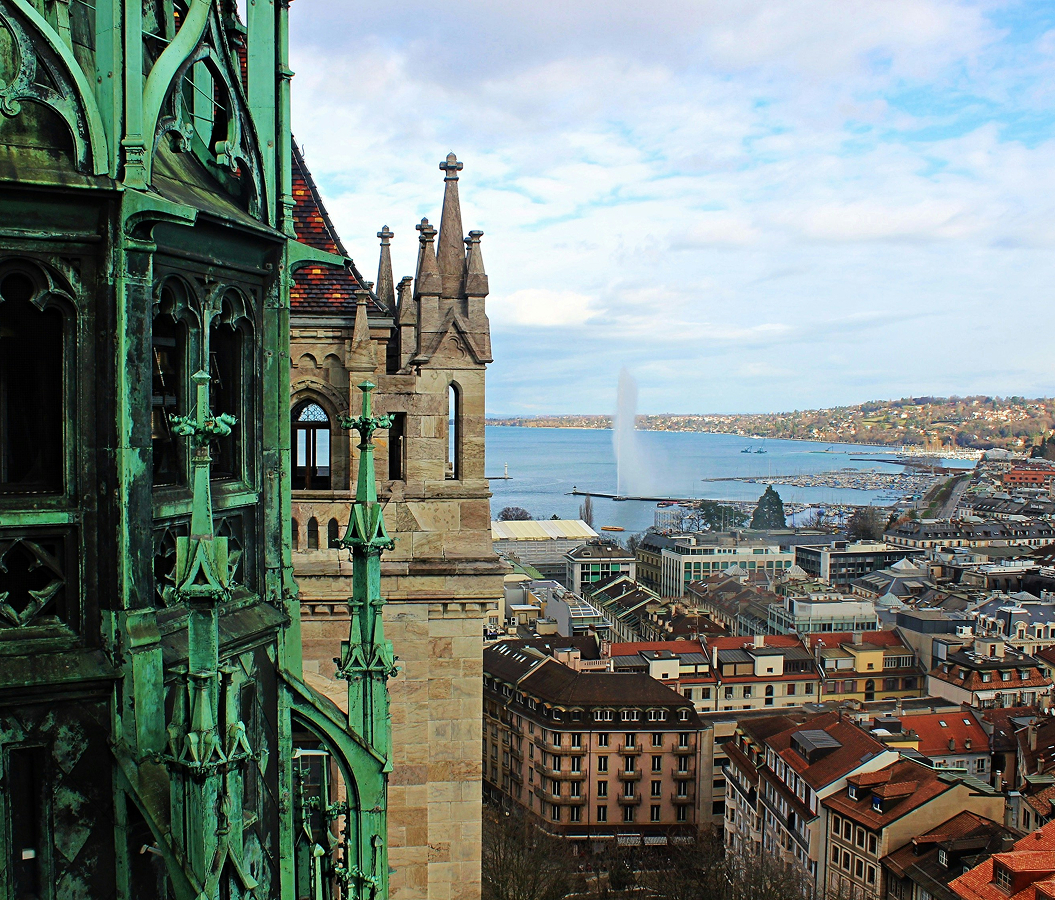
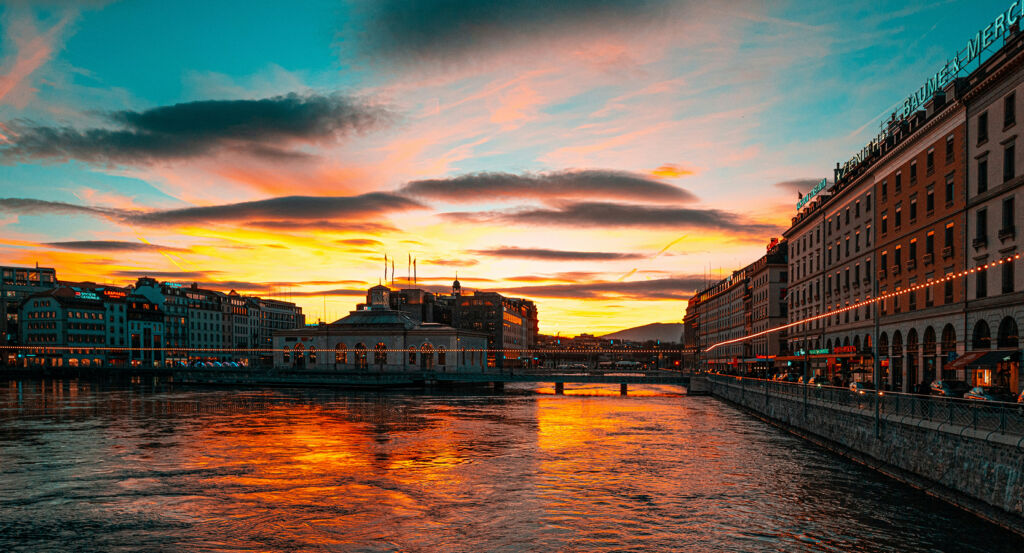
Rising from a stone jetty extending into Lake Geneva near the eastern edge of the Rade de Genève, Jet d'Eau occupies a commanding position between the Eaux-Vives waterfront and the open waters of Lac Léman, with the Mont-Blanc Bridge, Jardin Anglais, and the historic city center forming its immediate urban surroundings. The fountain stands at the point where Geneva's southern lakeshore opens toward the broad central basin, projecting a brilliant white column of water above the harbor's boats, stone embankments, and waterfront promenades. Quai Gustave-Ador follows the shoreline behind the installation, connecting the established residential streets of Eaux-Vives with landscaped public spaces and the broader lakeside recreational corridor. A narrow pedestrian jetty extends toward the fountain's base, placing the expansive water column within reach of the surrounding promenade. The jetty's stone surface, low parapets, and exposed position establish a striking relationship between the mechanical installation and the open lake. Across the harbor, the buildings of the Pâquis district and the Hôtel Beau-Rivage line the opposite shore, creating a substantial architectural backdrop beneath the distant Jura Mountains. The historic rooftops of Geneva's Old Town rise farther inland, with Saint-Pierre Cathedral contributing a distinctive silhouette above the southern waterfront. The fountain's extraordinary height establishes a visual landmark across the entire harbor, remaining visible from numerous lakeside viewpoints and elevated positions throughout the city. Its surrounding landscape incorporates public promenades, pleasure-boat moorings, mature trees, and extensive pedestrian routes that connect the water monument with Geneva's established civic and recreational spaces. The result is an exceptional urban landmark whose expansive scale, open-water setting, and close relationship with Geneva's historic waterfront make the fountain an enduring expression of the city's geographical and cultural character.
What defines Jet d'Eau.
Jet d'Eau is best known for originating as an accidental performance within Geneva's nineteenth-century hydraulic power network before evolving into a 140-metre fountain whose development reflects the city's industrial history and international ambitions. During the second half of the nineteenth century, Geneva underwent substantial industrial expansion, with watchmaking workshops and other manufacturing businesses requiring dependable mechanical power. The city's population increased from 64,000 inhabitants in 1850 to 100,000 by 1890, intensifying demand for the infrastructure supporting its growing industrial economy. The Usine de la Coulouvrenière, a hydraulic power station constructed along the Rhône, became an important component of this transformation when its first section entered service in 1886. The installation harnessed the river's energy to distribute pressurized water through a network serving Geneva's workshops, allowing artisans and manufacturers to operate machinery through hydraulic power. The system encountered a significant engineering problem when workshops closed during the evening and the sudden reduction in demand created excessive pressure within the distribution network. Engineers introduced an open-air safety outlet to release the accumulated pressure, producing a water column thirty metres high beside the power station. The unexpected fountain attracted public attention, turning a practical industrial intervention into an increasingly recognizable feature of the Rhône waterfront. Improvements to the hydraulic system eventually eliminated the original pressure-release requirement, creating an opportunity to preserve the fountain as a deliberate civic attraction. Geneva's municipal authorities selected a more prominent location at the Eaux-Vives jetty, placing the installation within the central harbor where it would be visible across the lakefront. The new Jet d'Eau was inaugurated in 1891 during the Federal Gymnastics Festival, an event that brought substantial public activity into Geneva. Its introduction also coincided with celebrations marking the six-hundredth anniversary of the Swiss Confederation, giving the monument a direct association with national commemoration. The relocated fountain reached ninety metres, tripling the height of the original industrial water column and establishing an unprecedented presence above the harbor. Electric illumination accompanied the anniversary celebrations, introducing a nighttime dimension to the fountain's public presentation. The installation initially operated on Sundays and public holidays, drawing upon Geneva's drinking-water network to maintain the performance. Its popularity gradually expanded the operating schedule, and occasional weekday performances began in 1906. The fountain's position within the Rade subsequently became an important element of Geneva's visual presentation, appearing in photographs and promotional imagery associated with the city's expanding international profile. A decisive transformation arrived in 1951 when the installation received a dedicated pumping station constructed partially beneath the lake surface. The project replaced the earlier dependence on drinking water with a system drawing directly from Lac Léman, fundamentally changing the fountain's technical operation. Swiss engineering manufacturer Sulzer supplied two powerful pumps named Jura and Salève, connecting the installation's mechanical infrastructure with the mountain ranges surrounding Geneva. Their combined output increased the fountain's maximum height to 140 metres, establishing the proportions that continue to define its expansive appearance. The upgraded system propelled water at 200 kilometres per hour, producing a substantially more powerful and consistent column than its nineteenth-century predecessors. The redesign also introduced a distinctive nozzle that aerated the projected water, creating the brilliant white plume that became inseparable from the fountain's appearance. Services Industriels de Genève assumed responsibility for maintaining and operating the installation as the monument's technical requirements became increasingly specialized. The fountain subsequently developed into a prominent element of Geneva's international civic life, with colored illuminations marking humanitarian initiatives, national commemorations, and major events associated with the city's diplomatic institutions. Its operating schedule expanded further in 2003, introducing regular daytime operation throughout the year when weather conditions permitted. The transformation from an industrial pressure valve into an expansive public installation reflects three interconnected chapters of Geneva's development: the expansion of nineteenth-century manufacturing, the emergence of an ambitious lakeside civic landscape, and the technological modernization of a landmark whose physical presence became synonymous with the city.
Sulzer's Jura and Salève pumps form the mechanical foundation of the fountain's extraordinary visual character, drawing lake water from a depth of thirteen metres before forcing it through the submerged pumping station toward the projecting nozzle. The two machines collectively propel 500 litres of water every second, producing a continuous vertical column whose apparent simplicity conceals an immense transfer of mechanical energy. Water leaves the nozzle through an opening sixteen centimetres in diameter, accelerating into the air before gravity gradually reverses its movement. The resulting plume reaches a maximum height equivalent to a substantial forty-storey building, creating a vertical landmark visible across the Rade and surrounding districts. At any given moment, several tonnes of water occupy the fountain's airborne column, producing a constantly changing structure shaped by gravity, atmospheric conditions, and the velocity of the projected stream. The nozzle introduces millions of microscopic air bubbles into the water, scattering incoming light and producing the fountain's characteristic brilliant white appearance. This aeration gives the column a distinctive visual density, allowing the water to appear almost solid near its base before dispersing into a broad cloud of droplets near its upper reaches. Wind changes that composition substantially, bending the column away from its vertical axis and carrying fine spray across the surrounding lake surface. The resulting mist creates a physical encounter with the fountain along the pedestrian jetty, where even modest changes in wind direction alter the relationship between the water column and the approaching shoreline. Sunlight introduces another visual dimension through refraction within suspended droplets, producing rainbows when the viewing angle and atmospheric conditions align. The fountain's expansive scale also creates a distinctive acoustic environment, with the continuous rush of projected water accompanied by the sound of falling droplets returning to the lake. Its open-water position allows that sound to dissipate across the harbor, preserving a direct relationship between the mechanical installation and the surrounding landscape. Services Industriels de Genève developed a specialized lighting system that introduces colored illumination after dark, transforming the white plume into a vertical display associated with international commemorations and public events. LED projectors positioned around the fountain direct light through the rising water, allowing the illuminated column to retain its distinctive shape as its color changes. The monument's operation depends upon close attention to atmospheric conditions, particularly strong winds and freezing temperatures that threaten safe operation or disrupt the intended water trajectory. Five retired employees of Services Industriels de Genève serve as volunteer guardians, supervising the installation and intervening when changing conditions require the fountain to be shut down. Their responsibility preserves a direct human connection with the technical monument, maintaining the continuity between its industrial origins and its public role. The fountain's extraordinary character emerges through this relationship between hydraulic power, aerated water, changing natural light, and specialized stewardship, creating an expansive performance whose appearance changes continuously even as its underlying engineering remains constant.
How Jet d'Eau fits.
Jet d'Eau works as the waterfront centerpiece of a Geneva exploration connecting the city's nineteenth-century landscaped gardens, its celebrated watchmaking heritage, and the historic public bathing complex occupying the opposite side of the harbor.
Begin at Jardin Anglais, the landscaped public garden extending along Geneva's southern lakeshore near the Mont-Blanc Bridge. Developed during the nineteenth century as the city's waterfront underwent substantial transformation, the garden introduced an English landscape style characterized by curved pathways, freely arranged trees, and ornamental planting. The original Promenade du Lac gradually expanded into a substantial public landscape overlooking the Rade, becoming an important setting for civic recreation and public monuments. The construction of the Mont-Blanc Bridge in 1862 strengthened the garden's relationship with Geneva's developing waterfront, establishing a major crossing between the city's two lakeshores. The Monument National was inaugurated in 1869, commemorating Geneva's entry into the Swiss Confederation through a sculptural composition of two female figures representing Geneva and Helvetia. An expansive bronze fountain dedicated to the Four Seasons contributes another important element to the park's historic landscape, connecting ornamental sculpture with the surrounding lawns and mature trees. Continue to the Flower Clock, the extraordinary botanical timepiece occupying a prominent position near the garden's entrance. Created in 1955 as a tribute to Geneva's centuries-old watchmaking industry, the clock translates the city's reputation for precision into a living horticultural installation. Its dial incorporates 12,000 flowers and plants, arranged into carefully maintained seasonal compositions that change throughout the year. The clock's mechanism receives accurate time information through satellite transmission, connecting traditional watchmaking symbolism with contemporary timekeeping technology. Its second hand measures 2.5 metres, giving the installation a particularly distinctive technical feature within the history of expansive floral clocks. Geneva's municipal gardeners maintain the botanical composition through regular planting and cultivation, preserving the relationship between mechanical precision and living seasonal decoration. Conclude at Bains des Pâquis, the historic public bathing complex extending into Lake Geneva from the northern shore of the harbor. Established in 1872, the baths began as a wooden installation before undergoing expansion on piles in 1889. The municipality assumed responsibility for the facility in 1890, establishing a public bathing institution that became closely associated with Geneva's recreational culture. A major reconstruction followed in 1931 and 1932, replacing the earlier wooden structures with a substantial reinforced-concrete complex designed by architect Henry Roche and engineer Louis Archinard. The project incorporated 448 supporting piles and 6,500 square metres of bathing facilities, introducing a modernist architectural composition organized around public access to the lake. Its design allocated equivalent space to male and female bathers, reflecting changing approaches to public recreation during the early twentieth century. The baths subsequently developed into a year-round social institution, incorporating swimming, winter bathing, sauna facilities, and a restaurant associated with traditional Swiss fondue. Their position across the harbor provides a striking perspective toward the expansive fountain and Geneva's historic southern waterfront. The progression moves from Jardin Anglais' nineteenth-century civic landscape through the Flower Clock's celebration of Swiss precision and culminates at Bains des Pâquis, where Geneva's historic bathing culture occupies one of the harbor's most distinctive waterfront settings.
Where your story begins.
Foresyte Travel reveals places that feel extraordinary long before you arrive.
Enjoy editorial crafted for luxury travelers.
Foresyte may earn a commission when you book.