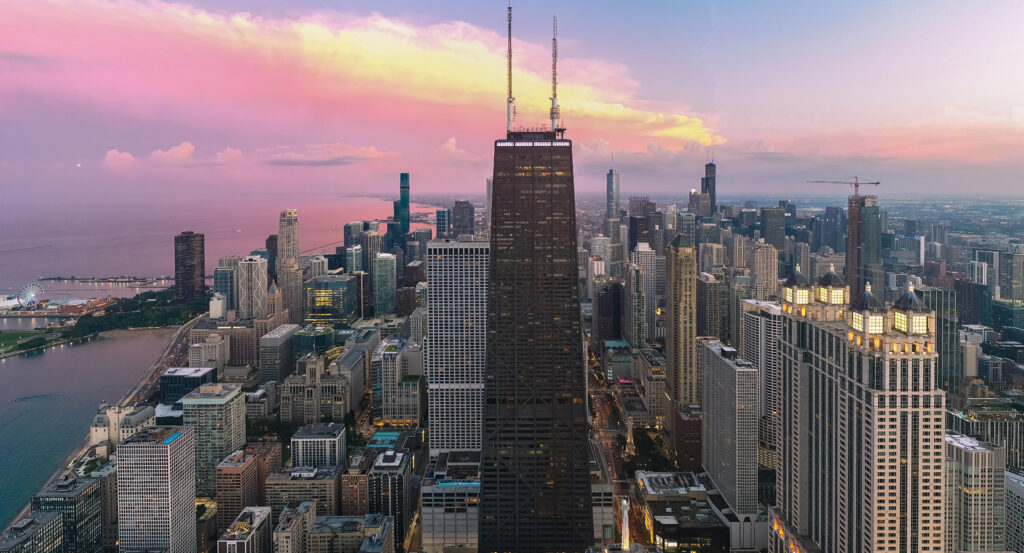
Why you should experience 875 North Michigan Avenue in Chicago, Illinois.
Soaring high above the Magnificent Mile, 875 North Michigan Avenue, formerly known as John Hancock Center, stands as one of Chicago's most defining architectural icons.
This 100-story skyscraper isn't just a marvel of engineering; it's a love letter to the city's skyline. Rising 1,128 feet into the clouds, its bold X-braced exterior makes it instantly recognizable, a masterpiece of structural expressionism designed by Bruce Graham and Fazlur Rahman Khan of Skidmore, Owings & Merrill. Completed in 1969, it symbolized a new era for modern skyscrapers, where art and utility collided in pure harmony. The building's black aluminum skin gleams against the shimmering blue of Lake Michigan, while the city grid stretches endlessly below, a visual testament to Chicago's reputation as the birthplace of the skyscraper. But the building's power isn't just in its form; it's in its perspective. The 360 Chicago Observation Deck, located on the 94th floor, offers sweeping, cinematic views in every direction, from the shimmering shoreline of Lake Michigan to the towers of downtown and the far-reaching suburbs beyond. On clear days, you can see across four states. To gaze from these heights is to feel Chicago's pulse, resilient, ambitious, and endlessly alive.
What you didn’t know about 875 North Michigan Avenue.
Behind its sleek black frame lies a story of innovation, controversy, and enduring influence.
When it opened, 875 North Michigan Avenue was the second-tallest building in the world, an engineering feat that reshaped what was possible in vertical living. The building's mixed-use design was revolutionary for its time, combining offices, luxury residences, restaurants, and observation decks into a single structure, a vertical city long before the term became trendy. Its distinctive X-shaped bracing system wasn't just aesthetic; it drastically reduced the need for internal support columns, freeing up interior space and strengthening the tower against Chicago's fierce winds. Over the decades, the building has been home to television studios, corporate headquarters, and some of the most sought-after condos in the city. Locals still affectionately refer to it as “The Hancock,” despite official rebranding in 2018. The tower's restaurant, once known as The Signature Room, was famous for its elevated dining with a view that stretched to infinity, the kind of place where proposals, anniversaries, and quiet moments of awe played out nightly. Beneath the glamour, however, the building also holds quieter triumphs: its wind-resistant design inspired skyscrapers worldwide, and its sky-high maintenance teams helped pioneer modern vertical engineering safety. Even its elevators, which shoot upward at 20 miles per hour, remain among the fastest in the Western Hemisphere, a reminder that Chicago has never been content to merely touch the sky.
How to fold 875 North Michigan Avenue into your trip.
Visiting 875 North Michigan Avenue is as essential to a Chicago itinerary as deep-dish pizza or the riverwalk, but it's best approached as an experience, not a checklist stop.
Begin at street level, where the tower's angular base commands the northern edge of the Magnificent Mile. The plaza often buzzes with street musicians, tourists, and locals on their daily commute, all dwarfed by the tower's dramatic ascent. Step inside and make your way up to 360 Chicago, where you can take in the city's architecture from a perspective that architects once only dreamed of. The TILT attraction, a glass platform that extends outward from the 94th floor, lets you lean out over the city, a thrilling encounter with gravity that transforms fear into exhilaration. Time your visit for sunset, when the golden light bathes the skyline and the lake reflects the fire of dusk. Afterward, head to the nearby Water Tower Place for shopping or dine at one of the many restaurants that flank Michigan Avenue, where the tower remains visible like a sentinel of Chicago's soul. For a deeper connection, walk to the Museum of Contemporary Art just a few blocks away, whose exhibitions often echo the same spirit of innovation embodied by the Hancock's design. As night falls, look back one more time at its illuminated crown, those twin antennas glowing above the skyline, and you'll understand why this building isn't just part of Chicago's landscape; it is the landscape. To stand beneath it is to stand at the crossroads of ambition and artistry, where the city's heartbeat meets the sky.
Where your story begins.
Start your planning journey with Foresyte Travel.
Experience immersive stories crafted for luxury travelers.