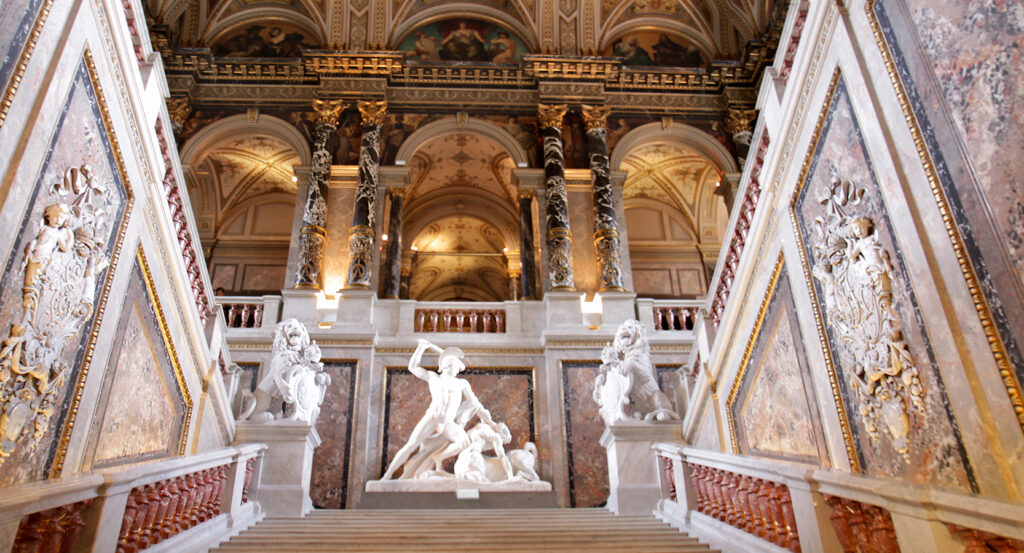
Why you should experience Collection of Greek and Roman Antiquities in Vienna, Austria.
The Collection of Greek and Roman Antiquities is the soul of the Kunsthistorisches Museum, a realm where beauty, proportion, and power merge into the foundation of Western art.
Stepping inside feels like entering a discussion across two thousand years: marble gods, bronze heroes, and ceramic myths converse in silence beneath vaulted ceilings. The light glances softly off the contours of ancient torsos, revealing the impossible precision of sculptors who believed perfection was the divine made visible. Each room opens like a temple, a world governed by geometry, discipline, and grace. The marble busts of emperors command stillness; the red-figure vases flicker with the firelight of forgotten symposiums. The museum's layout allows this art to breathe, a measured rhythm of open space and intimacy, where every statue seems to hold its own gravity. For all its formality, there's something profoundly human here: chipped edges, faint cracks, traces of pigment that once blazed with color. You begin to see not ruins, but the living pulse of ancient imagination. It's the closest you can come to walking through the idea of civilization itself, one that continues to echo through every gallery, every city, every work of art that followed.
What you should know about Collection of Greek and Roman Antiquities.
The collection owes its existence to centuries of imperial fascination, the Habsburgs' relentless pursuit of classical perfection.
Many of the sculptures and artifacts were acquired during the 18th and 19th centuries, when the Grand Tour was both a rite of passage and an assertion of empire. Ancient statues unearthed in Rome and southern Italy found their way to Vienna through diplomatic channels, archaeological expeditions, and even artistic replication. The collection's centerpiece, the Gemma Augustea, is one of antiquity's greatest masterpieces, a two-tiered sardonyx cameo celebrating Emperor Augustus as both ruler and god, carved with such intricacy it seems to shimmer from within. Nearby, Roman portrait busts capture power and mortality in equal measure, their realism striking against the idealized serenity of earlier Greek works. The galleries move fluidly between civilizations: black-figure kraters, marble friezes, and bronze mirrors arranged to evoke both contrast and continuity. Yet what sets Vienna's collection apart is its curatorial narrative, it's not merely about ancient art, but about how Europe rediscovered itself through antiquity. The display reminds you that the classical world never truly vanished; it was absorbed, reinterpreted, and reborn through centuries of cultural longing. Even the museum's architecture mirrors this inheritance, the grand arches and Corinthian columns of the Kunsthistorisches Museum echoing the very temples these statues once inhabited.
How to fold Collection of Greek and Roman Antiquities into your trip.
Visit the antiquities wing after exploring the Egyptian and Near Eastern collections, the contrast heightens the experience, revealing the shift from sacred ritual to human-centered philosophy.
Enter from the museum's central rotunda, and move chronologically through the Greek galleries first. Begin with the geometric pottery and early kouroi, the marble youth statues that mark the dawn of Western sculpture. As you progress, watch how stillness becomes motion, how form learns to breathe. Pause before the Hellenistic pieces, where emotion and anatomy merge into drama; the Pergamon fragments and athletic torsos feel alive under the natural light. Continue into the Roman rooms, where you'll sense a transformation, Greek ideals translated into imperial imagery. The marble heads of emperors like Hadrian and Marcus Aurelius radiate stoic grandeur, yet the chipped noses and worn surfaces whisper of time's erosion. Don't miss the bronze and glass artifacts, small, luminous reminders of everyday life in ancient cities. End your visit by returning to the rotunda and looking upward at the dome; its harmony mirrors the mathematical balance that defined classical art. The Greek and Roman Antiquities are not relics, they are the architecture of memory itself, the scaffolding upon which all beauty, order, and human aspiration still stand.
Where your story begins.
Foresyte Travel reveals places that feel extraordinary long before you arrive.
Experience premium editorial crafted for luxury travelers.