Why you should experience Kunsthistorisches Museum Wien in Vienna, Austria.
Kunsthistorisches Museum Wien in Vienna is a temple to human imagination, a place where beauty and intellect converge beneath a dome of divine light.
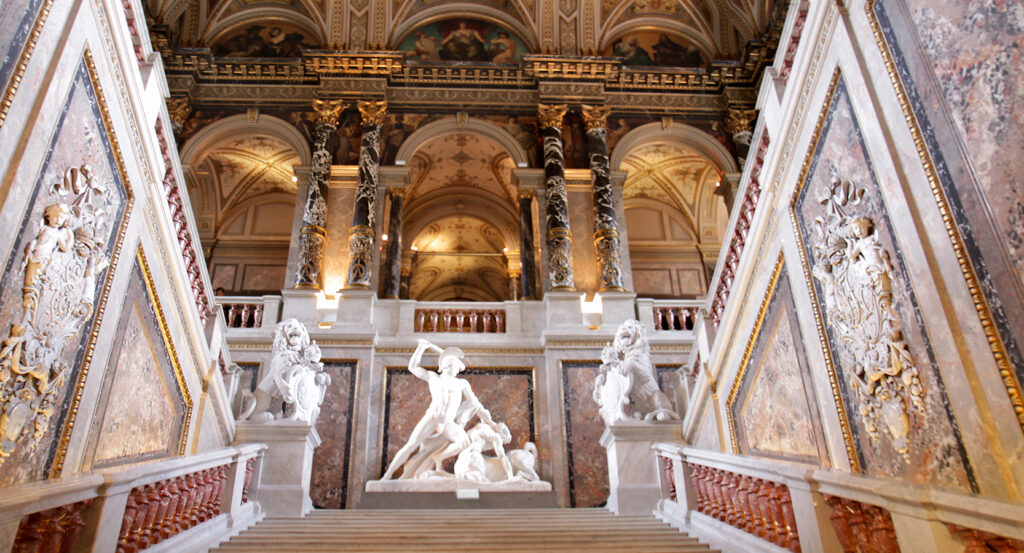
Standing regally on Maria-Theresien-Platz, across from its architectural twin, the Natural History Museum, this grand palace of art is among the finest expressions of imperial ambition and cultural devotion in Europe. Commissioned by Emperor Franz Joseph I and opened in 1891, it was designed to showcase the vast art collections of the Habsburgs, rulers whose passion for beauty rivaled their thirst for power. Step inside, and the world seems to slow. Marble staircases rise toward frescoed ceilings by Gustav Klimt, their golden hues echoing the warmth of candlelight on stone. Each gallery feels like a kingdom unto itself, a chronicle of civilization told through brushstroke, bronze, and marble. The museum's collection reads like a who's who of artistic genius: Titian, Caravaggio, Rubens, Rembrandt, Raphael, Vermeer, and Velázquez all share the same air. Yet the jewel of the museum may well be Pieter Bruegel the Elder's The Tower of Babel, its dizzying complexity a mirror of Vienna's own blend of chaos and order. The Egyptian and Near Eastern collections whisper of eternity; the Greek and Roman antiquities gleam with the memory of empire. Even the light here feels curated, falling just so across the canvases, as though the gods themselves were adjusting it. The Kunsthistorisches isn't merely a museum, it's an experience of awe, a discussion between centuries that invites you to lose yourself and, somehow, feel found.
What you should know about Kunsthistorisches Museum Wien.
The Kunsthistorisches Museum is a living tribute to the Habsburg dynasty's obsession with collecting not merely art, but the world itself.
It was born from a need to give order to chaos, to house the treasures accumulated over centuries by emperors like Rudolf II, whose Prague collection once contained wonders from alchemy, astronomy, and art alike. The very architecture of the building reflects this ambition: architect Gottfried Semper envisioned the museum as a “cathedral of art,” where each hall would elevate visitors spiritually as well as intellectually. The façade is adorned with allegorical figures representing the arts and sciences, while inside, the building's symmetry mirrors the Enlightenment ideals of reason and harmony. The Kunstkammer (Chamber of Art and Wonders) is one of its most fascinating collections, a cabinet of curiosities where mechanical marvels, coral carvings, and gold clocks coexist with paintings and sculptures. Among its treasures lies the Saliera by Benvenuto Cellini, a golden salt cellar so exquisite that it was once stolen in 2003, sparking one of the most notorious art heists in Austrian history. The museum also harbors secrets in its structure: tunnels beneath it once connected directly to the Hofburg Palace, allowing the imperial family private access. Even the floors tell a story, intricate mosaics representing myth, history, and science weave through the corridors, echoing Vienna's reputation as the city where knowledge and beauty entwine. Though founded in an age of empire, the Kunsthistorisches today stands as a beacon of preservation and peace, a reminder that empires may fade, but art endures.
How to fold Kunsthistorisches Museum Wien into your trip.
Visiting the Kunsthistorisches Museum is to enter a discussion between past and present, one best savored slowly, like an aria unfolding.
Begin your visit in the early morning when the marble halls are quiet and the echoes of footsteps seem to belong to another century. Start on the grand staircase beneath Klimt's frescoes, letting your eyes trace the figures of women personifying ancient civilizations, Greece, Egypt, Mesopotamia, as if welcoming you to eternity. From there, move into the Picture Gallery, where Bruegel's Hunters in the Snow captures the poetry of winter, and Vermeer's serene domestic scenes breathe intimacy into grandeur. Take your time, the rooms are designed not for haste but for contemplation. When your mind needs a pause, ascend to the museum café beneath the rotunda, among the most elegant in Europe, where chandeliers glitter above marble tables and the aroma of Viennese coffee fills the air. Order a slice of Sachertorte or Apfelstrudel and watch the light spill through the dome as though the heavens themselves were peeking in. Afterward, explore the Kunstkammer for its strange and beautiful relics, then descend into the Egyptian galleries to stand before ancient sarcophagi that whisper stories older than Vienna itself. Before you leave, step outside onto Maria-Theresien-Platz and look across to the twin museum opposite, its mirrored façade reflecting a century of artistry and empire. If time allows, return at twilight, when the museum glows like a lantern against the evening sky, and the sculptures outside cast long shadows across the square. The Kunsthistorisches Museum Wien is not simply a place to see art, it's where you feel the weight and wonder of civilization, distilled into silence, color, and eternal grace.
Where your story begins.
Foresyte Travel reveals places that feel extraordinary long before you arrive.
Experience premium editorial crafted for luxury travelers.