Why L'Atelier Robuchon matters.
L'Atelier Robuchon is a two-MICHELIN-starred French restaurant where Pâquis' grand lakeside hospitality heritage meets Joël Robuchon's revolutionary counter-dining concept and Olivier Jean's precise interpretation of contemporary French gastronomy.
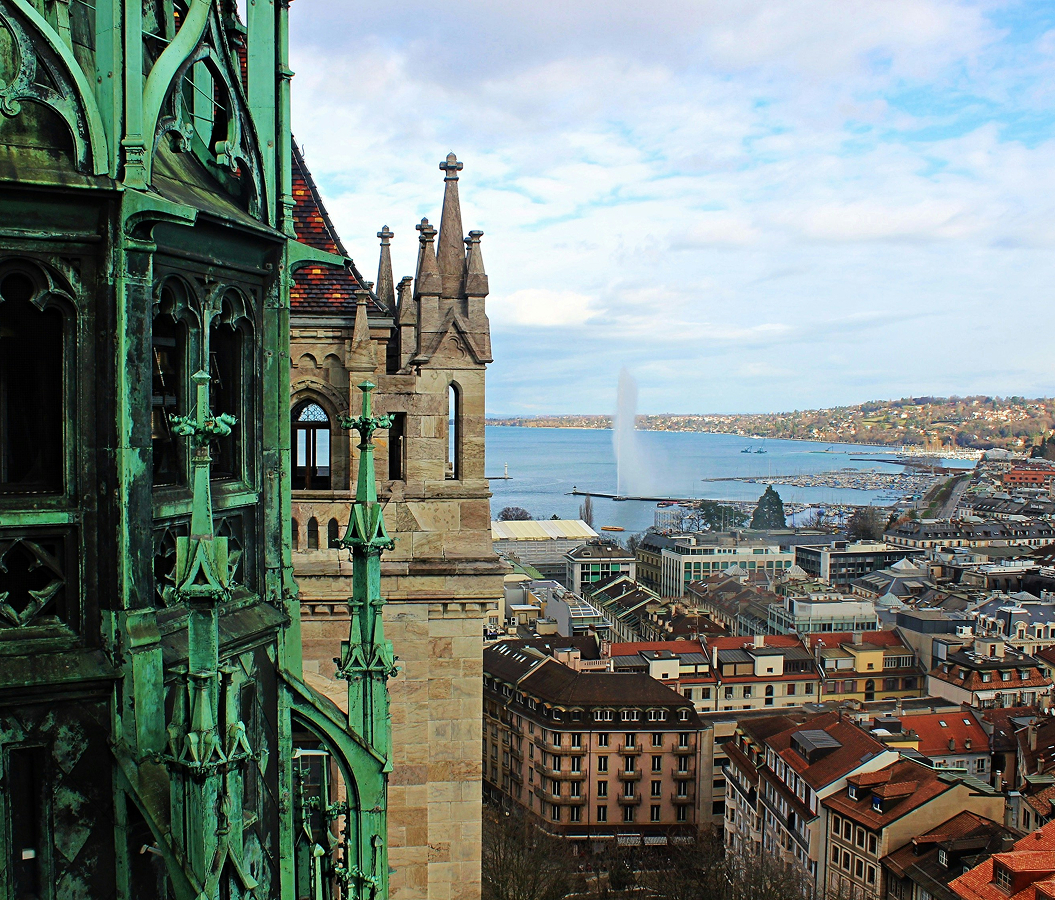
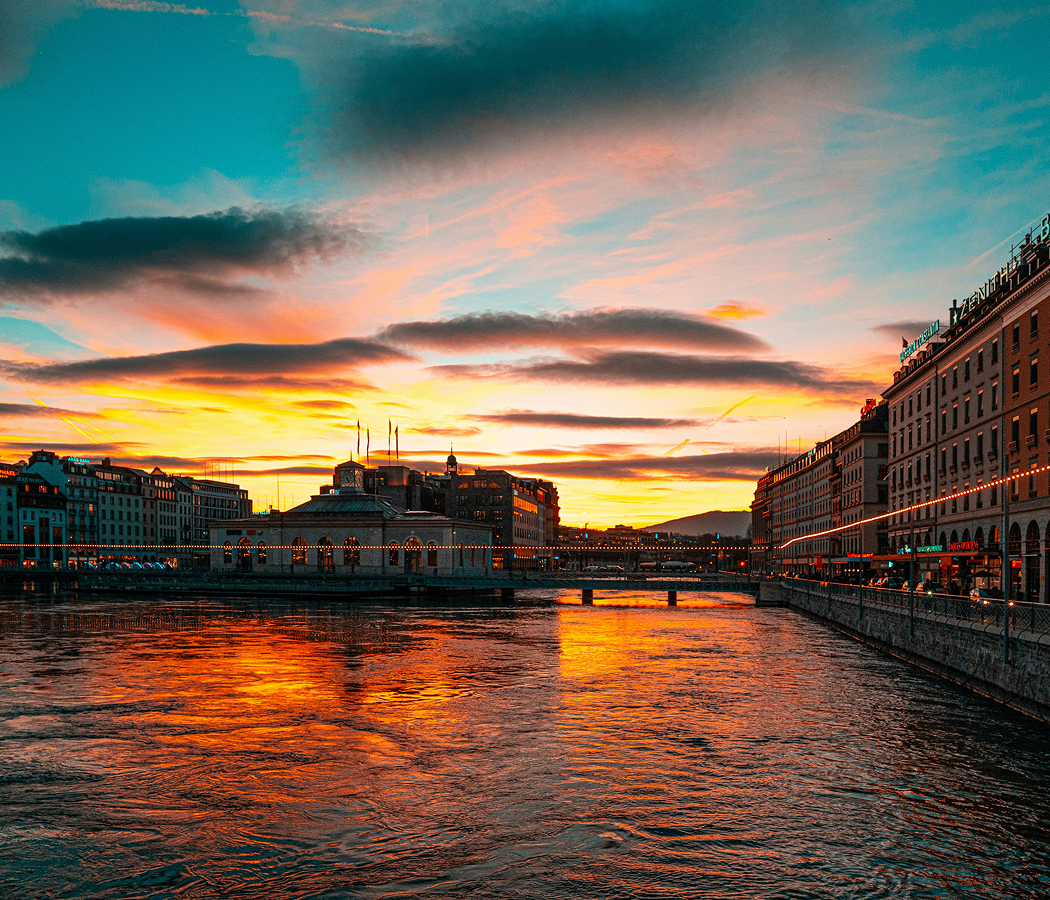
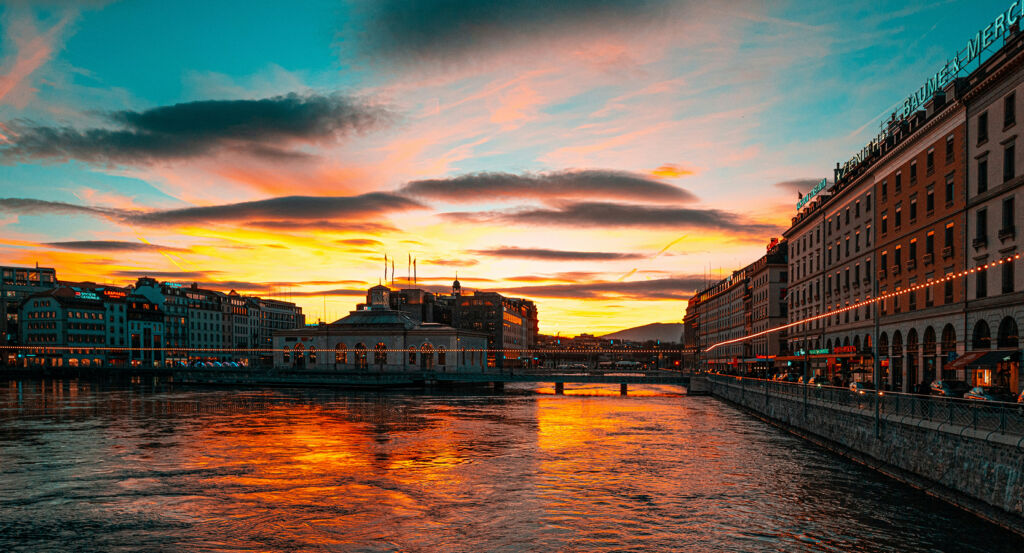
Occupying the ground floor of The Woodward on Geneva's northern waterfront, L'Atelier Robuchon stands beside Lake Geneva, with Quai Wilson extending northeast toward the landscaped estates of the Petit-Saconnex shoreline. Rue de Lausanne runs inland behind the waterfront buildings, Avenue de France continues toward the international district, and the Pâquis streets extend southwest toward the central harbor, placing the restaurant between Geneva's historic hotel quarter and its northern lakeside promenades. The restaurant's interior combines dark wood, polished surfaces, and the deep red associated with Robuchon's international dining concept, establishing a dramatic contrast with the pale stone exterior of its Belle Époque setting. A continuous counter surrounds the open kitchen, positioning diners directly opposite the chefs and bringing the preparation, finishing, and presentation of individual courses into full view. Two private dining rooms complement the principal counter, extending the restaurant's refined architectural character into more secluded surroundings. The result is an exceptionally focused gastronomic setting whose theatrical kitchen, intimate seating arrangement, and disciplined interior design place culinary craftsmanship at the center of the dining room.
What defines L'Atelier Robuchon.
L'Atelier Robuchon is best known for bringing the celebrated French chef's internationally influential restaurant concept to Switzerland through a collaboration between his culinary organization and the developers of The Woodward. Joël Robuchon established his reputation during the 1980s through an extraordinary command of classical French technique, earning three MICHELIN stars at his Paris restaurant Jamin before opening the eponymous restaurant that consolidated his standing among Europe's leading chefs. His decision to retire from daily restaurant service in 1996 marked a turning point in a career that subsequently developed through international consulting, television, publishing, and a new approach to gastronomic hospitality. The defining innovation arrived in April 2003 with the opening of L'Atelier de Joël Robuchon in Tokyo's Roppongi Hills, followed by a Paris location at the Hôtel Pont Royal the following month. Inspired by the counter-service traditions of Japanese restaurants and Spanish tapas bars, Robuchon developed a format that brought the precision of haute cuisine into direct contact with diners through an open kitchen. The concept expanded through major international destinations, establishing a recognizable culinary institution whose development continued after Robuchon's death in August 2018. Geneva had already entered his plans through the proposed restaurant at The Woodward, a historic lakeside property undergoing an extensive transformation into a luxury hotel. The building originated in 1901 through the work of architect François Durel, and its subsequent restoration under Parisian designer Pierre-Yves Rochon created the architectural setting for the Swiss debut of the Robuchon concept. The restaurant opened in 2021 under executive chef Olivier Jean, whose professional formation connected several generations of French haute cuisine. Born in Valence, Jean began his career in the kitchens of Alain Ducasse, encountering the celebrated chef at Le Louis XV in Monaco's Hôtel de Paris. That appointment introduced him to the exacting standards of Mediterranean haute cuisine, establishing a technical foundation for his subsequent work. Jean joined the Robuchon organization in 2010 at Joël Robuchon Monte-Carlo before moving to L'Atelier de Joël Robuchon Étoile in Paris as sous-chef. His career subsequently took him to Taipei, where he became the youngest executive chef in the group's history at twenty-seven. Seven years leading the Taiwanese restaurant gave him extensive responsibility for maintaining Robuchon's culinary standards within an international dining culture shaped by Asian ingredients and techniques. Jean also participated in the development of the group's restaurants in Miami and New York, broadening his responsibilities beyond a single kitchen. His appointment in Geneva brought that international background into a city whose gastronomic culture combines French culinary traditions with the agricultural products of western Switzerland. L'Atelier Robuchon earned its first MICHELIN star within a year of opening, establishing its position among Geneva's leading gastronomic restaurants. A second star followed in October 2023, making it the city's only restaurant holding that distinction. Gault&Millau awarded the restaurant 17 points, providing further recognition of Jean's cooking and the kitchen's technical consistency. The appointment of executive pastry chef Titouan Claudet strengthened the restaurant's creative leadership, particularly through a dessert program developed around precise textures, concentrated flavors, and elaborate presentation. Claudet received Gault&Millau's Pastry Chef of the Year distinction in 2025 and earned international recognition from La Liste in the same year. The restaurant's rise connects Robuchon's original transformation of gastronomic service with Jean's international apprenticeship, the restoration of a landmark Geneva hotel, and the development of a kitchen whose technical achievements have earned exceptional critical recognition.
Olivier Jean's cooking develops Robuchon's commitment to concentrated flavor through an approach that combines classical French technique, exceptional European ingredients, and carefully controlled Asian influences. The kitchen preserves the founder's conviction that the principal ingredient must remain unmistakable, allowing preparation, seasoning, and accompanying elements to intensify its natural character. Jean's years in Taipei introduced a particular sensitivity to aromatic balance, bringing subtle accents of lemongrass, ginger, and other Asian ingredients into a repertoire grounded in French gastronomy. The treatment of seafood demonstrates this approach through precise temperature control and preparations that protect delicate textures. Sea bass acquires additional aromatic complexity through lemongrass, whose citrus fragrance complements the fish's natural sweetness and restrained richness. Blue lobster demands a different balance, with carefully judged searing developing the crustacean's flavor before a concentrated sauce extends its depth. The kitchen's treatment of caviar emphasizes temperature and texture, bringing the salinity of the roe into contact with cool shellfish preparations whose delicate consistency supports the intensity of the principal ingredient. These preparations share a disciplined approach to richness, acidity, and aromatic concentration, giving successive courses a recognizable culinary relationship. Swiss ingredients introduce another dimension through Jean's collaboration with regional producers, connecting the restaurant's international repertoire with the agricultural character of its host country. Alpine beef and locally cultivated beetroot provide opportunities to develop French techniques around products whose flavors reflect distinct growing and breeding traditions. The treatment of meat retains the influence of classical haute cuisine, particularly through the careful control of roasting, resting, and sauce reduction. Robuchon's celebrated pommes purée supplies a direct connection with the founder's culinary legacy, transforming potatoes and butter into an exceptionally smooth preparation through meticulous handling and emulsification. Its richness demonstrates the importance of technical precision in a dish built from familiar ingredients, a principle that informs the broader menu. Jean extends this approach through tasting menus whose successive courses develop contrasts between delicate seafood, richer meat preparations, and the increasingly aromatic compositions of the dessert kitchen. Claudet's pastry work introduces a complementary discipline through carefully balanced sweetness, acidity, and texture, extending the kitchen's technical character into the concluding courses. The counter arrangement makes this precision visible, bringing the finishing of sauces, placement of garnishes, and coordination of service into the immediate surroundings of the dining table. Individual plates emerge from a tightly organized sequence of preparation and presentation, connecting the kitchen brigade's work with the measured rhythm of a gastronomic meal. The restaurant's wine program reinforces the relationship between food and place through French appellations and carefully selected international producers, with individual pairings developing the aromatic character of successive preparations. L'Atelier Robuchon's culinary distinction rests on this sustained relationship between the founder's technical principles, Jean's international training, and the direct presentation of exceptional ingredients through a kitchen whose craftsmanship forms an integral part of the dining room.
How L'Atelier Robuchon fits.
L'Atelier Robuchon works as the evening centerpiece of a Geneva waterfront exploration connecting nineteenth-century scientific patronage, the development of public lakeside recreation, and the architectural legacy of an exiled European ruler.
Begin at Musée d'histoire des sciences, housed within Villa Bartholoni in Parc de la Perle du Lac, northeast of the restaurant along Geneva's northern lakeshore. Banker François Bartholoni commissioned the Italianate residence in 1825, establishing an elegant country property whose architecture reflected his family's Florentine origins. French architect Félix-Emmanuel Callet developed the villa's distinctive classical composition, including a projecting loggia oriented toward the lake and the distant mountains. Bartholoni subsequently became a major promoter of the railway connecting Geneva with Lyon, contributing to the development of the city's nineteenth-century transport infrastructure. The villa became home to Geneva's Museum of Science History in 1964, preserving historical scientific instruments associated with astronomy, physics, and the development of experimental knowledge. Continue to Bains des Pâquis, the historic public bathing complex extending into the harbor from Geneva's northern waterfront. The first wooden bathing facilities appeared in 1872 and expanded on piles during the following decades, establishing a recreational institution closely connected with the city's relationship to the lake. Municipal authorities assumed responsibility in 1890, introducing a public bathing service that included free admission on Sundays and public holidays. A major reconstruction undertaken in 1931-1932 replaced the wooden structures with reinforced concrete facilities designed by architect Henry Roche and engineer Louis Archinard. Their project established equal bathing areas for men and women across a complex covering 6,500 square metres, reflecting the changing social organization of public recreation. The Association des usagers des Bains des Pâquis subsequently became central to the preservation of the institution's public character and its cultural activities. Conclude at Monument Brunswick, the elaborate neo-Gothic mausoleum standing within Jardin des Alpes near Geneva's historic luxury hotel district. Charles II, Duke of Brunswick, died in Geneva in 1873 after years of European exile, leaving the city an extraordinary inheritance of 24 million gold francs. His will required the construction of a grand tomb inspired by the medieval Scaliger monuments in Verona, transforming a private dynastic ambition into a major public architectural commission. Architect Jean Franel developed the monument with sculptural contributions from Vincenzo Vela, Auguste Caïn, and other prominent artists. Inaugurated in 1879, its elaborate composition of Carrara marble, Verona stone, pointed arches, and sculptural ornament introduced a remarkable expression of aristocratic commemoration into Geneva's lakeside landscape. The progression moves from Villa Bartholoni's scientific and architectural patronage through Bains des Pâquis' development of public waterfront recreation and culminates at Monument Brunswick, where nineteenth-century wealth became an enduring part of Geneva's expansive civic heritage.
Where your story begins.
Foresyte Travel reveals places that feel extraordinary long before you arrive.
Enjoy editorial crafted for luxury travelers.
Foresyte may earn a commission when you book.