
Why Marienplatz matters.
Marienplatz is a historic civic square where Altstadt's medieval commercial foundations meet Bavarian religious tradition, expansive municipal architecture, and the public ceremonies that have shaped Munich for centuries.
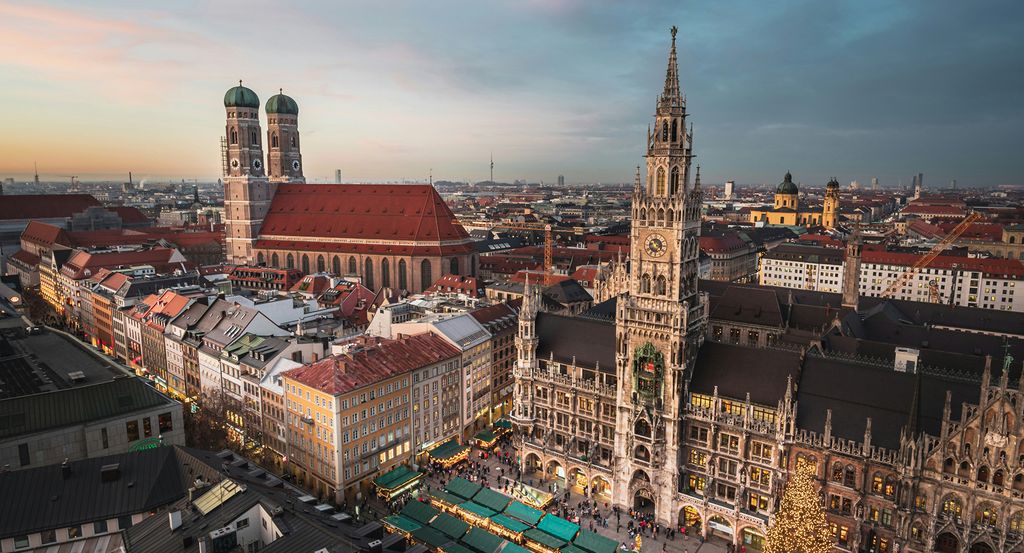
Occupying the geographical center of Munich's Old Town, Marienplatz extends between the pedestrian shopping streets of Kaufingerstraße and Tal, with routes toward Sendlinger Straße and the surrounding historic quarters converging around its rectangular open space. Its northern frontage is dominated by the elaborate Neo-Gothic Neues Rathaus, whose towers, pointed arches, sculptural decoration, and extensive stonework establish a commanding architectural presence above the square. The central pedestrian area brings together the Mariensäule, the Fischbrunnen, and the contrasting façade of the Altes Rathaus, creating a continuous encounter with religious sculpture, civic architecture, and the physical remnants of Munich's former marketplace. Shops and cafés occupy the surrounding commercial properties, with outdoor seating, public gatherings, and the steady movement of pedestrians connecting the square to the adjoining streets. The result is an expansive urban gathering place whose architecture, ceremonial traditions, and commercial surroundings preserve Munich's historical importance as the political and cultural center of Bavaria.
What defines Marienplatz.
Marienplatz is best known for serving as Munich's principal civic and commercial square since the city's establishment under Henry the Lion in 1158, developing from a medieval trading crossroads into the ceremonial center of the Bavarian capital. Its geographical importance originated at the intersection of the east-west salt-trading route and the north-south connection between the settlements of Schwabing and Sendling. Henry the Lion's consolidation of Munich as a commercial settlement established the foundations for a market whose economic importance extended across southern Germany. Merchants assembled around the central open space to trade grain, eggs, flour, wine, fish, and other essential goods, creating a commercial institution that supported the growing town. The square became known as the Markt and subsequently Schrannenplatz, a name associated with the grain trade and the market facilities that occupied the surrounding area. Its position within the medieval settlement also gave it an important political function, bringing municipal administration, commercial regulation, and public ceremonies into close geographical relationship. The Wittelsbach dynasty's consolidation of authority in Bavaria strengthened Munich's importance as a princely residence, increasing the ceremonial significance of its principal public square. The marriage of Duke Wilhelm V and Renata of Lorraine in 1568 brought elaborate festivities into the city, including a jousting tournament that subsequently became one of the best-known episodes in Munich's civic history. Religious conflict transformed the square's significance during the Thirty Years' War, when Swedish forces occupied Munich in 1632. Elector Maximilian I subsequently commissioned the Mariensäule as an act of thanksgiving for the city's survival during the conflict. The monument was consecrated on November 7, 1638, placing the Virgin Mary at the geographical center of Munich's public life. Its gilded bronze statue had been created by Hubert Gerhard during the late sixteenth century and was subsequently elevated above an eleven-meter column of Tegernsee marble. The monument's base incorporated four sculptural groups depicting angels defeating the traditional afflictions of humanity: war, plague, famine, and heresy. These figures connected Catholic religious symbolism with the political and military circumstances surrounding Bavaria's participation in the Thirty Years' War. The square's commercial organization underwent a substantial transformation during the nineteenth century as Munich expanded under the Bavarian monarchy. King Maximilian I Joseph ordered the relocation of the principal food market in 1807, creating space for a dedicated market district beyond the increasingly congested central square. The subsequent reorganization gradually separated the city's principal ceremonial space from the commercial activities that had dominated it since the Middle Ages. In 1854, Munich formally adopted the name Marienplatz, placing the square under the protection of the Virgin Mary during a cholera epidemic. The renaming reinforced the religious association established through Maximilian I's seventeenth-century monument and gave the square its enduring civic designation. Munich's rapid nineteenth-century population growth also required substantial expansion of the municipal administration. The city commissioned architect Georg von Hauberrisser to design a new town hall, initiating construction in 1867 on the northern side of Marienplatz. Hauberrisser was twenty-five when he developed the Neo-Gothic design, which incorporated elaborate sculptural decoration, ceremonial rooms, courtyards, and an imposing tower. Construction continued through successive phases until 1905, transforming the northern frontage into one of Germany's most elaborate examples of nineteenth-century municipal architecture. The building's Glockenspiel began operating in 1908, introducing a mechanical performance that commemorated the sixteenth-century ducal wedding and the traditional dance of Munich's coopers. Its forty-three bells and moving figures connected the architecture of the municipal building with episodes from the city's earlier history. The square subsequently endured substantial destruction during the Second World War, when Allied bombing damaged the surrounding urban fabric and several historically significant buildings. Postwar reconstruction restored important architectural features and reorganized portions of the surrounding commercial district. The approach of the 1972 Summer Olympics brought another decisive transformation as Munich pedestrianized the central route between Karlsplatz and Marienplatz. The project removed ordinary vehicular traffic from the historic commercial corridor, establishing the pedestrian environment that governs the square's principal public functions. Marienplatz also became an important public transportation interchange through the development of the underground railway network, connecting the historic center with the expanding metropolitan region. The square's subsequent history has included major political gatherings, municipal ceremonies, football championship celebrations, and the annual Münchner Christkindlmarkt. Its development connects medieval trade, Wittelsbach dynastic authority, Catholic religious patronage, nineteenth-century municipal expansion, wartime reconstruction, and modern urban planning within a single public space whose civic importance has endured for more than eight centuries.
Munich's public ceremonial calendar gives Marienplatz a distinctive character through the recurring transformation of its open space into a setting for religious observance, mechanical performance, seasonal commerce, and collective celebration. The Mariensäule establishes the central point of this activity, with the elevated Virgin Mary and the four sculptural groups beneath her connecting the square's everyday pedestrian movement with the historical religious traditions of Bavaria. The monument's importance extends into Catholic ceremonial life through papal visits, including those of Pius VI in 1782, John Paul II in 1980, and Benedict XVI in 2006. Its position also establishes a geographical reference point for Munich, connecting the historical center with the measurement of distances across the surrounding region. The square's most recognizable recurring performance takes place above the northern frontage, where the Rathaus-Glockenspiel brings historical episodes into motion through an elaborate arrangement of mechanical figures and tuned bells. The upper stage presents the wedding celebrations of Wilhelm V and Renata of Lorraine, culminating in a tournament between a Bavarian knight and a competitor representing Lorraine. The Bavarian rider defeats his opponent, giving the performance a clear dramatic conclusion before attention shifts toward the lower stage. The Schäfflertanz follows through a procession of cooper figures whose circular movements commemorate a Munich tradition associated with the restoration of public confidence following an epidemic. The dance preserves the historical connection between the barrel-making trade and the city's communal celebrations, bringing a craft guild's ceremonial traditions into a mechanical performance watched from the surrounding square. Its musical accompaniment changes through the year, with the sequence of melodies and moving figures governed by the Glockenspiel's internal machinery. Performances take place daily at eleven o'clock and noon, with an additional afternoon presentation at five o'clock between March and October. A separate evening sequence at nine o'clock introduces the night watchman, an angel, and the Münchner Kindl, connecting the municipal clock with another traditional representation of the city. The Glockenspiel's sound travels across the surrounding pedestrian area, bringing movement through the square into temporary concentration around the tower. That relationship between scheduled performance and public gathering extends into the seasonal celebrations that occupy the ground below. The Münchner Christkindlmarkt transforms Marienplatz during Advent through wooden market stalls, illuminated decorations, traditional crafts, and the aromas of roasted almonds, gingerbread, and mulled wine. A large decorated Christmas tree stands before the town hall, establishing a central visual feature around which the market's commercial and festive activities develop. The square's medieval association with food trading acquires another form during these weeks, connecting seasonal Bavarian specialties with the commercial traditions of the historical marketplace. Munich's Fasching celebrations bring a different atmosphere through costumes, music, public performances, and gatherings associated with the final days before Lent. The Fischbrunnen contributes its own recurring ceremony through the traditional washing of empty wallets on Ash Wednesday, a custom associated with hopes for financial prosperity during the coming year. Its sculptural composition incorporates elements from an earlier fountain destroyed during the Second World War, giving the ritual a physical setting that connects historical craftsmanship with postwar reconstruction. The square's ceremonial importance extends beyond religious and seasonal occasions through civic gatherings organized around the municipal administration. FC Bayern Munich's championship celebrations bring players and supporters together before the town hall, with the building's balcony serving as the principal platform for public appearances. The architectural relationship between the elevated balcony and the open pedestrian area allows large crowds to assemble around a single visual focus, transforming the square into a collective sporting celebration. Political demonstrations, commemorative ceremonies, and public festivals make use of the same spatial arrangement, establishing Marienplatz as Munich's principal setting for major communal gatherings. Its commercial surroundings support this recurring public activity through shops, restaurants, cafés, and pedestrian connections that carry movement across the Old Town throughout the day. Marienplatz's distinctive character develops through these successive forms of civic participation, connecting medieval religious symbolism, mechanical historical performance, seasonal commerce, and contemporary public celebrations within the architectural setting of Munich's central square.
How Marienplatz fits.
Marienplatz works as the geographical centerpiece for an exploration connecting Munich's medieval religious foundations, Gothic cathedral architecture, and the culinary traditions of its historic market district.
Begin at St. Peter's Church, Munich's oldest parish church, whose position on the Petersbergl connects the surrounding urban settlement with its earliest religious institutions. The church's origins extend into the twelfth century, when the growing settlement developed around the commercial and religious communities associated with the Isar crossing. Its architectural history incorporates successive medieval, Renaissance, and Baroque alterations, preserving the accumulated work of generations of Munich builders and artists. The high altar, created between 1730 and 1734, incorporates work by Nikolaus Gottfried Stuber, Johann Georg Greiff, and Egid Quirin Asam, with a golden statue of Saint Peter by Erasmus Grasser occupying its center. The church also preserves the relics of Saint Munditia, whose remains have been associated with the institution since 1677. Its ninety-one-meter tower provides an elevated perspective across the Old Town, reached by climbing 306 steps to the observation platform. Continue to Frauenkirche, the Gothic cathedral whose twin towers have defined Munich's skyline since the late Middle Ages. Master builder Jörg von Halsbach began construction in 1468, using brick as the principal building substance in response to the region's limited local stone resources. The main structure was completed in 1488, establishing an immense late-Gothic church whose scale corresponded with Munich's growing political and religious importance. Its distinctive domed tower roofs were added in 1525, drawing upon architectural forms associated with the Dome of the Rock in Jerusalem. The cathedral suffered extensive damage during the Second World War and underwent reconstruction between 1948 and 1955, preserving its principal architectural character through substantial restoration. Its interior contains important religious artworks and monuments, including the tomb of Emperor Ludwig IV and the Teufelstritt, a footprint associated with a medieval legend concerning the cathedral's construction. Conclude at Viktualienmarkt, the historic food market whose development established a dedicated commercial center for Munich's growing population. King Maximilian I Joseph authorized the market in 1807, directing the transfer of food trading into the area between Heiliggeistkirche and Frauenstraße. Its subsequent expansion during the nineteenth century accommodated increasing commercial demand as Munich developed into a major European capital. The market incorporates specialist vendors selling vegetables, fruit, meat, fish, cheese, bread, spices, and regional delicacies, preserving the commercial traditions of independent food production and distribution. Its central beer garden serves beer from Munich's six traditional breweries on a rotating basis, connecting the marketplace with the city's established brewing culture. A decorated maypole, installed through the support of local breweries beginning in 1962, commemorates Bavarian craft traditions and seasonal festivities through painted figures associated with the city's commercial and cultural history. The progression moves from St. Peter's Church's medieval religious foundations through Frauenkirche's Gothic architectural development and culminates at Viktualienmarkt, connecting Munich's ecclesiastical history with the food commerce and public traditions that sustain its Old Town.
Where your story begins.
Foresyte Travel reveals places that feel extraordinary long before you arrive.
Enjoy editorial crafted for luxury travelers.
Foresyte may earn a commission when you book.




















































































































