Why Mariposa matters.
Mariposa is a cosmopolitan restaurant where Third Ward's contemporary arts district meets Jill Marcus's international culinary vision, the communal dining traditions of the Mediterranean and a distinctly Charlotte approach to hospitality shaped by cultural exchange, artistic expression and the pleasure of gathering around a shared table.
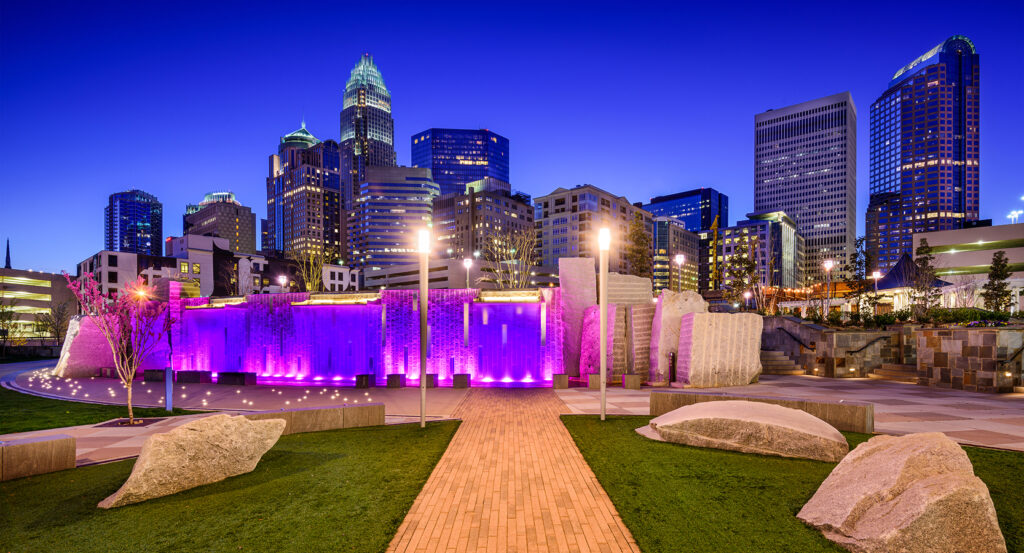
Set along South Tryon Street near West Martin Luther King Jr. Boulevard and a short walk from Charlotte's central business district, the restaurant occupies a prominent cultural corridor where contemporary towers, landscaped public spaces and major arts institutions define Uptown's evolving architectural character. Its expansive windows introduce a sophisticated interior combining black-and-white decorative elements, velvet seating and contemporary furnishings with views of the surrounding city. Prism chandeliers and artwork by Charlotte muralist Owl contribute a distinctive visual character, connecting the dining room with the city's creative community. Comfortable banquettes, carefully arranged tables and a substantial bar establish complementary settings for intimate meals, larger gatherings and leisurely afternoon dining. The result is a restaurant whose contemporary design, artistic details and welcoming communal atmosphere establish a natural gathering place within Charlotte's principal cultural district.
What defines Mariposa.
Mariposa is best known for bringing internationally inspired communal dining to Uptown Charlotte through the creative direction of restaurateur Jill Marcus and her Mother Earth Group hospitality company. Marcus developed her career through Something Classic Catering, establishing a Charlotte-based business centered on event hospitality, culinary presentation and the social connections created through shared meals. Her enterprise subsequently expanded into Mother Earth Group, bringing catering, specialty food products and restaurant operations together under a broader commitment to community and environmental responsibility. The group's restaurant portfolio included Halcyon, a farm-to-table establishment occupying a prominent position within Charlotte's growing cultural district. Halcyon closed in December 2020, creating an opportunity for Marcus to reconsider the relationship between the dining room, its surrounding institutions and the international influences shaping Charlotte's restaurant culture. Her travels across multiple continents provided the foundation for a new concept organized around shared plates and culinary traditions drawn from different regions of the world. The resulting restaurant took its name from the Spanish word for butterfly, reflecting Marcus's interest in transformation, personal growth and the relationships formed through hospitality. Mariposa opened on October 15, 2021, introducing the Mother Earth Group's new culinary direction within the former Halcyon premises. Executive chef Jonathan Moore, who had previously led Halcyon's kitchen, participated in the transition, developing a menu that extended the restaurant's culinary style beyond its earlier emphasis on regional farm-to-table cooking. The opening concept incorporated influences from Latin America, Asia, Africa and the Mediterranean, establishing a distinctive international perspective within a city whose dining scene had become increasingly diverse. Brad Grubb, a Level 3 sommelier, contributed to the original beverage program through selections designed to introduce less familiar wine regions and grape varieties to Charlotte diners. The restaurant's early development also reflected Marcus's commitment to local artistic collaboration, integrating original work by Charlotte artists into an environment designed for conversation and cultural discovery. A further evolution brought executive chef Octavio Lopez, also known as Tavi Lopez, into leadership of the kitchen, continuing the restaurant's emphasis on international flavors and shareable preparations. The broader Mother Earth Group subsequently developed Coquette, a French-inspired buvette, extending Marcus's hospitality enterprise into a complementary interpretation of European café and restaurant traditions. Mariposa's development connects the evolution of a longstanding Charlotte catering business with the city's expanding cultural institutions and the growing influence of international culinary traditions on contemporary Southern dining.
Jill Marcus's approach to hospitality places communal dining at the center of Mariposa's culinary character, drawing particular inspiration from the Mediterranean and North African tradition of mezze. This approach organizes a meal around multiple shared preparations, allowing contrasting flavors, textures and cooking techniques to develop through conversation and the gradual arrival of dishes. Executive chef Octavio Lopez extends that foundation through a broader international repertoire, connecting the bright acidity of Latin American cooking with the aromatic spices, grilled preparations and layered sauces associated with other culinary regions. The kitchen's treatment of seafood demonstrates this approach through carefully controlled cooking, assertive seasoning and accompaniments that introduce contrasting temperatures and textures. Octopus prepared a la plancha develops a concentrated exterior through direct contact with a hot cooking surface, preserving tenderness while allowing sauces and complementary ingredients to contribute additional depth. Piri piri chicken introduces the Portuguese and southern African inheritance of chili-based marinades, building flavor through the relationship between heat, acidity and roasting. Gullah paella connects the rice-centered cooking traditions of the Carolina Lowcountry with the communal character of the Spanish dish, establishing a culinary relationship between regional Southern ingredients and an international preparation. Larger shared dishes extend the same principle through substantial proteins and carefully developed accompaniments, giving groups an opportunity to construct a meal around collective preferences. The restaurant's sourcing practices reinforce its relationship with Charlotte through a partnership with Sam Fleming and 100 Gardens, whose aquaponics operation at The Innovation Barn supplies fresh lettuces and greens. Aquaponic cultivation combines fish production with plant growth in a recirculating water system, establishing an agricultural model centered on resource efficiency and local food production. The beverage program complements the kitchen through wines selected from established and emerging international regions, accompanied by cocktails that incorporate herbs, fruit and aromatic ingredients. Weekend brunch introduces a complementary social tradition, with live jazz on Sundays connecting the restaurant's daytime service to the musical culture of communal gathering. Mariposa's distinctive character emerges from this relationship between international culinary traditions, local agricultural partnerships and generous shared dining, creating a restaurant whose broad cultural perspective remains grounded in Charlotte's contemporary hospitality community.
How Mariposa fits.
Mariposa works as the anchor for an outing connecting Charlotte's international modern art collections, the preservation of African American cultural heritage and the performing arts institutions that established Uptown as a major cultural destination.
Begin at Bechtler Museum of Modern Art, the distinctive museum designed by Swiss architect Mario Botta and opened in January 2010 as part of Charlotte's expanding cultural district. Its collection originated with Bessie and Hans Bechtler, whose relationships with influential twentieth-century artists helped establish a substantial private collection in Switzerland. Their son Andreas Bechtler brought the family's artistic inheritance to Charlotte, contributing works by Pablo Picasso, Alberto Giacometti, Alexander Calder and other major figures of European and American modernism. Botta's terracotta-clad building provides a striking architectural setting for the collection, with its elevated upper gallery establishing a recognizable presence along South Tryon Street. Outside, Niki de Saint Phalle's expansive Firebird sculpture, completed in 1991 and covered in thousands of mirrored mosaic pieces, introduces the museum's commitment to modern artistic experimentation. Continue to Harvey B. Gantt Center for African-American Arts + Culture, the institution whose origins reach back to the efforts of educators Mary T. Harper and Bertha Maxwell-Roddey during the 1970s. Their work established the Afro-American Cultural Center, creating a permanent institution devoted to preserving and interpreting African American artistic achievement and historical experience in Charlotte. The organization moved into its current building in October 2009, adopting the name of Harvey Gantt, the city's first African American mayor and a prominent architect and civic leader. Architect Philip Freelon designed the striking contemporary structure with references to the historic Myers Street School, whose distinctive exterior staircases once stood within Charlotte's predominantly Black Brooklyn neighborhood before its destruction during urban renewal. The center's exhibitions and cultural programs preserve that historical inheritance through visual art, community education and major collections, including works associated with the Hewitt Collection of African American Art. Conclude at Knight Theater, the contemporary performance venue developed through Charlotte's ambitious Cultural Facilities Master Plan and opened in 2010. Its creation formed part of a coordinated investment in museums and performing arts facilities intended to strengthen the cultural infrastructure of the city's central business district. Designed by tvsdesign, the theater incorporates a contemporary architectural composition whose curving forms and metallic surfaces establish a distinctive presence within the surrounding arts campus. Its 1,200-seat auditorium accommodates dance, theater, music and other performances, providing a flexible setting for resident cultural organizations and visiting productions. The theater's development strengthened the relationship between Charlotte's visual arts institutions and its performing arts community, establishing a concentrated cultural destination within walking distance of the city's major commercial corridors. The progression moves from the international modernism preserved at the Bechtler through the African American artistic and historical inheritance represented by the Gantt Center and culminates in Knight Theater's contemporary performing arts program, revealing the cultural breadth of the district surrounding Mariposa.
Where your story begins.
Foresyte Travel reveals places that feel extraordinary long before you arrive.
Enjoy editorial crafted for luxury travelers.
Foresyte may earn a commission when you book.