Why Merdeka Square matters.
Merdeka Square is a colonial-era civic square where Kuala Lumpur City Centre's administrative heritage meets the declaration of Malayan independence, the architectural development of British Malaya and the establishment of Malaysia's national ceremonial traditions.
Set along Jalan Raja near Jalan Tun Perak and just steps from the Royal Selangor Club, the square occupies a rectangular expanse beside the Klang River, between the former colonial administrative buildings and the commercial streets extending toward Kuala Lumpur's historic market district. A broad grass field forms its central open space, bordered by pedestrian paths and institutional façades. A tall flagpole stands near the southern end, marking the location associated with the independence ceremonies of 1957. The surrounding buildings incorporate architectural styles developed during the colonial administration of Selangor. The result is a civic landscape where the physical arrangement of a nineteenth-century recreational field preserves the political transition from British colonial rule to independent Malaya.
What defines Merdeka Square.
Merdeka Square is best known for its association with the declaration of Malayan independence on 31 August 1957 and its position at the center of Kuala Lumpur's historic administrative district. The square originated as the Selangor Club Padang, a recreational field established during the development of Kuala Lumpur as the administrative capital of Selangor. Kuala Lumpur expanded during the late nineteenth century through tin mining, commercial activity and the consolidation of British colonial administration. The field became an important recreational ground for members of the Selangor Club, which was founded in 1884 as a social institution serving the European colonial community. Cricket matches and other sporting activities occupied the open ground, establishing the padang as a principal gathering place within the administrative district. The surrounding area developed through the construction of substantial government buildings associated with the Federated Malay States. British architect A. C. Norman designed the Sultan Abdul Samad Building, which was completed in 1897 and became one of the principal administrative structures facing the square. Its architectural composition incorporated arched colonnades, domed towers and decorative elements associated with Indo-Saracenic design. The building accommodated colonial government offices and subsequently housed judicial and administrative functions. During the early twentieth century, the square continued to serve recreational and ceremonial purposes as Kuala Lumpur developed into a major administrative and commercial center. The Japanese occupation of Malaya during the Second World War disrupted British colonial administration and contributed to political changes that accelerated the movement toward independence. Following the war, constitutional negotiations and the growth of Malay nationalist organizations shaped the transition toward self-government. The Federation of Malaya achieved independence from Britain on 31 August 1957, with ceremonies held at the square marking the transfer of sovereignty. The Union Jack was lowered and the flag of the independent federation was raised, establishing the site as an enduring symbol of national independence. The square was subsequently renamed Dataran Merdeka, meaning Independence Square, reflecting its political importance. National Day celebrations and other public ceremonies reinforced its position within Malaysia's civic life. Its preservation connects the colonial development of Kuala Lumpur with the constitutional establishment of independent Malaya.
Tunku Abdul Rahman's leadership during the independence movement established the political context for the ceremonies that transformed the former colonial recreation ground into a national civic space. The square's central field preserves the open dimensions of the original padang, maintaining an unobstructed area between surrounding institutional buildings. Its grass surface supports public gatherings and ceremonial activities associated with national commemorations. A flagpole rising 95 meters marks the southern portion of the square, providing a prominent vertical element within the otherwise open landscape. The surrounding pedestrian routes connect the field with historic government buildings and adjoining streets. The Sultan Abdul Samad Building forms the principal architectural frontage along the eastern side, incorporating a central clock tower rising above its arched façade. Its copper-covered domes and decorative masonry establish a distinctive composition associated with the late nineteenth-century colonial administration. The Royal Selangor Club occupies the western side of the square, preserving a Tudor Revival architectural character associated with British colonial social institutions. Its timber-framed façades and pitched roofs contrast with the domed government buildings across the field. The Kuala Lumpur City Gallery occupies a historic building near the southern end of the square, presenting exhibitions associated with the city's development. Its premises originated as the Government Printing Office, reflecting the administrative functions concentrated around the padang. The square's position near the Klang River connects it with the geographical setting of Kuala Lumpur's early commercial settlement. Its surrounding streets preserve relationships between governmental, recreational and commercial districts established during the colonial period. Public ceremonies incorporate flag displays and commemorative activities associated with Malaysian national history. The square's open arrangement allows the surrounding architecture to remain visible as a continuous historical setting. Its preservation maintains the spatial relationship between colonial administration and the public ceremonies associated with independence.
How Merdeka Square fits.
Merdeka Square works as the civic centerpiece for a historic Kuala Lumpur itinerary connecting the city's colonial commercial institutions, Islamic religious architecture and the development of its early urban settlement around the Klang and Gombak rivers.
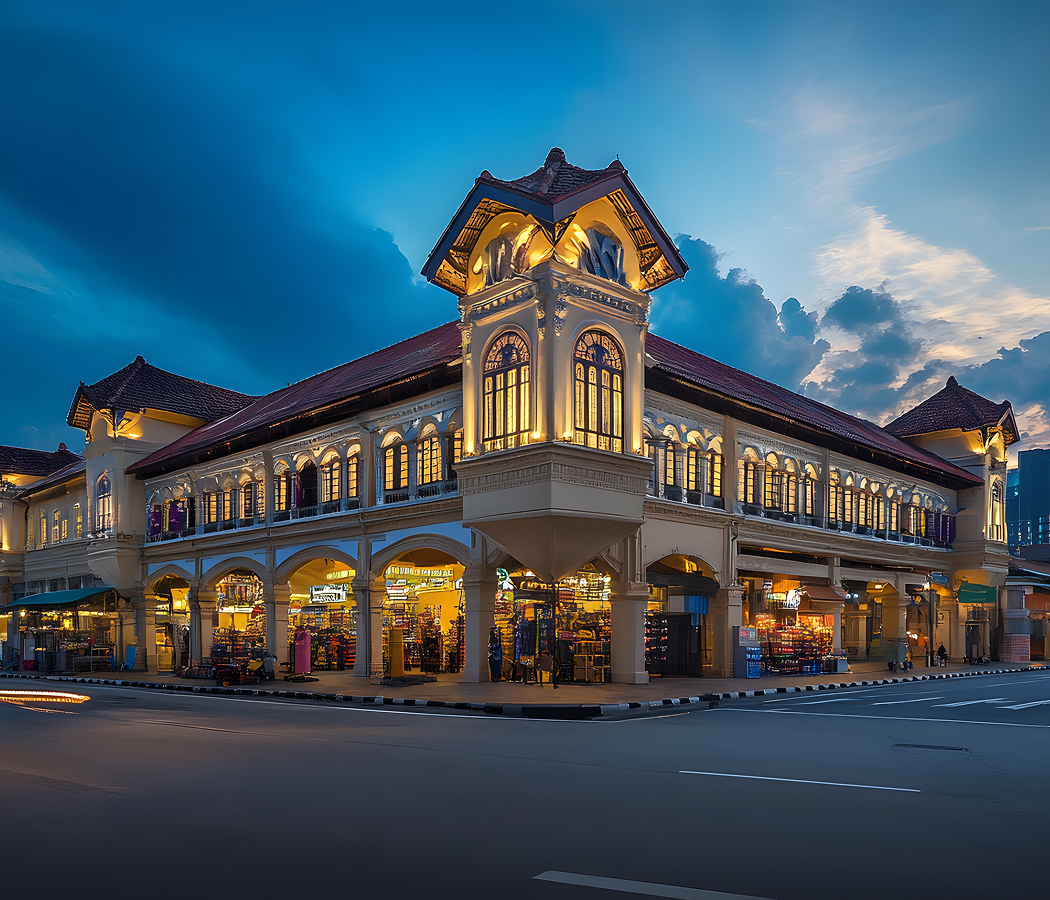
Begin at Central Market Kuala Lumpur, the historic commercial institution situated southwest of the square near the Klang River. The market originated in 1888 as a wet market serving Kuala Lumpur's growing population during the expansion of the tin mining economy. Its surviving building was completed in 1937, incorporating Art Deco architectural elements associated with the interwar period. The market subsequently developed into a center for Malaysian handicrafts, textiles and cultural commerce. Its stalls and workshops contain products associated with Malay, Chinese and Indian artistic traditions. The building's preservation connects the city's early commercial development with the continuation of traditional craft production. Continue to Masjid Jamek Sultan Abdul Samad, the historic mosque situated near the confluence of the Klang and Gombak rivers. Completed in 1909, the mosque was designed by architect Arthur Benison Hubback, whose work incorporated Indo-Saracenic architectural elements into several major buildings in British Malaya. Its composition includes domes, minarets and arched colonnades arranged around the principal prayer spaces. The mosque occupied a site associated with Kuala Lumpur's early Malay settlement and became an important religious institution during the city's expansion. Its location at the river confluence connects Islamic religious architecture with the geographical origins of Kuala Lumpur. Conclude at National Textile Museum, the cultural institution occupying a former colonial government building near the square. The building was completed in 1896 and originally accommodated offices associated with the Federated Malay States administration. Its architectural composition incorporates arched openings, decorative masonry and elements associated with Indo-Saracenic design. The museum presents collections devoted to Malaysian textile traditions, including songket, batik and other woven and decorated fabrics. Its exhibitions examine techniques, materials and ceremonial uses associated with the country's diverse communities. The institution preserves the relationship between traditional textile production and the social history of Malaysia. The progression moves from colonial commercial infrastructure through early Islamic religious architecture and culminates in the preservation of Malaysian textile traditions, connecting Merdeka Square with the economic, religious and cultural institutions that shaped Kuala Lumpur.
Where your story begins.
Foresyte Travel reveals places that feel extraordinary long before you arrive.
Enjoy editorial crafted for luxury travelers.
Foresyte may earn a commission when you book.