Why National Mosque of Malaysia matters.
National Mosque of Malaysia is the architectural soul of Kuala Lumpur, where faith, modernity, and national character unite under a canopy of light and geometry.
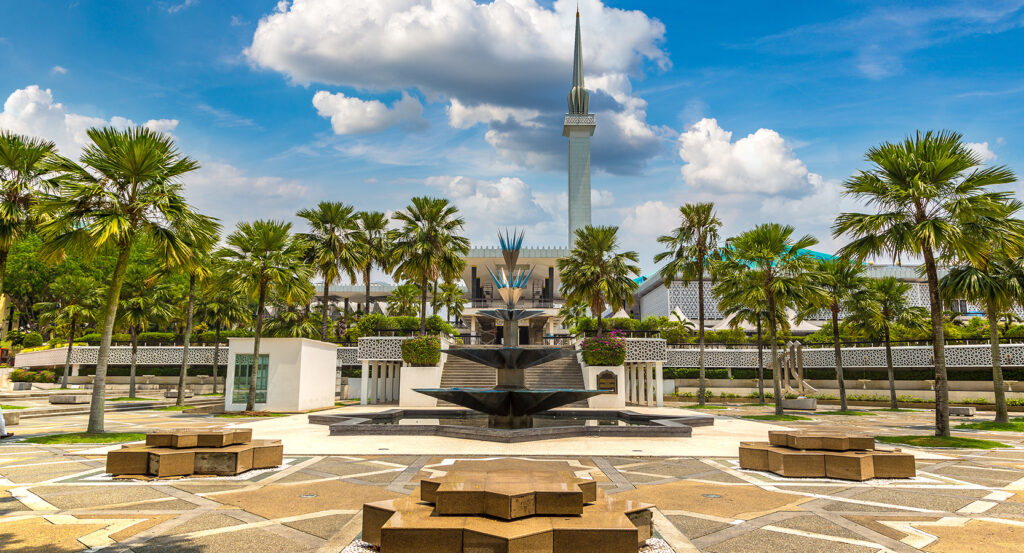
Set amid lush gardens and reflective pools in the heart of Kuala Lumpur, National Mosque, or Masjid Negara, stands as one of Southeast Asia's most striking symbols of Islamic architecture and post-independence pride. Completed in 1965, just eight years after Malaysia gained independence, the mosque was envisioned as a celebration of a nation reborn, modern, multicultural, and deeply rooted in its Islamic heritage. Designed by a team of Malaysian architects led by Howard Ashley, Hisham Albakri, and Baharuddin Kassim, its aesthetic blends traditional motifs with contemporary innovation. The main roof, shaped like a 16-pointed star, unfolds like an abstract umbrella, a metaphor for divine protection and unity. Clad in turquoise tiles, it glimmers in the tropical sun, echoing both the calm of water and the expanse of sky. A 73-meter minaret rises beside it, sleek and angular, contrasting with the soft curves of the gardens below. Inside, the mosque's main prayer hall feels both expansive and intimate, marble floors gleam beneath soaring ceilings, intricate arabesques trace the walls, and filtered light washes across thousands of worshippers gathered in prayer. The air is still, dignified, and somehow electric, a quiet power that captures Malaysia's deep sense of faith and forward momentum.
What defines National Mosque of Malaysia.
Beyond its serene design lies a story of national vision, one that reflects Malaysia's journey toward unity through faith and architecture.
When plans for Masjid Negara were conceived in the early 1960s, Malaysia's leaders sought to create a mosque that would represent both the country's Islamic roots and its modern aspirations. Rather than emulate the domed grandeur of Ottoman or Persian mosques, the architects envisioned something uniquely Malaysian, minimalist, geometric, and bold. The umbrella-inspired roof was chosen as a symbol of shelter and inclusion, while the star-shaped pattern reflected the guiding principles of Islam radiating outward to the world. Construction took three years, using materials sourced locally wherever possible, concrete, marble, and mosaic, to express national self-reliance. The mosque can accommodate over 15,000 worshippers at a time, with the main prayer hall reserved for men and adjacent galleries for women. Above the entrance, verses from the Qur'an are inscribed in fluid calligraphy, complementing the precision of the structure's modern lines. The surrounding gardens, designed in harmony with Islamic landscaping principles, feature fountains, reflecting pools, and tropical flora that create a sense of tranquility even in the heart of the city. Few realize that the original dome design was revised late in the process after Prime Minister Tunku Abdul Rahman, inspired by the symbolic power of the umbrella, suggested a more abstract form. The mosque also includes a mausoleum, the Makam Pahlawan, where Malaysia's national heroes are buried beneath an elegant star-shaped dome. During major Islamic festivals, the mosque becomes a hub of communal life, its courtyards filled with prayer mats, families, and the rhythmic cadence of the call to prayer rising into the humid afternoon air. It remains not only a place of worship but a living tribute to Malaysia's identity: progressive, peaceful, and profoundly grounded in faith.
How National Mosque of Malaysia fits.
To truly experience National Mosque, approach it not just as a religious site but as a reflection of Malaysia's spirit, an experience that's architectural, cultural, and deeply human.
Start the visit in the early morning or late afternoon, when the sunlight softens and the turquoise roof shimmers like glass. As you walk along the tree-lined pathways leading to the mosque, the hum of the city fades into the quiet rustle of palm leaves and the echo of water from nearby fountains. Remove your shoes at the entrance and, if you're not Muslim, don the robe provided for modesty, an act that immediately slows your pace and draws you into a sense of reverence. Inside, let your eyes wander across the marble expanses and delicate lattice screens that filter the light into intricate shadows. The sense of space is unique, vast yet grounded, open yet centered. Stand beneath the central ceiling and look upward: the geometry of the roof forms a radiant pattern that seems to pull the gaze heavenward. Take a moment to walk around the courtyard, where reflecting pools mirror the minaret's sharp silhouette against the sky. From certain angles, the structure feels almost weightless, its modernity softened by the natural world around it. After exploring, step into the adjacent gardens to rest under the shade of frangipani trees, where the sound of prayer drifts faintly through the air. Pair your visit with nearby landmarks like the Islamic Arts Museum or the old Kuala Lumpur Railway Station, both within walking distance, to deepen your appreciation for Malaysia's fusion of heritage and innovation. National Mosque of Malaysia isn't simply a monument to religion, it's a poem in stone and water, an example of unity through design. To stand beneath its turquoise roof is to glimpse Malaysia's heart laid bare: confident, inclusive, and at peace. Here, modern lines meet ancient devotion, and a young nation's dream continues to unfold, serene, radiant, and unbroken beneath the tropical sun.
Where your story begins.
Foresyte Travel reveals places that feel extraordinary long before you arrive.
Enjoy editorial crafted for luxury travelers.
Foresyte may earn a commission when you book.