Why Old Phuket Town matters.
Old Phuket Town is a historic urban enclave where Phuket City's maritime trading heritage meets the prosperity of its tin-mining industry, the multicultural traditions of its Baba-Peranakan communities and one of Thailand's most distinctive concentrations of Sino-European architecture.
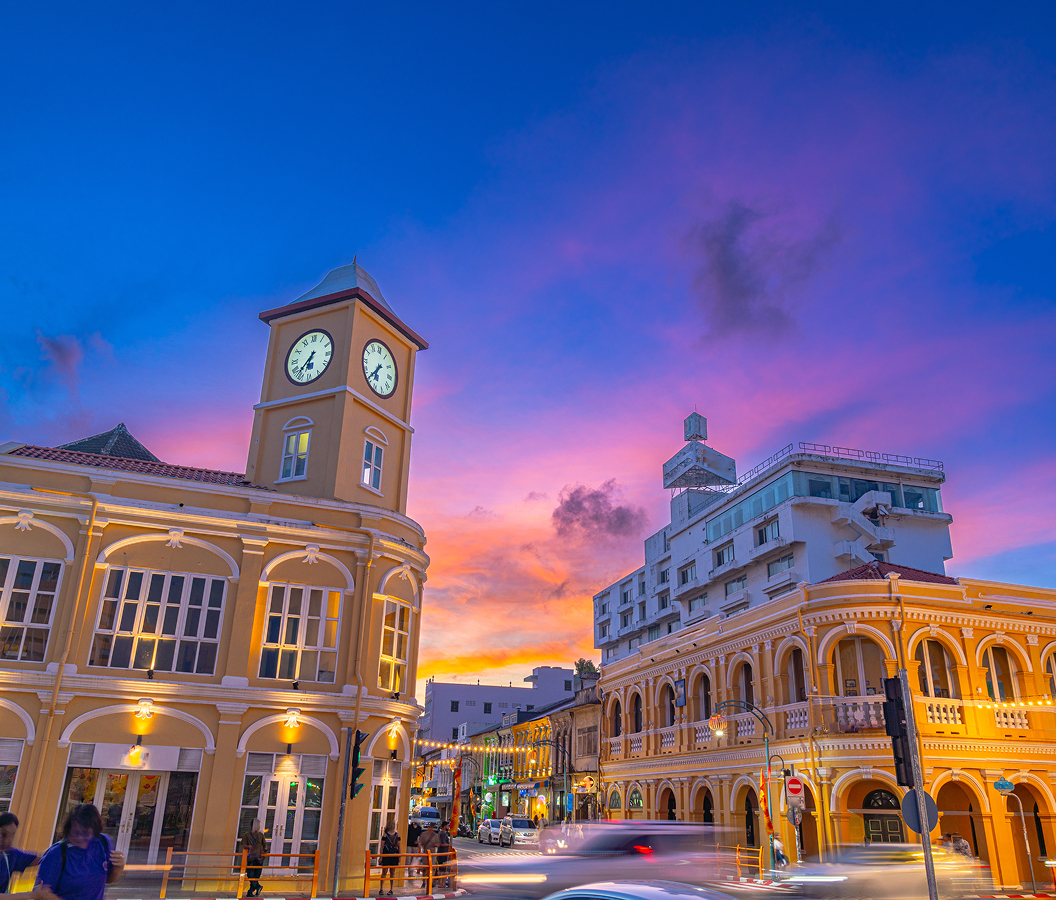
Occupying the historic center of Phuket City, Old Phuket Town extends through the interconnected streets of Thalang Road, Dibuk Road, Krabi Road, Phang Nga Road and Yaowarat Road, with Soi Romanee linking the northern commercial blocks and Ranong Road approaching the traditional market district to the southwest. Continuous rows of two-story shophouses establish the neighborhood's architectural character, their pastel façades incorporating decorative plasterwork, arched openings, shuttered windows and ornamental columns. Covered pedestrian arcades run beneath portions of the buildings, creating sheltered passages between adjoining storefronts. Narrow commercial frontages conceal elongated interiors, internal courtyards and rear service areas developed around the practical requirements of merchant households. Larger freestanding mansions occupy prominent parcels beyond the principal shopping streets, distinguished by elaborate entrance halls, tiled floors and substantial landscaped grounds. Chinese shrines, traditional markets and restored civic buildings interrupt the commercial streetscape, preserving the spatial organization of a prosperous Southeast Asian trading town. The result is a remarkably coherent historic district whose architecture, religious institutions and surviving merchant houses preserve the physical character of Phuket's commercial development.
What defines Old Phuket Town.
Old Phuket Town is best known for the commercial prosperity generated by Phuket's tin deposits, which connected the island to international maritime trading networks and attracted successive generations of Chinese merchants, miners and entrepreneurs. Tin extraction had supported the island's economy for centuries, and European involvement in the regional trade expanded following the Portuguese capture of Malacca in 1511. Phuket's position along the Andaman Sea connected its mineral resources with shipping routes serving the Malay Peninsula, the Strait of Malacca and ports throughout Southeast Asia. During the nineteenth century, expanding tin production attracted substantial migration from southern China, particularly Fujian, whose Hokkien-speaking communities established commercial relationships with Penang, Singapore and other regional trading centers. Chinese entrepreneurs developed mining operations, financed commercial enterprises and established merchant households whose prosperity transformed the island's principal town. Intermarriage between Chinese settlers and local Thai and Malay families contributed to the emergence of Phuket's Baba-Peranakan community, whose distinctive customs incorporated elements of Hokkien Chinese, Malay and southern Thai culture. Wealthy merchant families commissioned elaborate residences and commercial buildings that combined southern Chinese spatial arrangements with European decorative influences circulating through British Malaya and the Straits Settlements. The resulting architectural tradition became widely known as Sino-Portuguese, although its development incorporated a broader combination of Chinese, British, Portuguese, Dutch and local craftsmanship. Phuket's commercial transformation accelerated during the reign of King Chulalongkorn, Rama V, whose administrative reforms strengthened Siamese authority over the southern provinces and encouraged improvements to regional infrastructure. Governor Phraya Ratsadanupradit Mahitsaraphakdi, commonly known as Khaw Sim Bee Na Ranong, became a consequential figure in this period through his support for mining development, transportation improvements and commercial modernization. His administration encouraged foreign investment in the tin industry and advanced the construction of roads and other infrastructure connecting Phuket's commercial districts with the surrounding island. The Na Ranong family belonged to an influential Chinese-Thai commercial network whose interests extended across the western Malay Peninsula, contributing to the economic development of several southern Siamese provinces. Prosperous families subsequently commissioned substantial mansions, schools and religious buildings that demonstrated the importance of merchant philanthropy within Phuket's Chinese community. The Chinpracha family established one of the neighborhood's best-known residences in 1903, creating a substantial mansion that incorporated architectural influences associated with Penang and the wider Straits Settlements. Educational institutions developed alongside these commercial enterprises as Chinese community leaders invested in schools serving their descendants. Phuket Thai Hua School emerged from this movement, eventually occupying a purpose-built building completed in 1934. Its educational program preserved Chinese-language instruction and community traditions during a period of changing political relationships between Siam, China and Southeast Asia's overseas Chinese populations. Chinese-language education faced restrictions during the Second World War, and the school temporarily closed in 1941 before resuming operations after the conflict. The institution eventually relocated to larger premises in 1995, leaving its historic building available for a different cultural purpose. The decline of tin mining during the twentieth century transformed Phuket's economy as international tourism gradually became the island's principal commercial industry. Investment increasingly concentrated along the western beaches, leaving the historic town with an extensive collection of merchant buildings whose economic functions had changed. Local preservation initiatives developed during the late twentieth century, bringing municipal authorities, property owners and community organizations together around the conservation of Phuket's architectural heritage. Restoration projects returned historic shophouses to commercial use, and traditional residences became museums, boutique accommodations, galleries and restaurants. Phuket Thai Hua Museum opened in 2010 following a community-led restoration of the former school building, creating a permanent institution devoted to the island's Chinese cultural history. Thalang Road underwent substantial streetscape improvements, including the underground relocation of overhead electrical cables in 2010. The Lard Yai Sunday Walking Street Market began in late 2013, transforming the historic commercial corridor into a weekly gathering devoted to local food, crafts and cultural activity.
How Old Phuket Town fits.
Old Phuket Town works as the centerpiece of an exploration connecting Phuket's Chinese educational heritage, the architecture of its prosperous merchant families and the religious institutions that supported the island's historic trading communities.
Begin at Phuket Thai Hua Museum, the former Chinese-language school occupying a substantial historic building on Krabi Road. Constructed in 1934 through contributions from Phuket's Hokkien Chinese community, the building incorporates a symmetrical façade, arched openings and an internal courtyard associated with Sino-European institutional architecture. King Prajadhipok, Rama VII, visited the school grounds in 1928, an event commemorated within the museum's historical exhibitions. The building was registered as a heritage property in 2002, and its subsequent restoration transformed the former educational institution into a museum that opened in 2010. Thirteen exhibition rooms examine Chinese migration, tin mining, family customs, educational development and the cultural traditions that shaped Phuket's urban history. Continue to Baan Chinpracha, the historic merchant mansion commissioned in 1903 by Phra Phitak Chinpracha, a prosperous member of Phuket's Chinese-Thai commercial community. The residence incorporates architectural influences associated with Penang, including imported decorative tiles, substantial timber furnishings and a central courtyard surrounded by domestic rooms. Its original layout preserves the organization of a wealthy merchant household, with formal reception areas connected to private family spaces. Ornamental furnishings and surviving household objects demonstrate the material prosperity generated through Phuket's tin industry and regional trading relationships. The mansion's preservation provides an intimate architectural counterpart to the commercial shophouses occupying the surrounding streets. Conclude at Shrine of the Serene Light, the historic Chinese religious sanctuary concealed behind the commercial frontage of Phang Nga Road. Established in 1889, the shrine is associated with the Tan Luan Jae community and preserves architectural elements characteristic of southern Chinese religious buildings. Its decorative program incorporates elaborate roof ornaments, carved details and painted panels depicting figures from Chinese religious traditions. The shrine occupies a compact courtyard reached through a narrow passage from the adjoining street, preserving a distinctive relationship between commercial buildings and community worship. Incense offerings and devotional ceremonies maintain its connection to the religious traditions of Phuket's Chinese families. The progression moves from Phuket Thai Hua Museum's educational and migration history through Baan Chinpracha's merchant architecture and culminates in Shrine of the Serene Light's religious heritage, connecting the institutions that shaped Old Phuket Town's multicultural urban development.
Where your story begins.
Foresyte Travel reveals places that feel extraordinary long before you arrive.
Enjoy editorial crafted for luxury travelers.