
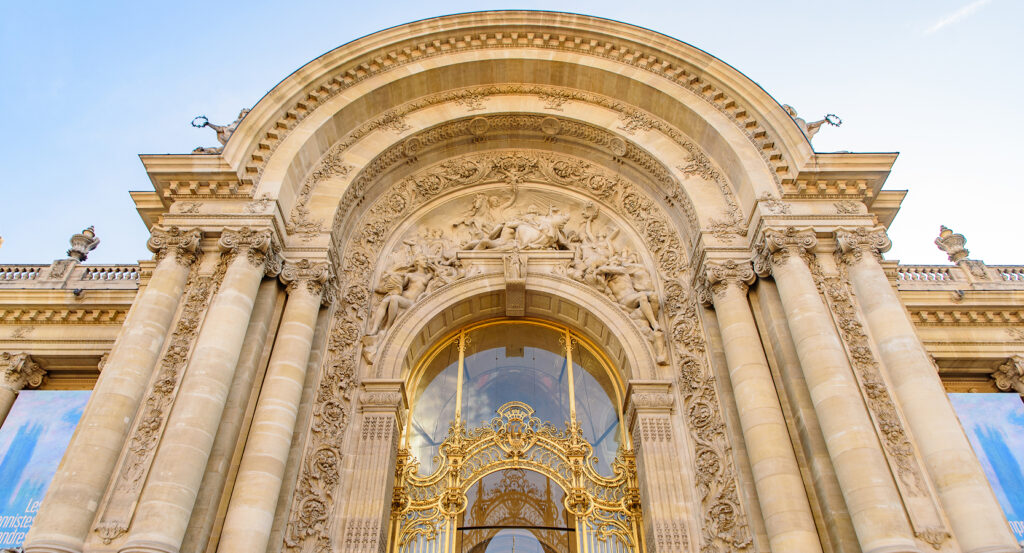
Why The Sculpture Gallery at Petit Palais matters.
The Sculpture Gallery at Petit Palais is a theatrical museum gallery where the Champs-Élysées quarter's Beaux-Arts grandeur meets expansive nineteenth-century statuary, preserved plaster models and Charles Girault's purpose-built architecture for the Exposition Universelle of 1900.
Set within Petit Palais along Avenue Winston Churchill near Avenue des Champs-Élysées and just steps from the Seine, the gallery occupies the building's great northern wing, where a fifteen-meter vault, tall lateral windows, mosaic paving and a long axial floor create an imposing setting for freestanding sculpture. Daylight enters through the high side openings and moves across white plaster figures arranged on substantial pedestals beneath Fernand Cormon's painted history of old Paris. Girault's elongated gallery gives large works enough distance to emerge individually before the architecture draws them back into a continuous procession toward the central rotunda. The surrounding Petit Palais links this interior with an entrance court, curved galleries and a garden peristyle across an ensemble conceived for art from its inception. The result is a grand exhibition chamber where architecture, daylight and expansive scale recover the physical conditions in which Paris presented sculpture at the opening of the twentieth century.
What defines The Sculpture Gallery at Petit Palais.
The Sculpture Gallery at Petit Palais is best known for returning the building's Galerie Nord to the expansive sculpture display Charles Girault conceived for the Exposition Universelle of 1900. Girault won the commission for the Petit Palais within the redevelopment that also produced the Grand Palais and Pont Alexandre III, conceiving his building as a model museum that joined classical references, Art Nouveau decoration and reinforced-concrete construction. The two immense galleries extending from the central rotunda rise fifteen meters and receive daylight through lateral windows, dimensions selected to accommodate large statuary within the exhibition palace. Sculpture occupied the Galerie Nord from the building's opening and remained central there into the early 1930s. Henri Lapauze, who directed the museum until 1925, developed its first major sculpture displays and expanded the holdings with groups associated with Jean Carriès and Jules Dalou. The Dalou studio collection entered municipal ownership in 1905 after the Ville de Paris purchased a large body of work from the sculptor's daughter Georgette, preserving studies connected with an artist whose public commissions included Le Triomphe de la République at Place de la Nation. Curatorial priorities later shifted large sculptures into storage as the gallery accommodated major exhibitions, including the 1935 exhibition of Italian art. Thérèse Burollet began restoring nineteenth-century sculpture to greater prominence in 1989 through the exhibition Quand Paris dansait avec Marianne, devoted to republican commissions created between 1870 and 1914. That recovery culminated in November 2018 when thirty-one sculptures from Petit Palais and the COARC returned the Galerie Nord to its original purpose. The revived gallery reconnects Girault's architecture with a municipal sculptural collection accumulated through Parisian commissions, museum acquisitions and surviving workshop models across more than a century.
The surviving plaster models deepen that history through the system by which nineteenth-century Paris converted sculptors' proposals into bronzes and marbles installed across the capital. Municipal commissions generated full-scale plasters as an intermediate stage in producing permanent public sculpture, and the Ville de Paris began accumulating an exceptional group after 1870. Ernest Barrias's Maria Deraismes, works by Auguste Bartholdi and David d'Angers, François Rolard's Monnaie de Singe and Paul Roussel's La Danse de Bébé now stand within the restored display, placing republican portraiture beside animal subjects and works drawn from popular entertainment. Alexandre Falguière and Jules Dalou extend the gallery into the careers of sculptors deeply connected with the public monuments of Third Republic Paris. Several plaster models also preserve the form of statues whose finished metal versions were melted during the Second World War, giving the collection a physical importance beyond preparatory practice. Fernand Cormon's vast ceiling cycle above them carries the chronology of Paris from the Battle of Lutetia to the French Revolution, connecting municipal sculpture below with a painted civic history overhead. Giandomenico Facchina's workshop supplied the mosaic pavement extending through the galleries, pavilions and central rotunda, completing a decorative scheme in which architecture and permanent art were conceived together. The 2018 installation placed the restored plasters on large pedestals within this original setting, reuniting objects created for Parisian public space with the gallery designed to display their artistic medium at full scale.
How The Sculpture Gallery at Petit Palais fits.
The Sculpture Gallery at Petit Palais works as the anchor for a daytime exploration of the Exposition Universelle precinct using three nearby sites that move from the exhibition palace facing it through the ceremonial bridge created on the same urban axis into nineteenth-century gardens reshaped for successive generations of Parisian performance.
Begin at Grand Palais, conceived with Petit Palais after an 1894 decision to remake the territory between the Champs-Élysées and Seine for the Exposition Universelle. An architectural competition in 1896 failed to produce a single winning solution, leading Henri Deglane, Albert Louvet and Albert Thomas to divide responsibility for the enormous building under Charles Girault's overall coordination. Construction began in 1897 and employed 1,500 workers by 1900, joining a masonry exterior with an immense iron-and-glass nave whose engineering announced the technological ambitions concealed behind its classical facades. President Émile Loubet inaugurated the Exposition Universelle on April 14, 1900, placing the two palaces opposite one another as permanent anchors of a district rebuilt for the fair. Continue to Pont Alexandre III, where the same exposition project crossed the Seine toward Hôtel des Invalides and gave the new palace ensemble its ceremonial southward axis. Tsar Nicholas II laid the first stone on October 7, 1896 beside President Félix Faure, giving the structure a diplomatic purpose tied to the Franco-Russian alliance. A low metal span preserved views toward Hôtel des Invalides, with four tall pylons carrying gilded bronze Pegasus groups and an extensive program of copper and bronze sculpture surrounding the roadway. The bridge joined engineering, international politics and architectural staging within the route created between the exhibition palaces and the Left Bank. Conclude at Jardins des Champs-Élysées, whose development predates the 1900 ensemble and reveals the recreational territory into which the exhibition palaces were inserted. Jacques Hittorff introduced restaurants, fountains and entertainment structures after 1835, followed by Adolphe Alphand's 1859 reorganization and Gabriel Davioud's Panorama National. That rotunda became the Palais des Glaces in 1893 and Théâtre du Rond-Point in 1981, preserving successive uses inside the gardens as other structures disappeared. Construction of the Grand and Petit Palais in 1900 reduced and reorganized portions of the planted ground, fixing the gardens beside the permanent architecture left by the exposition. The progression moves from Deglane, Louvet, Thomas and Girault's immense exhibition palace through the Franco-Russian bridge completing its ceremonial axis into Hittorff, Alphand and Davioud's older landscape of Parisian recreation, placing the Sculpture Gallery within the wider architectural world that generated the Petit Palais.
Where your story begins.
Foresyte Travel reveals places that feel extraordinary long before you arrive.
Enjoy editorial crafted for luxury travelers.
Foresyte may earn a commission when you book.














































































































