Why Petronas Twin Towers matters.
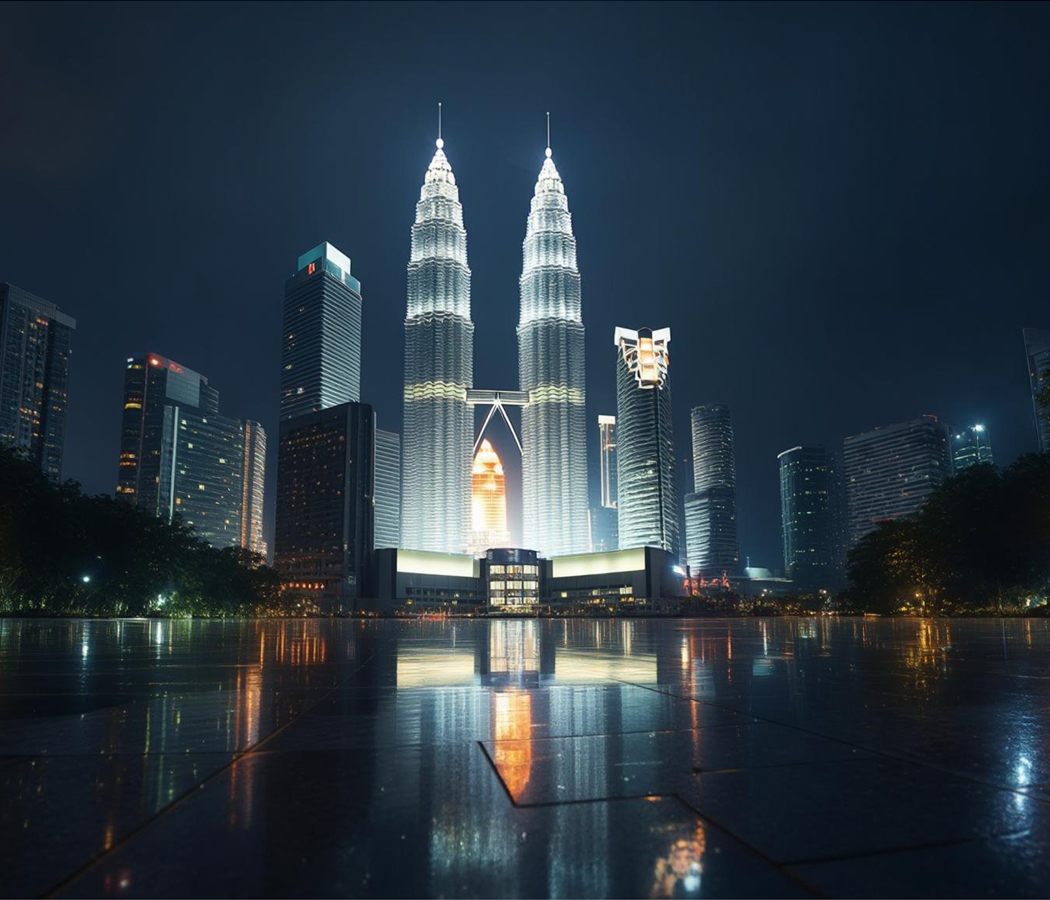
Petronas Twin Towers is a postmodern skyscraper complex where Kuala Lumpur City Centre's commercial development meets Malaysia's industrial modernization, the geometric principles of Islamic architecture and the engineering achievements that reshaped the capital's skyline during the late twentieth century.
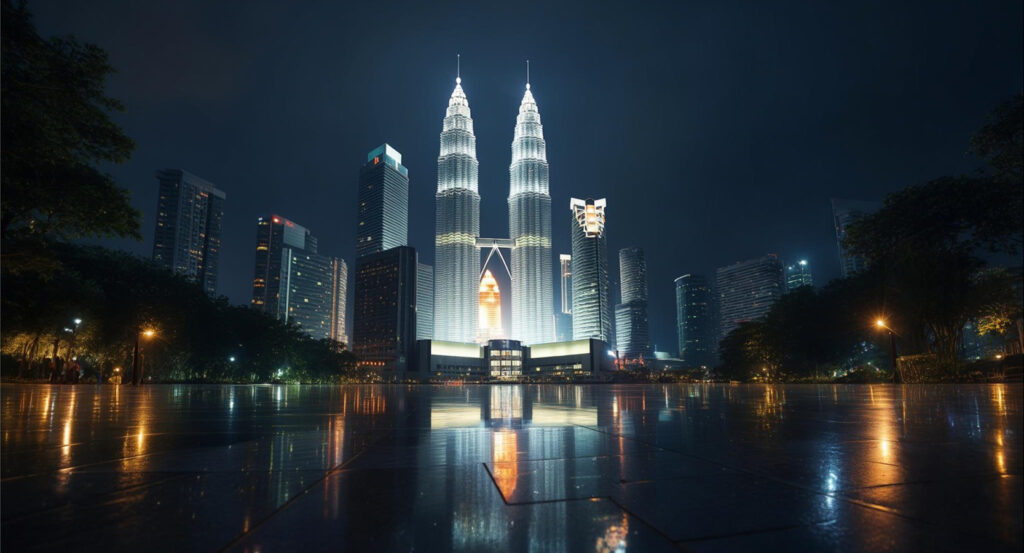
Rising along Jalan Ampang near Jalan P. Ramlee and just steps from the landscaped grounds of KLCC Park, the towers occupy the northern section of Kuala Lumpur City Centre on the former Selangor Turf Club grounds, between the city's commercial avenues and the surrounding high-rise financial district. Two identical towers rise above a shared podium, connected by an elevated skybridge. Stainless steel and glass cladding define the buildings' faceted exterior surfaces. The towers' upper levels terminate in slender pinnacles visible across the metropolitan skyline. The result is an architectural complex whose height, structural engineering and geometric design connect Malaysia's economic development with the international skyscraper construction of the 1990s.
What defines Petronas Twin Towers.
Petronas Twin Towers is best known for its paired 452-meter skyscrapers, elevated skybridge and former status as the tallest buildings in the world. The project originated during Malaysia's rapid economic expansion under Prime Minister Mahathir Mohamad, whose government pursued major infrastructure and architectural projects intended to strengthen Kuala Lumpur's international position. The towers formed the principal development within Kuala Lumpur City Centre, a large urban redevelopment program established on land previously occupied by the Selangor Turf Club. Malaysia's national petroleum corporation, Petroliam Nasional Berhad, commissioned the project as its corporate headquarters. Argentine-American architect César Pelli was selected to design the towers, working with an international team of architects and engineers. Pelli's design incorporated geometric patterns associated with Islamic architectural traditions, establishing an eight-pointed star as the basis of the towers' principal floor plans. Curved additions to the original geometry increased usable interior space while preserving the underlying symmetry. Structural engineering firm Thornton Tomasetti contributed to the development of the buildings' structural systems. Construction began in 1993, with separate construction teams assigned to the two towers to accelerate the building program. The Japanese consortium led by Hazama Corporation constructed Tower One, and the South Korean consortium led by Samsung C&T constructed Tower Two. The project employed high-strength reinforced concrete as its principal structural material, a consequential engineering decision for buildings of such height. Deep foundations and substantial concrete cores supported the towers' vertical loads and lateral stability. The towers were completed in 1998, becoming the tallest buildings in the world and surpassing Chicago's Willis Tower in architectural height. Their completion marked a major achievement in Malaysia's construction industry and established Kuala Lumpur as a center of high-rise architectural development. Taipei 101 surpassed the towers in height in 2004, ending their position as the world's tallest buildings. The complex retains its importance as a major work of late twentieth-century skyscraper architecture and a defining component of Malaysia's capital.
César Pelli's architectural composition organizes the towers through repeated geometric setbacks that gradually reduce their dimensions toward the upper floors. The exterior incorporates stainless steel and glass curtain walls arranged around the faceted perimeter of each building. These surfaces create a vertically articulated façade whose proportions emphasize the towers' height. The skybridge connects the buildings at the 41st and 42nd floors, spanning 58 meters between the two structures. Its engineering accommodates movement between the towers under wind and other structural loads. The bridge is supported by inclined legs extending downward to the buildings, creating a structural connection between the elevated passage and the principal towers. Public visits include access to the skybridge and an observation deck on the 86th floor of Tower Two. The observation deck provides views across Kuala Lumpur's central business district and the surrounding metropolitan landscape. High-speed elevators transport occupants and visitors between the podium and upper floors. The buildings incorporate double-deck elevator systems designed to accommodate substantial vertical passenger movement. Their structural frames use reinforced concrete columns and cores, supporting the steel-and-glass exterior enclosure. The towers' floor plans incorporate eight-pointed geometric arrangements associated with Islamic decorative traditions. Repeated setbacks create a tiered silhouette culminating in the upper pinnacles. The shared podium contains commercial and cultural facilities, including Suria KLCC, a retail complex occupying the lower levels. The complex also contains Petronas Philharmonic Hall, a concert venue designed for orchestral performance. The towers' architectural arrangement combines corporate offices, public observation facilities and cultural functions within a unified skyscraper development.
How Petronas Twin Towers fits.
Petronas Twin Towers works as the architectural centerpiece for a Kuala Lumpur itinerary connecting the city's late twentieth-century commercial development, Islamic cultural institutions and the public landscapes created around its central business district.
Begin at KLCC Park, the landscaped public park situated immediately south of the towers. Designed by Brazilian landscape architect Roberto Burle Marx, the park was developed as part of the Kuala Lumpur City Centre redevelopment program. Its grounds incorporate lawns, walking paths, water features and tropical planting areas arranged around the surrounding high-rise buildings. The park's Lake Symphony contains fountains programmed for illuminated water displays. Its design integrates public recreation with the commercial district, establishing a landscaped setting for the surrounding architectural complex. The park's development formed part of the broader effort to create substantial public spaces within Kuala Lumpur's expanding central business district. Continue to Islamic Arts Museum Malaysia, the cultural institution situated near the National Mosque and the city's historic administrative district. Opened in 1998, the museum maintains collections associated with Islamic artistic production across Asia, the Middle East and other regions. Its galleries contain manuscripts, textiles, ceramics, metalwork, jewelry and architectural models demonstrating the technical and decorative traditions of Islamic societies. The building incorporates domes and ornamental elements associated with Islamic architectural design. Its collections include substantial holdings of Southeast Asian Islamic art, connecting Malaysia's cultural history with wider artistic developments across the Islamic world. Conclude at Merdeka Square, the historic civic space situated near the confluence of the Klang and Gombak rivers. The square occupies the former Selangor Club Padang, a colonial-era playing field surrounded by substantial public buildings. On 31 August 1957, the Union Jack was lowered and the flag of independent Malaya was raised during ceremonies associated with the country's independence. The Sultan Abdul Samad Building stands along the square's eastern edge, incorporating copper domes, arched façades and a clock tower. The square preserves the relationship between Kuala Lumpur's colonial administrative history and the establishment of independent Malaysia. The progression moves from contemporary urban landscaping through Islamic artistic heritage and culminates in the civic setting of Malaysian independence, connecting Petronas Twin Towers with the cultural and political development of Kuala Lumpur.
Where your story begins.
Foresyte Travel reveals places that feel extraordinary long before you arrive.
Enjoy editorial crafted for luxury travelers.
Foresyte may earn a commission when you book.