Why Zürich Town Hall matters.
Zürich Town Hall, or Rathaus, is a living artifact of Swiss civic pride, standing gracefully above the River Limmat where history and democracy flow together.
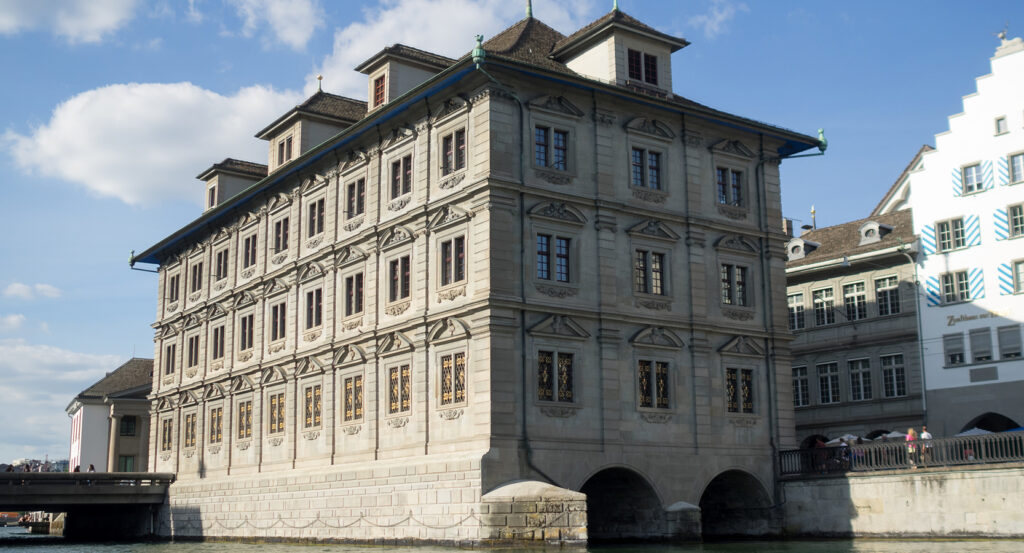
Built between 1694 and 1698, the Rathaus captures the spirit of Zürich's golden age, when commerce, craftsmanship, and governance were inseparable threads in the city's identity. Its elegant Renaissance façade rises directly over the water, its arches anchored into the river itself, a metaphor for a government rooted in both tradition and motion. From the outside, the building's proportions are simple yet noble: stone walls in soft grey tones, decorated with heraldic crests and finely carved reliefs that seem to speak of centuries of order and balance. Inside, the building transforms into something far more intimate, a place where art, politics, and community have coexisted for over 300 years. Wooden beams, coffered ceilings, and frescoed chambers create an atmosphere that feels less like a seat of power and more like a conversation with the past. Standing in the grand council chamber, where citizens once gathered to debate laws that shaped the republic, you can almost feel the echo of those early democratic voices, measured, deliberate, and fiercely proud. The Rathaus isn't just an emblem of Zürich's government; it's a monument to the idea of civic responsibility, reminding every visitor that freedom here is something built, brick by brick, vote by vote, over centuries of thoughtful self-rule.
What defines Zürich Town Hall.
Beyond its historic charm, Zürich's Rathaus holds a deeper significance, one that reveals the city's complex blend of independence, artistry, and identity.
Unlike many European city halls built on grand plazas, Zürich's Rathaus was deliberately constructed over the river, symbolizing both openness and stability. This architectural decision wasn't just aesthetic; it reflected Zürich's confidence as a self-governing city-state within the Old Swiss Confederacy. During the 17th and 18th centuries, the building served as the meeting place for both the cantonal and city governments, and its walls witnessed countless debates that defined Swiss neutrality and the balance of cantonal power. The structure's Renaissance style is also deeply Swiss in execution, balanced, modest, and rooted in craftsmanship. Step inside, and the atmosphere shifts from civic formality to artistic intimacy. The main council chamber, with its massive oak beams and painted allegories of justice and virtue, feels more like a cathedral of reason than a government hall. Every corner seems to whisper about Zürich's dual nature, pragmatic yet philosophical, reserved yet quietly proud. Hidden within the building are archives containing centuries-old records, from guild decrees to trade agreements that helped Zürich flourish as a financial and cultural capital. Even the art adorning its walls carries meaning: portraits of magistrates and coats of arms serve not as decoration, but as reminders of the collective will that has guided the city since the Middle Ages. Over time, the Rathaus has become more than a meeting hall, it's a museum of citizenship, a place where Zürich's democratic experiment continues to evolve in harmony with its heritage. And in typical Swiss fashion, it does so without performance, embodying the understated excellence that defines the nation itself.
How Zürich Town Hall fits.
A visit to Zürich Town Hall is as much a walk through the city's civic soul as it is a tour of its architectural elegance.
Start from the cobblestone lanes of the Altstadt (Old Town), where the Rathaus reveals itself like a jewel set in the heart of medieval Zürich. Approaching from Münsterbrücke, you'll see how the building seems to hover gracefully above the Limmat, a view best appreciated from the opposite riverbank, where the water mirrors its Renaissance symmetry. Step inside during the Rathaus's public hours to explore the richly adorned council chamber, whose carved woodwork and ceiling frescoes have been meticulously preserved. Guides often recount the building's role in the early Reformation, when Zürich, under the leadership of Huldrych Zwingli, became one of Europe's first Protestant centers. The Rathaus was where theological debates once intertwined with the governance of daily life, shaping both the city's moral compass and its political independence. After the visit, wander through the surrounding Old Town, its narrow alleys filled with antique shops, cafés, and hidden courtyards that still pulse with Zürich's old-world rhythm. Pause for a coffee at a riverside café along Limmatquai, where the Rathaus gleams softly in the afternoon light, or cross the bridge to Grossmünster for a panoramic view of the city it helped shape. For an even deeper appreciation, visit at dusk, when the building's stone façade takes on a warm, golden hue under the streetlights and the river glows with reflected light, a moment that feels timeless, as if the centuries have folded into one. Zürich Town Hall is more than a relic of the past, it's a living symbol of civic dignity, a reminder that governance, when done with wisdom and restraint, can itself be a form of art. To stand before it is to understand Zürich not just as a city of bankers and scholars, but as a community built on centuries of trust, craftsmanship, and balance, the quiet architecture of democracy itself.
Where your story begins.
Foresyte Travel reveals places that feel extraordinary long before you arrive.
Enjoy editorial crafted for luxury travelers.
Foresyte may earn a commission when you book.