Why you should experience The Gates of Hell at Rodin Museum in Philadelphia, Pennsylvania.
Standing like a portal between the mortal and the divine, The Gates of Hell at the Rodin Museum in Philadelphia is among the most haunting and extraordinary works of art in existence.
Towering over the museum's courtyard, this bronze masterpiece by Auguste Rodin captures an entire universe of passion, torment, and redemption in motion. Inspired by Dante Alighieri's Divine Comedy, the massive double doors teem with over 200 figures, each twisting, reaching, or falling in eternal struggle. At first glance, the composition feels chaotic; but as you draw closer, order reveals itself. Familiar forms emerge: The Thinker, presiding over the threshold as a symbol of human contemplation; The Three Shades, poised at the top, pointing downward toward damnation; lovers from The Kiss entwined amid the flames of desire. Every inch is alive with movement, light, and shadow, as though the bronze itself were breathing. To stand before The Gates of Hell is to feel time and silence expand, a confrontation with art at its most elemental. It's not just a sculpture; it's a vision of the human soul rendered in metal.
What you should know about The Gates of Hell at Rodin Museum.
The Gates of Hell was Rodin's lifelong obsession, a commission that began in 1880 for a proposed museum in Paris and consumed him for the next 37 years.
Although the original marble structure was never built, Rodin continued to refine his vision, reworking figures, altering forms, and casting new details until his death in 1917. The Philadelphia cast, completed under the authority of the Musée Rodin, is among the few full-scale bronze editions in the world, standing nearly 20 feet tall and weighing over six tons. What many visitors don't realize is that this portal served as the creative laboratory for Rodin's most famous individual sculptures, The Thinker, The Kiss, The Falling Man, and The Three Shades all began as studies for this work before evolving into independent icons. The figures were modeled in clay and wax, then cast in bronze using the lost-wax method, allowing for astonishingly fine detail. Rodin's surface textures, rough, molten, almost volcanic, were intentional, reflecting his belief that beauty resided in imperfection. Each ripple of bronze suggests both movement and decay, light and darkness intertwined. Thematically, the work transcends Dante's narrative to become something universal: a meditation on creation, judgment, and the human condition. The portal itself was never meant to open; it is metaphor, not mechanism, a vision of humanity caught forever at the threshold between salvation and despair.
How to fold The Gates of Hell at Rodin Museum into your trip.
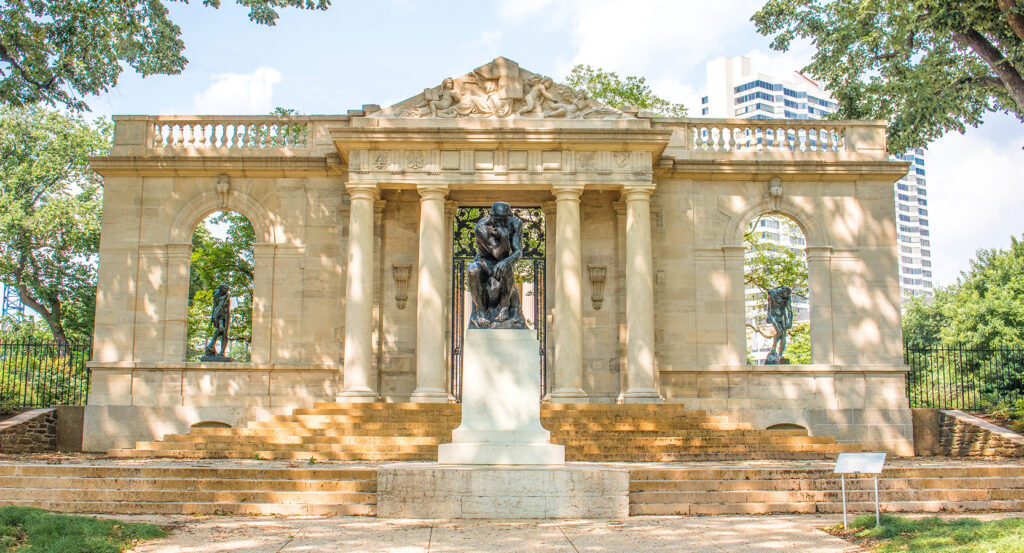
When visiting the Rodin Museum, make The Gates of Hell your first and most deliberate stop, it's not merely an entrance, but the resonant axis of the entire site.
Approach slowly along the garden path from the Benjamin Franklin Parkway, letting the sculpture reveal itself through the framing of trees and fountains. From a distance, you'll see the grand silhouette; up close, the detail becomes overwhelming. Spend time observing the blend of light and shadow across the relief, morning light brings out the soft gold of the bronze, while afternoon sun casts long, dramatic shadows that intensify the figures' anguish. Notice The Thinker perched above the doors, smaller than the freestanding version outside, his gaze turned downward in contemplation of the chaos below. Step closer to the panels and you'll find new discoveries with every glance, the lovers of Francesca da Rimini, the weeping sinners, the angelic forms twisted into motion. Take a full circle around the courtyard; the work changes depending on where you stand and the time of day. For the best experience, visit during quieter hours, early morning or late afternoon, when the museum grounds are hushed, and the wind rustles softly through the surrounding ivy. End your visit by moving into the museum's interior galleries, where Rodin's smaller studies and plasters reveal how The Gates of Hell evolved from chaos into coherence. The Gates of Hell isn't just a work to be viewed, it's an experience to be absorbed, a masterpiece that stands as both monument and mirror to the restless depths of the human spirit.
Where your story begins.
Foresyte Travel reveals places that feel extraordinary long before you arrive.
Experience premium editorial crafted for luxury travelers.