Why Schmalznudel matters.
Schmalznudel is a traditional Bavarian pastry café where Altstadt's historic market culture meets the Frischhut family's confectionery craftsmanship, Munich's enduring tradition of freshly fried yeast pastries and the distinctive social customs of the Bavarian capital's early-morning hospitality.
Standing on the southern edge of Viktualienmarkt, directly opposite Schrannenhalle and near the junction of Prälat-Zistl-Straße and Westenriederstraße, the café occupies a compact Old Town storefront between the market's food stalls, the commercial buildings of Frauenstraße and the pedestrian routes approaching Isartor. Its street-facing windows reveal the preparation of fresh pastries, establishing a direct visual connection between the working bakery and the surrounding pedestrian environment. The compact interior incorporates traditional wooden tables, simple chairs and a service counter arranged around the preparation and sale of freshly baked goods. Landscape paintings and scenes of Bavarian rural life decorate the walls, contributing a personal artistic character to the established café interior. Outdoor tables extend the seating onto the adjoining pedestrian space, connecting the small establishment to the surrounding market district. The result is an intimate Munich café whose visible baking operation, traditional furnishings and immediate relationship to the historic food market preserve the character of a family-operated Bavarian pastry shop.
What defines Schmalznudel.
Schmalznudel is best known for preserving the traditional Bavarian Auszogne through the work of the Frischhut family, whose specialized pastry café has become an established institution within Munich's historic food culture. The establishment's commercial origins predate the family's ownership, with a bakery operating at the location during the early twentieth century. The business developed within a neighborhood whose economic character depended heavily on the commercial activities of food merchants, agricultural traders and the substantial population employed in Central Munich's hospitality industry. Manfred Frischhut acquired the establishment from its previous proprietor, Unsinn, in 1973, initiating a new period of family ownership centered on the production of traditional Bavarian yeast pastries. His approach emphasized a deliberately restricted selection of baked goods, allowing the family to concentrate its production on the technical requirements of a small number of established regional specialties. The business subsequently became widely recognized by the name of its principal product, establishing Schmalznudel as the customary designation for the café itself. Manfred's wife, Ursula Frischhut, contributed substantially to the establishment's decorative character through paintings inspired by Bavarian landscapes and scenes of the surrounding city. Her work developed during the years when their son Andreas attended school in Munich, providing a creative undertaking alongside the responsibilities of the family business. The paintings acquired a following among regular customers, and selected works eventually entered private collections beyond Germany. Andreas Frischhut began helping in the café at the age of fifteen, developing practical knowledge of dough preparation, frying techniques and the daily demands of a specialized pastry operation. He subsequently joined his father in managing the establishment, establishing a second generation of professional continuity within the family. The café developed a particularly distinctive social character through its early opening hours, which once began at five in the morning. Its clientele included market traders preparing their stalls, taxi drivers completing overnight shifts, window cleaners beginning work and customers arriving after evenings spent in Munich's entertainment establishments. These overlapping groups created an unusual commercial environment in which the rhythms of food distribution, night work and urban recreation converged around a shared breakfast tradition. The family subsequently adjusted its opening schedule as the surrounding city changed, particularly following the relocation of substantial nightlife activity toward the eastern entertainment districts. By 2011, the establishment's morning service had shifted to a seven o'clock opening, reflecting the later working patterns of market merchants and the changing composition of its clientele. The transition preserved the business's established relationship with the surrounding commercial district through a more concentrated daytime service. Andreas also developed a detailed understanding of the sensitivity of yeast dough to environmental conditions, particularly changes in atmospheric humidity preceding thunderstorms. His professional experience emphasized the importance of judging fermentation and dough elasticity through direct observation, establishing the practical knowledge required for consistent production. The family's continued specialization strengthened the café's reputation beyond Munich, with international guidebooks and personal recommendations introducing the establishment to a broader audience. Its significance rests on the preservation of a highly specific regional pastry tradition through successive generations of family ownership, supported by the technical discipline and social continuity of a working Munich bakery.
Andreas Frischhut's approach to pastry production centers on the Bavarian Auszogne, a traditional yeast preparation whose distinctive shape and texture depend on careful fermentation, manual stretching and precise frying. The dough develops through the combination of flour, yeast, milk and other conventional baking ingredients, producing an elastic structure capable of expanding during fermentation. Its preparation requires sufficient resting time for the yeast to generate gas within the dough, creating the internal structure responsible for the finished pastry's lightness. Individual portions are shaped by hand, with the dough stretched outward from the center to create a broad circular form. The middle becomes exceptionally thin, and the surrounding edge retains a thicker ring of fermented dough. This deliberate variation in thickness determines the pastry's character during frying, allowing the central portion to develop a crisp, delicate surface as the outer ring expands into a softer, aerated structure. The pastry enters hot frying fat and develops its characteristic golden color through the interaction between heat, moisture evaporation and the browning of its surface. Careful temperature control allows the dough to cook thoroughly, preserving the contrast between the thin center and the substantial outer edge. The finished Schmalznudel is served warm, with a light coating of sugar emphasizing the sweetness of the dough and the toasted character of the fried exterior. Its shape distinguishes it from conventional filled doughnuts, connecting the preparation to the regional baking traditions of Bavaria and Austria. The café's limited selection also incorporates Rohrnudeln, soft yeast buns whose preparation follows a separate baking tradition associated with southern German household cooking. These substantial pastries develop a tender interior and lightly browned exterior, with fruit fillings contributing sweetness and acidity. Plum-filled variations draw on the agricultural traditions of Central Europe, where preserved and freshly harvested stone fruits occupy an important position in seasonal baking. Striezel introduces another preparation through braided yeast dough, whose elongated form develops through the interlacing of individual strands before baking. The resulting pastry combines a soft crumb with a delicately browned crust, demonstrating the versatility of enriched yeast dough across different Bavarian specialties. Krapfen contribute a further expression of regional confectionery through their rounded shape and traditional association with Fasching, the festive period preceding Lent. Their production incorporates a carefully fermented dough that expands during frying, developing a soft interior suitable for sweet fillings. The café's concentrated pastry selection establishes a coherent relationship between these preparations through their shared foundations in yeast fermentation and traditional German baking techniques. Fresh production remains central to the establishment's character, with individual batches prepared throughout the working day and served shortly after cooking. The visible preparation area connects the technical work of shaping and frying to the service of individual pastries, making the production process an integral part of the café's daily operation. Coffee accompanies the baked goods in traditional cups decorated with old German lettering, preserving a visual connection to the establishment's established hospitality customs. The combination of warm pastries and freshly prepared coffee reflects a longstanding Bavarian breakfast tradition built around simple preparations, substantial craftsmanship and informal communal dining. The café's enduring distinction derives from its concentration on a small family of regional pastries, the technical knowledge required for their consistent preparation and the preservation of traditional baking within Munich's historic commercial center.
How Schmalznudel fits.
Schmalznudel works as the starting point for an exploration connecting Munich's theatrical Baroque architecture, its oldest parish church and the Gothic cathedral that established the Bavarian capital's most recognizable historic skyline.
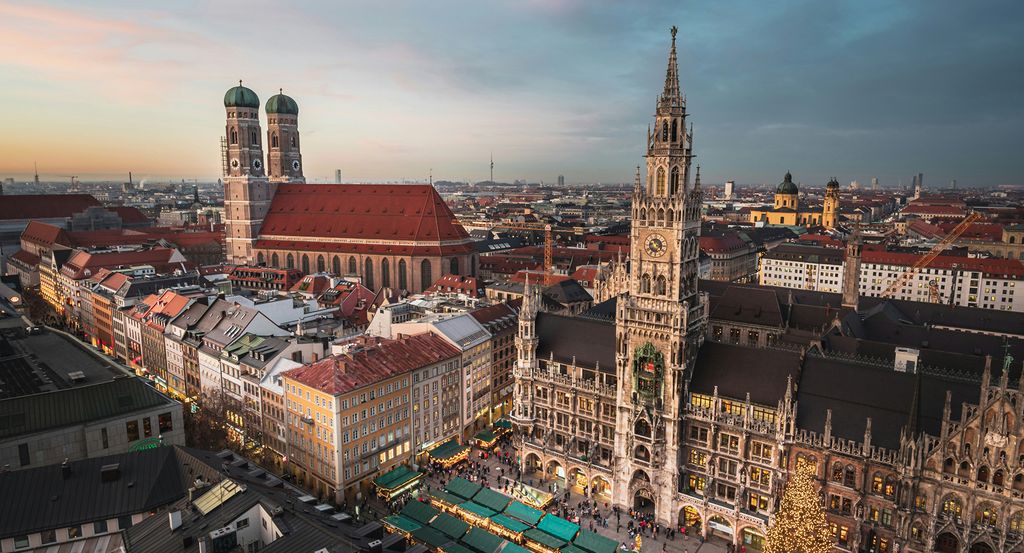
Begin at Asamkirche, the elaborate Catholic church constructed between 1733 and 1746 by brothers Cosmas Damian Asam and Egid Quirin Asam on Sendlinger Straße. Egid Quirin acquired several adjoining properties between 1729 and 1733, developing a private religious complex that incorporated his residence, workshop and a chapel dedicated to St. John of Nepomuk. The church occupies a narrow site measuring 22 by 8 meters, with its interior organized into three symbolic levels representing earthly suffering, imperial authority and the celestial realm. Cosmas Damian contributed the elaborate ceiling frescoes, and Egid Quirin developed the sculptural decoration, stucco ornament and architectural composition. Public pressure secured access to the originally private chapel, establishing its lasting function within Munich's religious community. Continue to St. Peter's Church, the historic parish church whose origins reach back to the earliest development of medieval Munich. Its first Romanesque building emerged during the twelfth century, establishing a principal religious institution near the commercial settlement that developed under the Wittelsbach dynasty. The church underwent substantial Gothic reconstruction following the destruction caused by the city fire of 1327, with successive architectural campaigns introducing additional chapels, vaulted interiors and an enlarged choir. Its 91-meter tower, popularly called Alter Peter, developed into a prominent observation point above the surrounding historic streets. The high altar incorporates a substantial figure of St. Peter created by Erasmus Grasser, connecting the church's religious furnishings to the artistic achievements of late medieval Bavaria. Conclude at Frauenkirche, the substantial Late Gothic cathedral whose construction began on February 9, 1468, under the direction of master builder Jörg von Halspach. Duke Sigismund laid the foundation stone, establishing an ambitious rebuilding project that replaced the earlier Romanesque church with an expansive brick structure. The principal building reached completion in 1488, and its consecration followed in 1494, creating a major religious institution associated with the Wittelsbach dynasty. The cathedral's twin towers acquired their distinctive copper-covered domes in 1525, establishing an architectural silhouette that became inseparable from Munich's historic skyline. Its interior incorporates substantial octagonal columns, ribbed vaulting and an extensive ambulatory, preserving the spatial character of southern German Late Gothic architecture. The progression moves from Asamkirche's intimate Baroque composition through St. Peter's Church's medieval parish heritage and culminates in Frauenkirche's expansive Gothic architecture, connecting three successive chapters in the religious and architectural development of Central Munich.
Where your story begins.
Foresyte Travel reveals places that feel extraordinary long before you arrive.
Enjoy editorial crafted for luxury travelers.
Foresyte may earn a commission when you book.