Why St. Michael's Church matters.
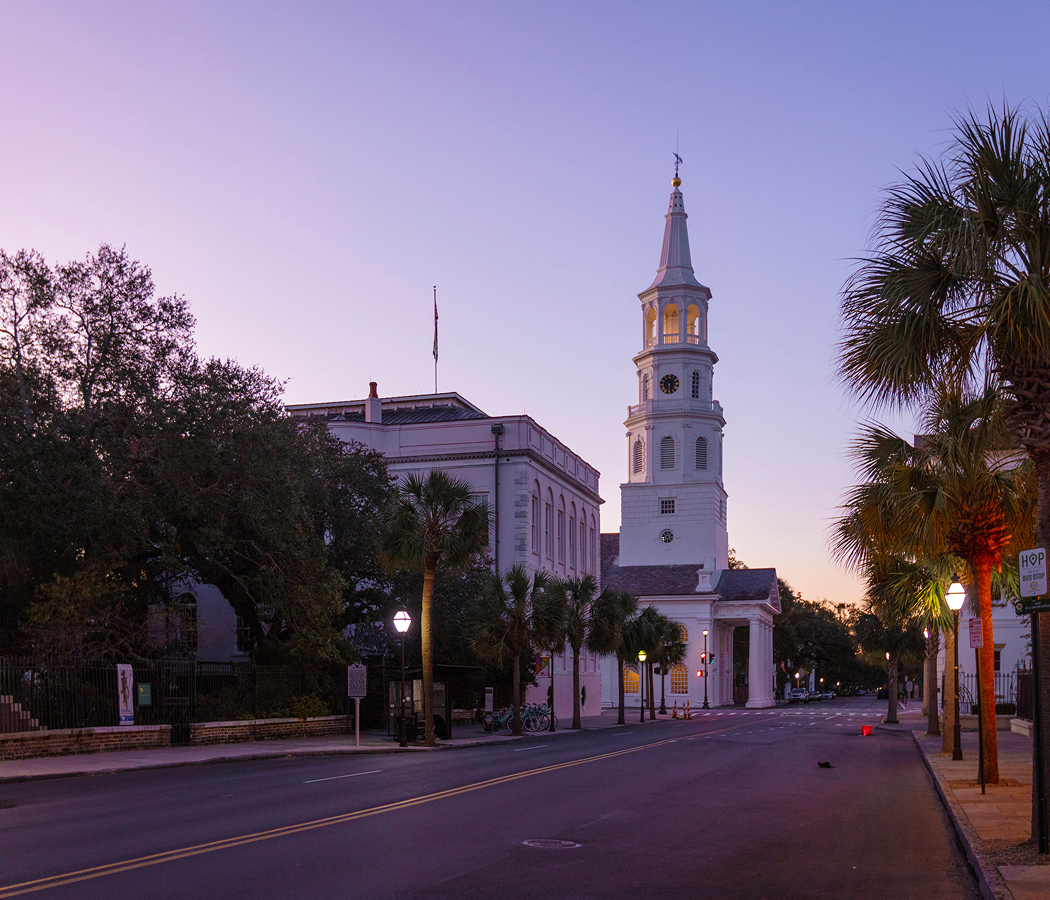
St. Michael's Church in Charleston is the city's oldest and most enduring house of worship, a gleaming white sentinel of faith, history, and architectural grace that has stood watch over the Holy City for more than 250 years.
Rising at the intersection of Meeting and Broad Streets, where Charleston's “Four Corners of Law” meet, church, state, federal, and municipal, St. Michael's feels less like a building and more like a cornerstone of American identity. Its towering steeple, piercing 186 feet into the sky, has guided sailors, soldiers, and citizens alike since before the Revolution. Completed in 1761, the church exemplifies the restrained elegance of colonial Georgian design: balanced, symmetrical, and dignified. The gleaming white façade, punctuated by tall arched windows and crowned with a graceful spire, reflects sunlight like a maritime beacon against Charleston's pastel skyline. Inside, time seems to stand still. The mahogany pews, still numbered from their original box assignments, face a pulpit carved in the mid-18th century, among the oldest of its kind still in use in the United States. Every creak of the floorboards, every soft echo of footsteps through the nave, whispers of centuries past. To stand beneath its vaulted ceiling is to feel the weight and wonder of Charleston's spiritual and civic journey, a city that has endured wars, fires, and hurricanes, yet continues to rise with grace and faith intact.
What defines St. Michael's Church.
The story of St. Michael's Church mirrors the story of Charleston itself, among endurance, reinvention, and quiet majesty.
Built on the foundations of the city's first Anglican church, St. Philip's, St. Michael's became the centerpiece of religious life in the colonial South. Its bells, imported from London in 1764, are among the oldest working bells in America. Their peal, once heard across the harbor, marked everything from royal visits to the outbreak of war. During the American Revolution, British troops occupied the church and used its tower as a lookout, yet miraculously spared it from destruction. In the Civil War, Union artillery targeted Charleston relentlessly, shattering parts of the steeple and damaging the roof, but the church survived once again. The same bells were later melted and recast in England after being cracked by shellfire, a transatlantic restoration that symbolizes Charleston's ability to rebuild with reverence for the past. The graveyard surrounding the church is among the city's most historic, its weathered stones marking the resting places of prominent patriots, including two signers of the U.S. Constitution - Charles Cotesworth Pinckney and John Rutledge. Beneath the surface beauty lies an intricate story of Charleston's evolving faith. While St. Michael's began as an Anglican congregation, it later joined the Episcopal Church after the Revolution, and today remains an active parish in the Anglican Diocese of South Carolina. The structure's survival owes as much to stewardship as to providence, generations of Charlestonians have safeguarded it against time and turmoil. The church's organ, first installed in 1768 and later expanded, continues to fill the sanctuary with resonant hymns that echo across centuries. Every detail, from the Palladian window above the altar to the iron gates enclosing the churchyard, tells of a community that has held fast to its faith through every trial.
How St. Michael's Church fits.
Visiting St. Michael's Church offers a chance to experience Charleston not as a backdrop, but as a living narrative, one where faith and history meet beneath a single steeple.
Located at the heart of the historic district, the church anchors one of the most photographed intersections in the South. Start the visit by approaching from Meeting Street, where the full profile of the spire reveals itself above the tree line. Step through the iron gates into the churchyard, a quiet oasis framed by ancient oaks and weatherworn tombstones. Pause at the graves of Revolutionary patriots and Civil War veterans, each etched with the language of another era. Inside the sanctuary, sunlight filters through tall clear windows, bathing the pews and pulpit in a golden glow. Take time to admire the craftsmanship, the hand-carved details, the unpainted mahogany, the intricate plasterwork along the ceiling cornices. Visitors are often struck by the simplicity of the space, which feels deeply human despite its grandeur. For a deeper connection, attend a Sunday service, where the choir and organ create an atmosphere that bridges centuries, the same hymns once sung by Charleston's earliest congregants still resonate through the air. After the visit, linger outside to take in the view of Charleston's famed skyline, the white steeple of St. Michael's rising proudly beside St. Philip's and the City Hall dome across the square. Together, they form a tableau that defines the city's spiritual and civic soul. For those tracing the story of Charleston's resilience, St. Michael's is essential, a place where beauty, belief, and history converge. As the bells toll across the old streets, their sound carries not just through the city, but through time itself, a melody of endurance, faith, and grace that still rings true today.
Where your story begins.
Foresyte Travel reveals places that feel extraordinary long before you arrive.
Enjoy editorial crafted for luxury travelers.
Foresyte may earn a commission when you book.