Why The Ritz-Carlton matters.
The Ritz-Carlton is a luxury hotel where Uptown Charlotte's banking heritage meets environmentally responsible high-rise architecture, contemporary Southern hospitality, and a consequential chapter in the Ritz-Carlton brand's development.
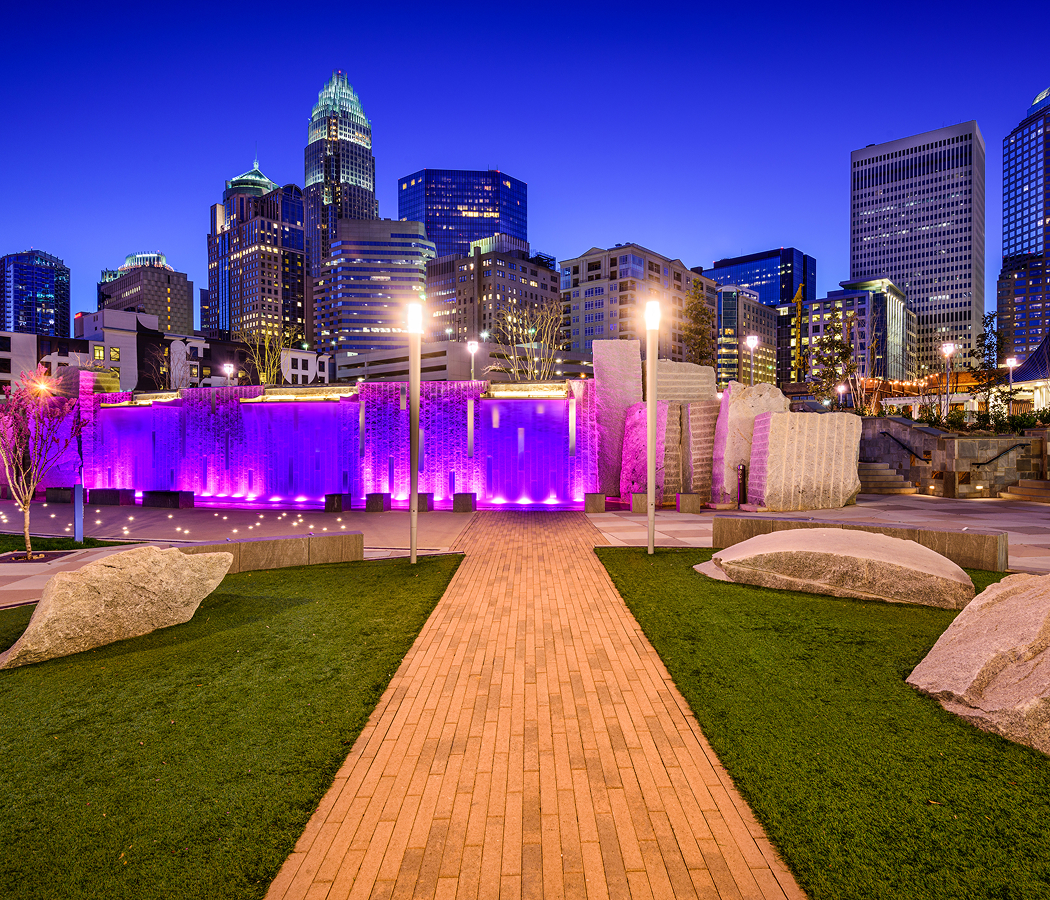
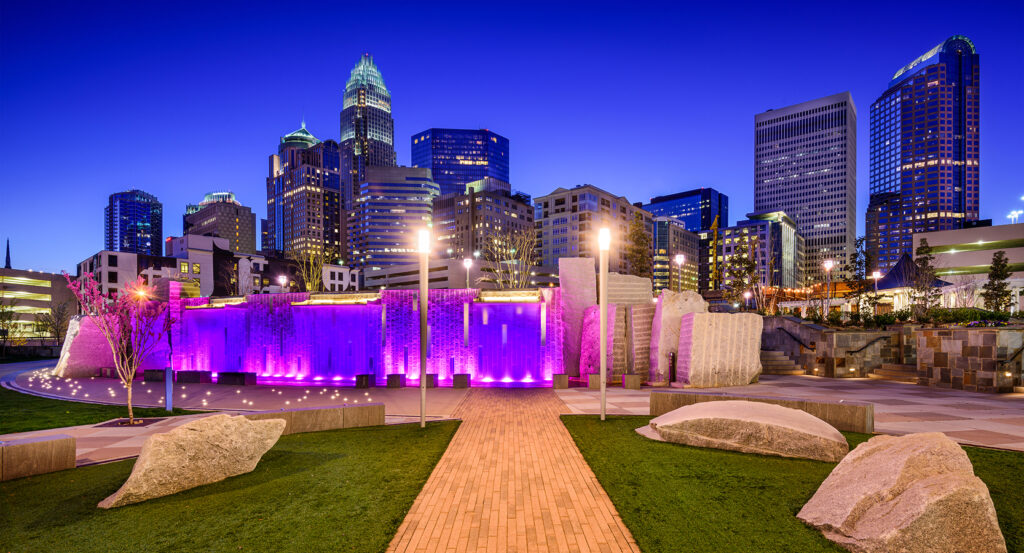
Standing near the intersection of East Trade Street and North College Street, the hotel occupies the commercial center of Charlotte, surrounded by banking headquarters, office towers, restaurants, and the pedestrian corridors extending toward the city's civic institutions. Its 18-story structure combines a glass-and-stone exterior with contemporary architectural proportions, forming a distinct component of the surrounding corporate development. The entrance leads into a polished lobby with substantial glazing, refined furnishings, and an arrangement of gathering spaces that connects the hotel's reception areas with its street-level hospitality facilities. An upper-floor wellness environment provides a second encounter with the building through a naturally illuminated indoor swimming pool and expansive views across the surrounding skyline. The result is a metropolitan hotel whose architectural composition, elevated leisure spaces, and central position establish a distinctive relationship between international luxury hospitality and Charlotte's financial district.
What defines The Ritz-Carlton.
The Ritz-Carlton is best known for becoming the first Ritz-Carlton hotel constructed to achieve LEED Gold certification, introducing a comprehensive environmental program into the brand's luxury hospitality operations during Charlotte's emergence as a major American financial center. Bank of America announced the development in July 2005 as part of an expansion of its headquarters complex, extending the institution's substantial investment in Uptown commercial real estate. The bank retained ownership of the hotel and appointed Ritz-Carlton to manage the property, creating a direct relationship between corporate accommodation requirements and an international hospitality operator. The development proceeded alongside a separate office tower, strengthening the concentration of commercial activity surrounding the company's headquarters. Smallwood, Reynolds, Stewart, Stewart & Associates designed the hotel, with construction undertaken by Balfour Beatty Construction and RT Dooley. The project advanced during the financial disruption of 2008 and 2009, when Bank of America faced substantial scrutiny following its acquisition of Merrill Lynch and participation in federal financial stabilization programs. Its original proposed name, The Ritz-Carlton at Bank of America Corporate Center, was shortened before opening, establishing the hotel under the brand's conventional city-based naming system. The property opened on October 1, 2009, introducing the first purpose-built Ritz-Carlton hotel in the Charlotte metropolitan area. Its environmental program represented a substantial departure from conventional luxury hotel construction, emphasizing energy conservation, reduced water consumption, and improved indoor air quality. The building incorporated a vegetated roof intended to moderate surface temperatures and slow stormwater runoff, supported by an irrigation system using captured rainwater. An internal water purification and bottling operation reduced dependence on disposable plastic containers, with the original program designed to eliminate tens of thousands of bottles annually. Energy-efficient lighting, water-saving plumbing fixtures, and an enhanced outdoor-air circulation system extended the environmental strategy into the building's daily operation. The project also introduced bicycle transportation facilities and preferential accommodation for hybrid vehicles, broadening its environmental approach beyond the building itself. In April 2010, the United States Green Building Council awarded the hotel LEED Gold certification in the New Construction category. The recognition was presented to general manager David Rothwell by council president Rick Fedrizzi, marking the first LEED certification achieved by a Ritz-Carlton hotel or resort. Its construction established an important precedent for incorporating measurable environmental performance into luxury hospitality during a period when sustainability standards were gaining prominence across American commercial development.
Frank Nicholson Inc. developed the original interior design, bringing contemporary furnishings and carefully selected finishes into a building whose environmental requirements shaped its construction and operation. The decorative program incorporated recycled leather, sustainably sourced timber, and other products selected to complement the property's conservation objectives. This relationship between environmental design and hospitality extended into the culinary operation, where the hotel developed a distinctive approach to local agricultural production. Its rooftop garden became a working source of herbs, vegetables, and edible flowers for the property's kitchens and cocktail program. Two beehives supported a substantial colony of honeybees, producing honey used in desserts, beverages, and spa preparations. The program expanded in 2015 through additional rooftop planting areas and a lobby farmers market, bringing the building's agricultural production into direct contact with its hospitality operations. The same year marked an important development in the hotel's cocktail culture through the opening of The Punch Room. Mixologist Bob Peters directed the intimate bar, drawing on historical punch traditions and contemporary techniques to create drinks incorporating fresh botanical ingredients. Its upper-floor position and restrained interior established a separate evening setting within the property, distinguishing the cocktail program from the original lobby-centered hospitality arrangements. Charlotte Magazine subsequently recognized The Punch Room through several annual awards, including Best Hotel Bar in 2015 and Best Place for an Inventive Cocktail in 2016. The culinary program entered another chapter in January 2024 with the opening of The Fifth Fork, which replaced the original BLT Steak restaurant. Its Southern-influenced cooking drew on North Carolina agricultural traditions, extending the property's established relationship with regional producers. These successive developments connected the hotel's original environmental investment with an evolving culinary program grounded in rooftop cultivation, specialist cocktail preparation, and the agricultural character of the Carolinas.
How The Ritz-Carlton fits.
The Ritz-Carlton works as the starting point for a walk southwest along Tryon Street, tracing the development of Charlotte's modern art collections, African American cultural preservation, and the transformation of its oldest art museum into a major metropolitan institution.
Begin at the Bechtler Museum of Modern Art, reached by following Trade Street west to Tryon Street and continuing south toward the Levine Center for the Arts. Swiss collectors Hans and Bessie Bechtler began assembling modern artworks during the 1950s, developing relationships with artists whose work shaped European and American modernism. Their son Andreas Bechtler subsequently settled in Charlotte and donated his family's portion of the collection to establish a public museum. Swiss architect Mario Botta designed the building, organizing its galleries around a distinctive elevated exhibition volume supported above the entrance plaza. The museum opened on January 2, 2010, bringing works by artists including Alberto Giacometti, Alexander Calder, Barbara Hepworth, and Jean Tinguely into a permanent Charlotte institution. Continue south along Tryon Street to the Harvey B. Gantt Center for African-American Arts + Culture, whose origins reach the Afro-American Cultural and Service Center founded in 1974 by University of North Carolina at Charlotte professors Mary Harper and Bertha Maxwell-Roddey. Their institution emerged during the aftermath of urban renewal programs that demolished substantial portions of Brooklyn, Charlotte's historically Black neighborhood in Second Ward. Architect Philip Freelon designed the center's permanent building with architectural references to the former Myers Street School, incorporating an exterior stair arrangement inspired by the demolished institution. The building opened on October 24, 2009, bringing the center's educational and exhibition programs into a dedicated cultural facility. Its John and Vivian Hewitt Collection includes works by Romare Bearden, Elizabeth Catlett, and other important African American artists. Conclude by returning north along Tryon Street to Mint Museum Uptown, where Charlotte's oldest art institution completed a substantial expansion of its exhibition program. The museum originated in 1936 within the former Charlotte Mint, a federal coinage facility established during North Carolina's nineteenth-century gold-mining industry. Its development eventually incorporated the Mint Museum of Craft + Design, creating a substantial collection devoted to ceramics, glass, textiles, and contemporary decorative arts. Machado and Silvetti Associates designed the new Uptown building, whose multilevel galleries and central atrium accommodated the consolidation of fine art and craft collections. The facility opened on October 1, 2010, completing a major cultural investment supported by Charlotte's public institutions and private philanthropists. The progression moves from the Bechtler family's international modern art collection through the Gantt Center's preservation of African American cultural history and culminates in the Mint Museum's expansion from a historic federal building into a major institution for fine art and contemporary craft.
Where your story begins.
Foresyte Travel reveals places that feel extraordinary long before you arrive.
Enjoy editorial crafted for luxury travelers.
Foresyte may earn a commission when you book.