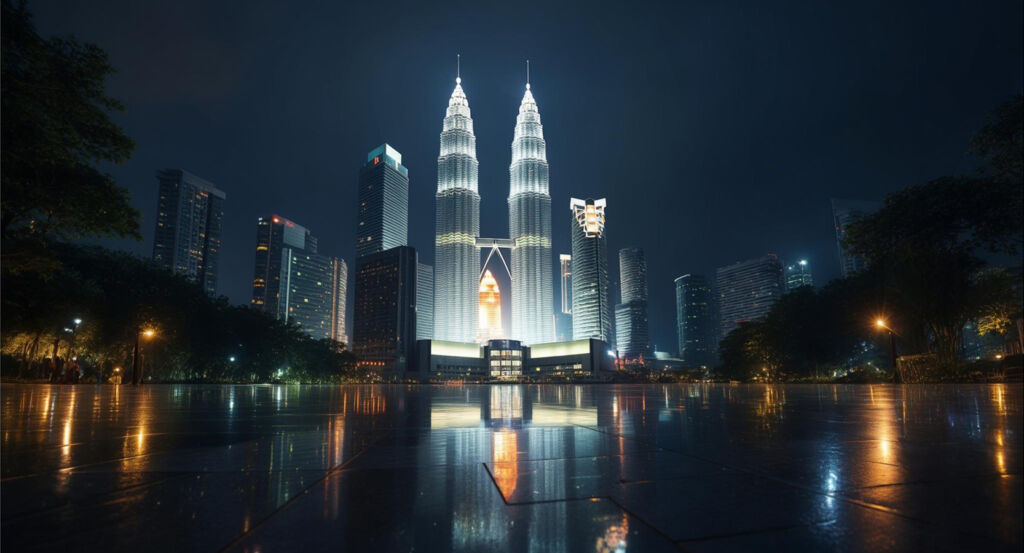
Why The Ritz-Carlton matters.
The Ritz-Carlton is a landmark hotel where Malaysia's modern luxury economy meets the culinary traditions, artistic craftsmanship and cosmopolitan energy of Bukit Bintang.
Positioned on Jalan Imbi in Kuala Lumpur's Golden Triangle, The Ritz-Carlton stands between Bukit Bintang's retail avenues, the boutiques of Pavilion Kuala Lumpur, Jalan Alor's food district and the commercial towers rising toward KLCC. The hotel shares its urban setting with JW Marriott Kuala Lumpur and occupies a quieter interior position behind the city's most active shopping streets. Dark timber, marble, tailored furnishings and framed artwork give the building a residential character that contrasts with the glass towers and illuminated malls surrounding it. Its service culture provides the primary way to encounter the property, with butlers, club attendants, dining rooms and lounges organizing the hotel around personal recognition and formal ritual. The result is a Kuala Lumpur hotel whose significance comes from the meeting of old-world service, Malaysian craftsmanship and the commercial intensity of Bukit Bintang.
What defines The Ritz-Carlton.
The Ritz-Carlton, Kuala Lumpur emerged from Malaysian conglomerate YTL Corporation's expansion into international luxury hospitality under the leadership of Tan Sri Yeoh Tiong Lay and his son, Tan Sri Francis Yeoh. The Yeoh family's hospitality ambitions had taken shape with the development of Pangkor Laut Resort in the 1980s, establishing a foundation for luxury properties combining international service traditions with Malaysian cultural identity. The opening of The Ritz-Carlton, Kuala Lumpur on December 1, 1997, introduced the country's first luxury boutique hotel under an internationally recognized hospitality brand, extending YTL's portfolio into the capital's emerging premium hotel market. Its European-inspired interiors incorporated Malaysian artwork and craftsmanship, establishing a design character that connected the formal elegance of Ritz-Carlton hospitality with the country's decorative traditions. The property introduced Malaysia's first all-butler hotel service, establishing personalized assistance as a defining feature of its luxury positioning. YTL expanded the development in 2005 with the completion of The Residences at The Ritz-Carlton, Kuala Lumpur, adding a residential component to its established hotel operations. The adjoining Suite Wing subsequently entered Starhill Real Estate Investment Trust in May 2007 through a RM125 million acquisition, integrating part of the development into YTL's publicly listed property investment structure. The trust underwent a strategic transformation into a hospitality-focused investment vehicle, acquiring the hotel's principal wing and the remaining Suite Wing interests in 2011 as part of a broader portfolio expansion. The property's international reputation grew through distinctions including recognition among the world's leading butler hotels by and inclusion in Gold List. Its first major renovation culminated in an official relaunch on March 31, 2016, following a comprehensive interior transformation directed by New York-based Champalimaud Design. The redesign introduced contemporary furnishings, renewed public spaces and an expanded dining program, including the wood-paneled Library, whose residential character strengthened the property's longstanding European aesthetic. Nine former meeting spaces were converted into four additional food and beverage venues, reflecting a deliberate expansion of the hotel's culinary and social functions. Sultan Sharafuddin Idris Shah of Selangor officiated the relaunch alongside Yeoh Tiong Lay, Francis Yeoh and Marriott International executive Craig Smith, marking a significant institutional milestone for the property. The transformation reinforced The Ritz-Carlton, Kuala Lumpur's position within Malaysia's luxury hospitality industry through the combined influence of family-led development, international hotel management, financial restructuring and architectural reinvention.
The Ritz-Carlton's distinctive hospitality character develops through a combination of personalized butler service, refined Cantonese gastronomy, European social rituals and Malaysian wellness traditions. The property's butler philosophy emphasizes continuity of personal attention, with individual preferences, practical arrangements and discreet assistance incorporated into the daily rhythm of a luxury hotel stay. This service culture finds its most elaborate culinary expression at Li Yen, where classical Cantonese cooking establishes a disciplined relationship between seasonal ingredients, precise heat control and the natural character of seafood, poultry and vegetables. The kitchen's approach draws upon the traditions of Hong Kong dim sum, delicate steaming, carefully developed roasting techniques and the measured use of aromatic sauces, preserving clarity and balance across an extensive Chinese dining program. Dim sum service introduces a particularly social dimension through individually prepared selections designed for shared tables, connecting the restaurant's formal surroundings with the communal conventions of Cantonese hospitality. Li Yen's recognition in the MICHELIN Guide reinforces its standing within Kuala Lumpur's established Chinese fine-dining culture, with embroidered wall panels, bronze-framed mirrors and curved velvet seating contributing to an atmosphere of ceremonial elegance. The Lobby Lounge develops a complementary hospitality tradition through English afternoon tea, combining delicate sandwiches, freshly prepared pastries, scones and carefully selected teas within a setting animated by live music. Its emphasis on leisurely conversation and attentive table service extends the hotel's European heritage into a daily social ritual. The Library carries that tradition into Sunday dining through a British-style roast presented from a carving trolley, with traditional accompaniments and tableside service giving the meal a distinctive sense of occasion. The Cobalt Room introduces a broader international culinary style through freshly prepared breakfast specialties, regional flavors and individual cooking stations that accommodate the varied dining preferences of an international clientele. At the RC Bar, composed cocktails and carefully selected spirits provide a more intimate interpretation of the hotel's established lounge culture. Spa Village Kuala Lumpur deepens the property's Malaysia character through therapies informed by regional healing practices, botanical ingredients and traditional approaches to physical restoration. Its treatment philosophy incorporates aromatic oils, therapeutic touch and physical relaxation, with the Sensory Sound Bath Room introducing an additional dimension through controlled sound and restorative immersion. Across these settings, the hotel's hospitality character emerges through the sustained relationship between personal service, Cantonese culinary discipline, British social traditions and the therapeutic heritage of Southeast Asia.
How The Ritz-Carlton fits.
The Ritz-Carlton works as the opening point for a daytime itinerary connecting Kuala Lumpur's Tamil religious heritage, Chinese commercial memory and colonial civic architecture.
Begin at Sri Mahamariamman Temple, Kuala Lumpur's oldest functioning Hindu temple and one of the clearest expressions of the Tamil community's early presence in the capital. K. Thamboosamy Pillai founded the temple in 1873 as a shrine connected with the growing Indian community of colonial Kuala Lumpur. The temple moved to its present Chinatown location in 1885, where its five-tiered gopuram and sculptural deities turned a community institution into a defining urban landmark. Its continued religious use links nineteenth-century Tamil migration with the living devotional culture of contemporary Malaysia. Continue to Kwai Chai Hong, a restored lane that reconstructs the atmosphere of Kuala Lumpur's Chinatown during the 1960s. Pre-war shophouses, murals, a red footbridge and bilingual inscriptions give the lane a carefully composed connection to the neighborhood's Chinese family businesses and working streets. The project preserves a small urban passage as a cultural setting, using art and architectural detail to connect present-day visitors with the social memory of old Chinatown. Conclude at Sultan Abdul Samad Building, the expansive civic structure completed in 1897 as the administrative headquarters of the Federated Malay States. Charles Edwin Spooner directed the project, A.C. Norman prepared the original design and R.A.J. Bidwell and A.B. Hubback refined its Indo-Saracenic architectural language. The building's clock tower, domes and arcades face Dataran Merdeka, where the Union Jack was lowered and the flag of the Federation of Malaya was raised before independence in 1957. The progression moves from Sri Mahamariamman Temple's Tamil religious foundation through Kwai Chai Hong's Chinese commercial memory and culminates in Sultan Abdul Samad Building's colonial civic architecture, connecting three cultural histories within Kuala Lumpur's central urban landscape.
Where your story begins.
Foresyte Travel reveals places that feel extraordinary long before you arrive.
Enjoy editorial crafted for luxury travelers.
Foresyte may earn a commission when you book.