Why Victory Monument matters.
Victory Monument isn't just a traffic circle, it's a symbol of Thailand's complex journey through pride, politics, and perseverance, standing tall in the restless pulse of Bangkok.
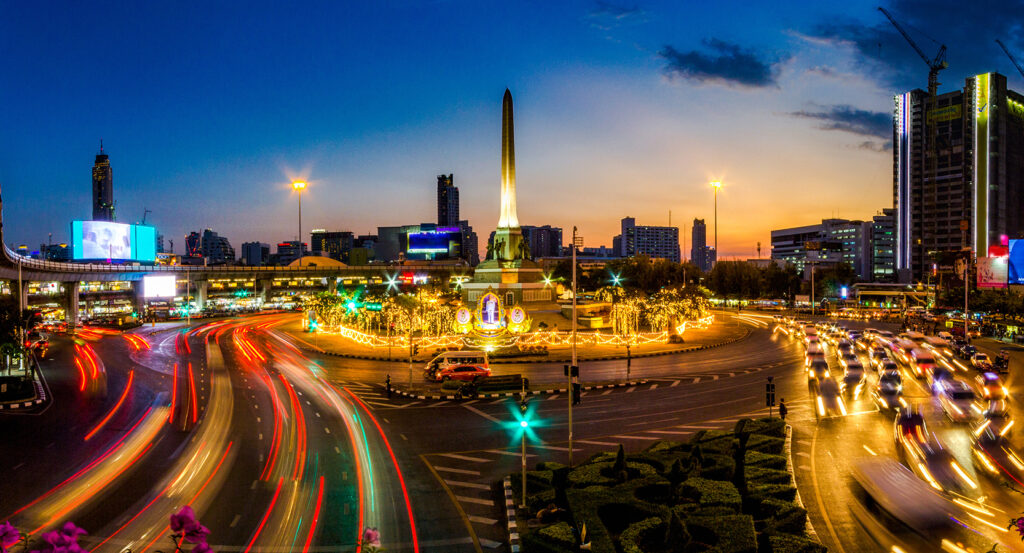
Erected in 1941 under the rule of Field Marshal Plaek Phibunsongkhram, this towering obelisk anchors one of the city's busiest intersections, where tuk-tuks, buses, and motorbikes flow endlessly around its base like the bloodstream of a living organism. The monument itself, a sleek blend of modernist and neoclassical design, commemorates the Thai soldiers who fought in the Franco-Thai War, its five statues representing the armed forces that defended the kingdom's sovereignty. Yet beyond its original military purpose, Victory Monument has evolved into a cultural landmark, a meeting point, a transport hub, and a place where the city's past brushes against its chaotic present. From dawn until midnight, food stalls sizzle nearby, their aromas mingling with the diesel and incense of a city in constant motion. In the evening light, the granite spire glows softly amid neon reflections, a quiet sentinel surrounded by perpetual noise. To stand here is to feel the heartbeat of Bangkok, proud, relentless, and alive in every direction.
What defines Victory Monument.
Behind its stoic façade lies a story as layered as the city itself, one shaped by war, reinvention, and the evolution of national identity.
When it was unveiled, the monument served as both a symbol of victory and propaganda for a modernizing Thailand eager to assert itself on the global stage. But history reshaped its meaning: the Franco-Thai conflict's political complexities soon faded into ambiguity, and after World War II, many of the “victories” it celebrated were diplomatically reversed. Yet rather than being dismantled, the monument endured, its physical presence outlasting the ideology that created it. Over time, it has become a mirror of Thai resilience and adaptability, reflecting how the nation transforms adversity into continuity. Its five heroic statues, sculpted by Italian artist Corrado Feroci (later known as Silpa Bhirasri, the father of Thai modern art), lend the structure both gravitas and grace. Around its circular base, countless demonstrations, memorials, and gatherings have unfolded, turning this wartime relic into a civic stage for public expression. Victory Monument is less about conquest now than about connection, a reminder that even symbols born from division can evolve into emblems of endurance.
How Victory Monument fits.
To experience the Victory Monument is to embrace Bangkok as it truly is, unfiltered, kinetic, and endlessly alive.
Start by taking the BTS Skytrain to Victory Monument Station, where the elevated tracks give you a striking first glimpse of the obelisk rising amid the city's controlled chaos. Descend into the plaza below and walk the perimeter, feeling the energy of buses roaring past, vendors calling out, and students threading through the crowd on their way home. Nearby, you'll find some of the best local street food in the city, famous boat noodles served in narrow shophouses that have operated for generations. Visit in the late afternoon when the heat softens, and the monument catches the warm orange of sunset, its granite glowing against Bangkok's high-rises. If you linger after dark, the area transforms again, alive with lights, laughter, and the hum of a city that never sleeps. From here, you can venture easily to Pratunam Market, Suan Santiphap Park, or the Ratchathewi art enclaves. The Victory Monument in Bangkok isn't just a site on the map, it's the city's living crossroads, a place where history stands still while life rushes on all around it.
Where your story begins.
Foresyte Travel reveals places that feel extraordinary long before you arrive.
Enjoy editorial crafted for luxury travelers.
Foresyte may earn a commission when you book.