Why Wat Chalong matters.
Wat Chalong is a historic Buddhist temple complex where Chalong's religious heritage meets Phuket's nineteenth-century tin-mining conflicts, the enduring veneration of Luang Pho Chaem and one of southern Thailand's most significant centers of Theravada Buddhist worship.
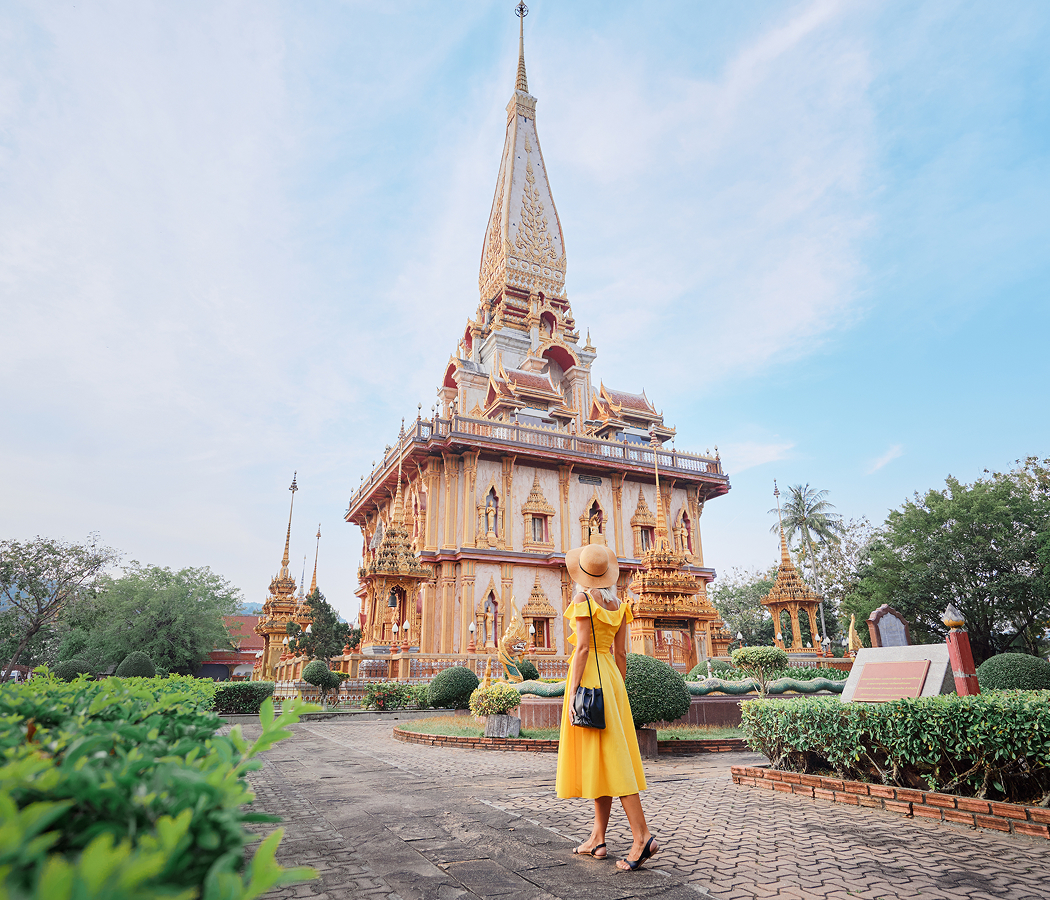
Situated in southern Phuket between Phuket Town and Chalong Bay, Wat Chalong occupies a substantial temple compound east of Chao Fa West Road, with the wooded slopes of the Nakkerd Hills rising to the southwest and the commercial districts of Chalong extending toward the coast. Its collection of religious buildings surrounds broad paved courtyards and landscaped gardens, creating an architectural ensemble distinguished by steeply pitched roofs, gilded ornamentation and elaborately decorated gables. The principal prayer halls incorporate red and gold architectural detailing, polished floors and ceremonial entrances framed by sculptural representations of Buddhist and Thai religious figures. A towering multilevel chedi rises above the surrounding structures, its white surfaces, golden finials and ornamental roof tiers establishing the compound's most prominent vertical feature. Covered walkways connect several buildings, and mature tropical trees provide shaded areas around the courtyards. Decorative boundary walls and ceremonial gateways organize movement between the temple's public spaces and its principal religious structures. The result is an architecturally elaborate Buddhist sanctuary whose expansive religious buildings and landscaped grounds preserve the ceremonial character of Phuket's most revered temple complex.
What defines Wat Chalong.
Wat Chalong, formally Wat Chaiyathararam, developed during the early nineteenth century as a Buddhist monastery serving the agricultural communities occupying southern Phuket. Its establishment is traditionally placed 1837, during a period when the island's tin-mining industry was attracting substantial migration and transforming the surrounding economy. The temple's historical significance became closely associated with Luang Pho Chaem, a monk whose religious leadership and reputation for traditional medicine established him among Phuket's most revered Buddhist figures. Born in 1827, Chaem entered monastic life at Wat Chalong and studied meditation and Buddhist discipline under the temple's senior monks. Following the death of his teacher, Phra Thao, in 1850, Chaem became the monastery's abbot, beginning a period of leadership that extended through several decades of substantial economic and political change. His religious influence developed through strict observance of monastic discipline, instruction in Buddhist teachings and the practice of traditional herbal medicine. The temple became an important spiritual center for surrounding communities, whose residents sought blessings, medical assistance and guidance from the abbot. In 1876, Phuket experienced a major uprising involving Chinese tin miners and secret societies associated with the island's rapidly expanding mining economy. The disturbances spread through parts of the island, creating insecurity among local communities and placing considerable pressure on the provincial authorities. Luang Pho Chaem refused to abandon the monastery during the unrest, remaining at Wat Chalong as villagers gathered around the temple seeking protection. According to the temple's devotional tradition, he distributed white cloth headbands bearing sacred inscriptions to residents who participated in defending their communities. These blessed cloths became associated with protection and courage, establishing a central episode in the religious memory of southern Phuket. Chaem also treated injured residents through his knowledge of herbal medicine, strengthening his reputation as a compassionate religious leader during the conflict. King Chulalongkorn, Rama V, subsequently bestowed the ecclesiastical title Phra Khru Wisutthiwongsachan Yanmuni upon him, recognizing his religious standing and contributions to the community. Luang Pho Chuang, another highly respected monk associated with the monastery, continued the tradition of spiritual guidance and traditional healing that had become central to Wat Chalong's reputation. Following Chaem's death in 1908, his memory became an enduring focus of local Buddhist devotion, with images and sacred objects associated with the former abbot attracting worshippers from across the island. The temple expanded during the twentieth century as Phuket's population increased and improved transportation connected the monastery with the island's principal settlements. Its architectural development culminated in the construction of the Phra Mahathat Chedi, an expansive reliquary begun in 1991 and completed in the early 2000s. The sixty-meter structure was created to enshrine a sacred bone relic of the Buddha, strengthening the monastery's importance as a Buddhist pilgrimage destination. The relic was presented by Sri Lanka to Thailand in 1999 during celebrations associated with King Bhumibol Adulyadej's seventy-second birthday. Its installation within the chedi connected Wat Chalong with the wider Theravada Buddhist world, whose religious institutions maintain longstanding traditions of venerating relics associated with the historical Buddha. The monastery's annual temple fair, celebrated around the Chinese New Year period, developed into one of Phuket's important community gatherings, combining religious observances with markets, performances and local festivities. Wat Chalong preserves a historical relationship between nineteenth-century mining unrest, the religious leadership of influential Buddhist monks, royal recognition and the continuing importance of sacred relics within southern Thai Buddhism.
Luang Pho Chaem's continuing veneration shapes the temple's distinctive devotional practices, particularly within the principal hall containing representations of the monastery's revered former abbots. Worshippers approach the figures with incense, flowers and candles, expressing gratitude and seeking blessings associated with health, protection and spiritual well-being. Thin sheets of gold leaf are applied to designated statues, creating surfaces whose accumulated gilding represents generations of individual devotional acts. The practice connects personal religious observance with the continuing remembrance of monks whose lives became closely associated with the surrounding community. Nearby representations of Luang Pho Chuang and Luang Pho Gluem extend this tradition, establishing a collective memorial to the monastery's influential religious teachers. The temple's ceremonial spaces support merit-making practices associated with Theravada Buddhism, including offerings to monks, devotional recitation and acts of generosity intended to cultivate wholesome karma. Incense smoke rises through the prayer halls as worshippers kneel before Buddha images, and the sound of ceremonial bells contributes to the atmosphere of religious observance. Firecrackers provide another distinctive element of the temple's devotional culture, with designated enclosed structures accommodating their controlled detonation. The practice is associated with expressions of gratitude following fulfilled prayers, introducing a pronounced auditory dimension to the surrounding courtyards. The Phra Mahathat Chedi develops a complementary form of religious engagement through its vertical organization and elaborate artistic program. Interior levels contain gilded Buddha images and painted scenes depicting episodes from the Buddha's life, connecting the building's decorative surfaces with the narrative traditions of Buddhist teaching. Murals portray significant events associated with Siddhartha Gautama's spiritual development, including his renunciation of princely life, meditation and attainment of enlightenment. Sculptural representations of the Buddha appear in different postures, each associated with particular events, teachings or devotional meanings within Thai Buddhist iconography. The arrangement of these images establishes a ceremonial ascent through the building, culminating in the upper chamber containing the sacred relic. The reliquary occupies a protected display area beneath the chedi's elaborate upper structure, emphasizing the religious significance of the object through its elevated position. Upper terraces provide views across the monastery's rooftops and surrounding districts, connecting the sacred building with the wider landscape of southern Phuket. The temple's architectural decoration incorporates familiar elements of Thai Buddhist design, including stylized naga figures, gilded roof ornaments and elaborate representations of celestial beings associated with Buddhist cosmology. These decorative forms communicate religious meanings through the relationship between architecture, sculpture and ceremonial movement. Monastic life continues within the compound through religious instruction, daily observances and the maintenance of sacred spaces. Worshippers follow established customs of respectful dress and remove their shoes before entering principal religious buildings, preserving the distinction between ordinary public circulation and consecrated interior spaces. Wat Chalong's enduring significance emerges through the continuing relationship between these devotional practices, the remembrance of its influential abbots and the architectural expression of Buddhist religious traditions.
How Wat Chalong fits.
Wat Chalong works as the centerpiece of an exploration connecting southern Phuket's expansive Buddhist architecture, the island's maritime geography and the coastal communities whose development shaped the Chalong district.
Begin at Phuket Big Buddha, the expansive seated Buddha overlooking southern Phuket from the summit of Nakkerd Hill. The white marble-clad statue rises forty-five meters above its base, depicting the Buddha in the seated meditation posture associated with serenity and spiritual concentration. Construction began in 2004 through donations supporting a major religious monument visible across substantial portions of southern Phuket. The hilltop setting establishes extensive views toward Chalong Bay, Phuket Town and the surrounding coastal landscape, connecting the monument with the island's broader geography. Its construction incorporates reinforced concrete beneath the marble exterior, combining contemporary structural engineering with traditional Buddhist sculptural forms. The site's religious significance developed through public donations and the participation of Buddhist communities supporting the project. Continue to Chalong Pier, the principal maritime departure point serving the protected waters of Chalong Bay. The pier extends into the bay from Phuket's southeastern coastline, connecting the island with excursion vessels traveling toward the surrounding Andaman Sea islands. Its development supported the expansion of recreational boating and marine tourism, establishing Chalong as an important center for diving excursions, sailing and island transportation. The surrounding waters are sheltered by Phuket's coastal geography, creating favorable conditions for boat operations and marine services. Fishing vessels and recreational craft occupy adjoining areas, preserving a relationship between traditional maritime activity and the island's contemporary tourism economy. The pier's waterfront setting establishes broad views across the bay toward the surrounding islands and coastal hills. Conclude at Wat Ladthi Wanaram, the Buddhist temple commonly known as Wat Tai within the Chalong district. Its religious buildings preserve a smaller-scale expression of southern Thai Buddhist architecture, incorporating ornamental roof tiers, gilded decorative elements and traditional prayer spaces. The temple serves the surrounding residential community through ceremonies, religious instruction and devotional activities associated with the Buddhist calendar. Its architectural composition establishes a closer relationship with the everyday religious life of Chalong's neighborhoods, providing a distinct counterpart to the expansive scale of the island's principal pilgrimage sites. The compound's ceremonial buildings and landscaped grounds maintain the spatial organization characteristic of local Thai Buddhist monasteries. The progression moves from Phuket Big Buddha's hilltop religious monument through Chalong Pier's maritime landscape and culminates in Wat Ladthi Wanaram's community-centered Buddhist traditions, connecting the spiritual and geographical character of southern Phuket.
Where your story begins.
Foresyte Travel reveals places that feel extraordinary long before you arrive.
Enjoy editorial crafted for luxury travelers.
Foresyte may earn a commission when you book.