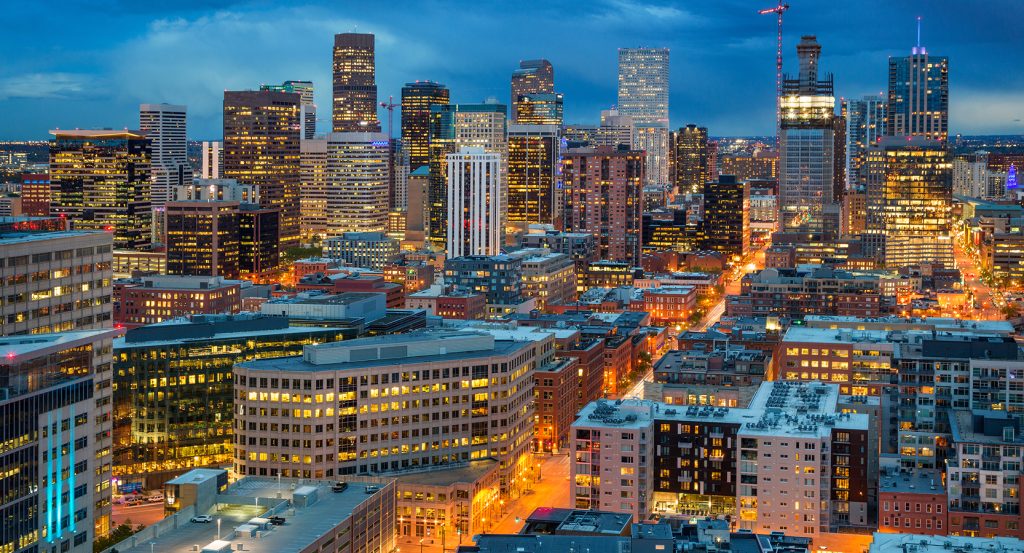
Why you should experience 18th Avenue in Denver, Colorado.
18th Avenue is a graceful corridor where City Park West's residential heritage, institutional legacy, architectural diversity, and enduring neighborhood character unfold across one of Central Denver's defining east-west streets.
Running through City Park West between Uptown and City Park, the avenue developed as Denver expanded beyond its nineteenth-century core, where carefully planned residential blocks, civic institutions, and neighborhood commerce established a distinctive urban setting. Brick apartment houses, Denver Squares, mature street trees, masonry churches, and early commercial buildings preserve a streetscape reflecting more than a century of continuous growth. The corridor ultimately expresses how thoughtful development and enduring architecture shaped one of Denver's most established residential districts. The result is an experience defined by continuity, craftsmanship, and an enduring sense of place.
What you should know about 18th Avenue.
18th Avenue is best known for developing across land opened through Wyman's Addition (1872), Cheesman & Moffat's Addition, and other late nineteenth-century subdivision plats that extended Denver's street grid eastward from the original city. Residential construction accelerated between the 1880s and the 1930s, introducing Queen Anne, Richardsonian Romanesque, Classical Revival, Denver Square, and Tudor Revival architecture that established a remarkably varied building chronology along the corridor. The avenue also became associated with substantial institutional construction as churches, apartment hotels, fraternal buildings, and medical offices emerged during the early twentieth century to serve Denver's rapidly expanding population. Historic resource inventories prepared by the City and County of Denver identify numerous individually documented residences and masonry apartment buildings that collectively preserve one of Central Denver's richest concentrations of period architecture.
Construction methods evolved as local builders transitioned from load-bearing brick masonry and sandstone foundations to structural clay tile, reinforced concrete floor systems, ornamental terra-cotta detailing, and pressed-metal cornices that reflected changing architectural practices during the early twentieth century. Property records document long-term investment by physicians, attorneys, merchants, architects, and civic leaders whose commissions produced substantial apartment buildings, duplexes, and finely detailed residences spanning nearly five decades of development. Historic architectural surveys further record original wood sash windows, decorative brick corbelling, limestone trim, stained-glass transoms, and intact lot configurations that continue illustrating the corridor's architectural evolution through surviving craftsmanship rather than reliance upon later destination sites. Together, subdivision history, documented construction techniques, ownership patterns, architectural inventories, and preserved residential fabric establish 18th Avenue as one of City Park West's defining historic corridors.
How to fold 18th Avenue into your trip.
18th Avenue works as an exploration of City Park West's cultural heritage, architectural character, and civic landscape.
Begin at Molly Brown House Museum, where the preserved Victorian residence introduces Denver's Gilded Age prosperity and provides historical context for the architectural ambition that spread throughout the surrounding neighborhoods during the late nineteenth century. Continue to the Cathedral Basilica of the Immaculate Conception, whose monumental-scale craftsmanship and historic significance deepen the narrative by illustrating the city's growing cultural and religious aspirations during the early twentieth century. Conclude at the Denver Museum of Nature & Science, where world-renowned scientific collections and enduring public engagement provide the historical payoff by demonstrating how Denver's commitment to education and civic enrichment complements the surrounding architectural legacy. The sequence moves from residential prosperity through institutional achievement before culminating in a destination that fully synthesizes the neighborhood's enduring cultural identity.
Where your story begins.
Foresyte Travel reveals places that feel extraordinary long before you arrive.
Experience premium editorial crafted for luxury travelers.