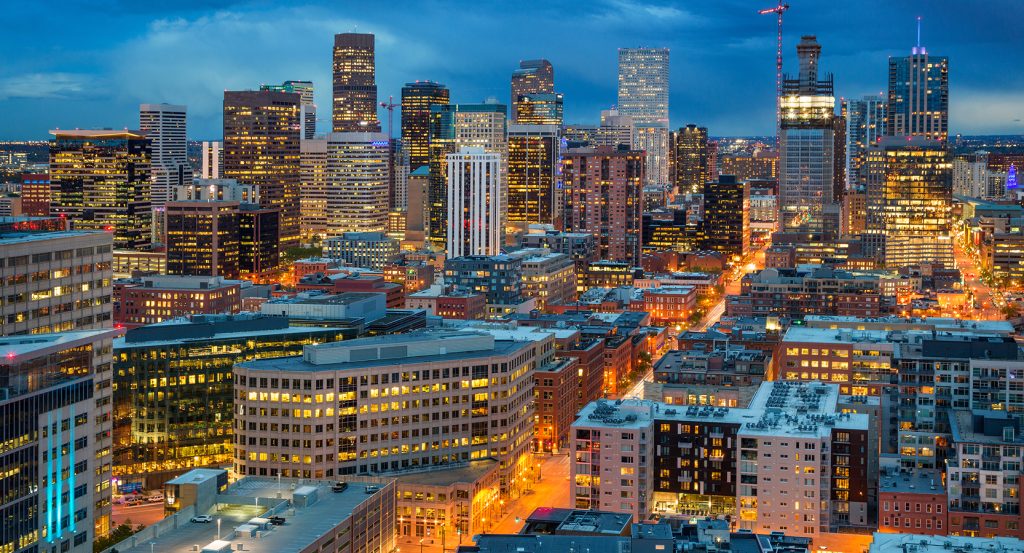
Why you should experience Washington Street in Denver, Colorado.
Washington Street is a resilient corridor where Globeville's industrial heritage, railroad legacy, neighborhood resilience, and evolving urba character converge along one of North Denver's defining thoroughfares.
Running through Globeville between the South Platte River and East 52nd Avenue, Washington Street links historic residential blocks, freight infrastructure, manufacturing districts, neighborhood businesses, and civic spaces that collectively reflect more than a century of economic growth and community perseverance. The streetscape alternates between early twentieth-century brick buildings, active industrial properties, rail corridors, mature neighborhood blocks, and expanding public improvements, revealing how manufacturing, transportation, and residential life have remained closely intertwined across generations. The corridor reaches its defining character where industrial strength, neighborhood continuity, and ongoing reinvestment reinforce one another throughout Denver's historic north side. The result is a corridor defined by resilience, industrial character, and Globeville's enduring contribution to Denver's economic development.
What you should know about Washington Street.
Washington Street is best known for developing alongside the industrial expansion that transformed North Denver during the late nineteenth and early twentieth centuries. Construction of extensive freight facilities serving the Denver and Rio Grande Railroad, Colorado and Southern Railway, and Union Pacific Railroad established the surrounding district as a major center for manufacturing, warehousing, livestock processing, and regional distribution. Completion of nearby improvements associated with the South Platte River and continued expansion of Denver's freight network strengthened commercial transportation while encouraging large-scale industrial investment throughout the corridor. During the twentieth century, infrastructure projects undertaken by the Colorado Department of Transportation, the City and County of Denver, and regional transportation agencies modernized roadway geometry, bridge connections, freight access, and utility systems while preserving Washington Street's strategic role within the metropolitan transportation network. Together, railroad expansion, river engineering, industrial growth, and transportation investment established Washington Street as one of Globeville's defining historic corridors.
Industrial development between the 1890s and the 1940s introduced substantial warehouses, processing facilities, machine shops, distribution buildings, and manufacturing plants characterized by heavy timber construction, reinforced concrete framing, brick masonry, and functional industrial design. The surrounding district evolved into one of Denver's principal employment centers for rail operations, meatpacking, metal fabrication, wholesale commerce, and freight logistics, supporting thousands of workers throughout the twentieth century. Long-term collaboration among neighborhood organizations, municipal agencies, environmental partners, and redevelopment initiatives continues supporting brownfield remediation, infrastructure modernization, multimodal transportation improvements, and adaptive reuse of historic industrial properties. Together, engineering achievement, industrial architecture, environmental investment, and sustained redevelopment explain why Washington Street remains one of North Denver's most historically significant urban corridors.
How to fold Washington Street into your trip.
Washington Street works as an exploration of North Denver's industrial heritage, riverfront renewal, and evolving public spaces.
Begin at Globeville Landing Park, where restored riverfront landscapes introduce the environmental renewal transforming the South Platte River corridor before naturally leading deeper into the neighborhood. Continue to National Western Center, where innovative educational facilities and public gathering spaces reveal the district's continuing role in Denver's agricultural and economic future before carrying the experience toward its conclusion. Conclude at RiNo ArtPark, where contemporary public art and creative programming provide a memorable finale illustrating how nearby industrial districts continue evolving through culture and adaptive urban reinvention. The progression moves naturally from ecological restoration to civic investment before concluding with one of Denver's most creative public destinations.
Where your story begins.
Foresyte Travel reveals places that feel extraordinary long before you arrive.
Experience premium editorial crafted for luxury travelers.