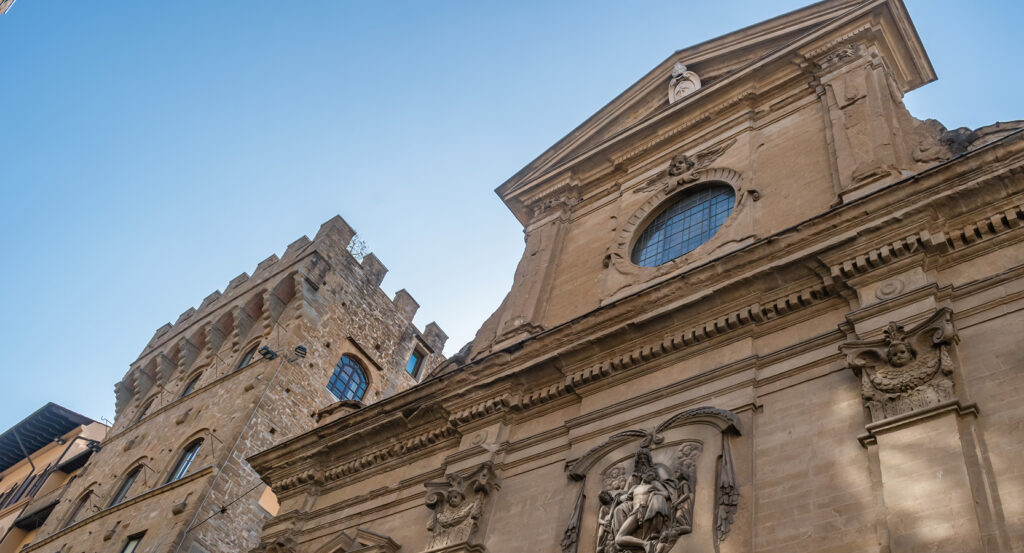
Why you should experience Florentine Façade at Santa Trinita in Florence, Italy.
The Florentine Trinity Façade of Santa Trinita is one of the city's most elegant architectural harmonies, a perfect dialogue between medieval devotion and Renaissance refinement.
Designed by Bernardo Buontalenti in the late 16th century under the patronage of the Medici, the façade gives the ancient Vallombrosan church its serene and noble face. Its geometry is calm, its proportions almost musical, a measured rhythm of pilasters, arches, and volutes rising from rusticated stone to sculpted pediment. The design reflects Florence's mastery of balance: solemn yet graceful, ornate yet restrained. Behind its travertine glow lies nearly five centuries of evolution, from the Romanesque church first built in the 11th century to the Gothic expansion that followed. Buontalenti's intervention unified those histories into a façade that speaks both of faith and reason, simplicity and sophistication. To stand before it is to see Florence itself reflected, a city that turns devotion into design.
What you didn't know about Florentine Façade at Santa Trinita.
The Florentine Trinity Façade conceals a deep conversation between time periods and ideals.
When Buontalenti undertook the project around 1593, the church had long needed a face that matched its artistic importance within. His façade, executed in luminous pietra serena and pale stone, was not meant to erase the past, but to reconcile it. The lower level mirrors the proportional harmony of early Renaissance churches like Alberti's Santa Maria Novella, while the upper pediment reflects the late Mannerist flair Buontalenti was famous for: graceful scrolls, elliptical oculi, and subtly exaggerated vertical lines that lift the eye heavenward. The Medici's support of the design was political as well as aesthetic, it symbolized the dynasty's patronage of order, intellect, and faith after the turbulence of the 16th century. Few visitors realize that embedded within the structure are remnants of the earlier Gothic church, its stones literally carried forward into the new design. Even the façade's restrained ornamentation, floral motifs and the central Trinity symbol, speaks of Florence's transition from medieval mysticism to rational elegance.
How to fold Florentine Façade at Santa Trinita into your trip.
When exploring Florence, make the Florentine Trinity Façade your pause between the bustle of Via Tornabuoni and the serenity of the Arno.
Approach the church from the Piazza Santa Trinita, where the façade frames the skyline like a living fresco. Visit in the early morning or near sunset, when the pale stone glows honey-gold and the shadows of its pilasters carve crisp geometry across the surface. Step back to appreciate its symmetry, the triangular pediment crowning the arched doorway in perfect proportion, then move closer to study the subtle carvings and the Medici crest at the center. Notice how the design aligns with the Column of Justice in the square, creating a visual axis that joins sacred and civic space. After admiring the exterior, step inside to experience the full effect: Buontalenti's balanced façade gives way to centuries of layered artistry, Ghirlandaio, Monaco, Neri di Bicci, each speaking in harmony through the architecture he framed. The Florentine Trinity Façade isn't merely an architectural front; it's Florence's invitation to enter a dialogue between art, faith, and time itself.
Where your story begins.
Start your planning journey with Foresyte Travel.
Experience immersive stories crafted for luxury travelers.