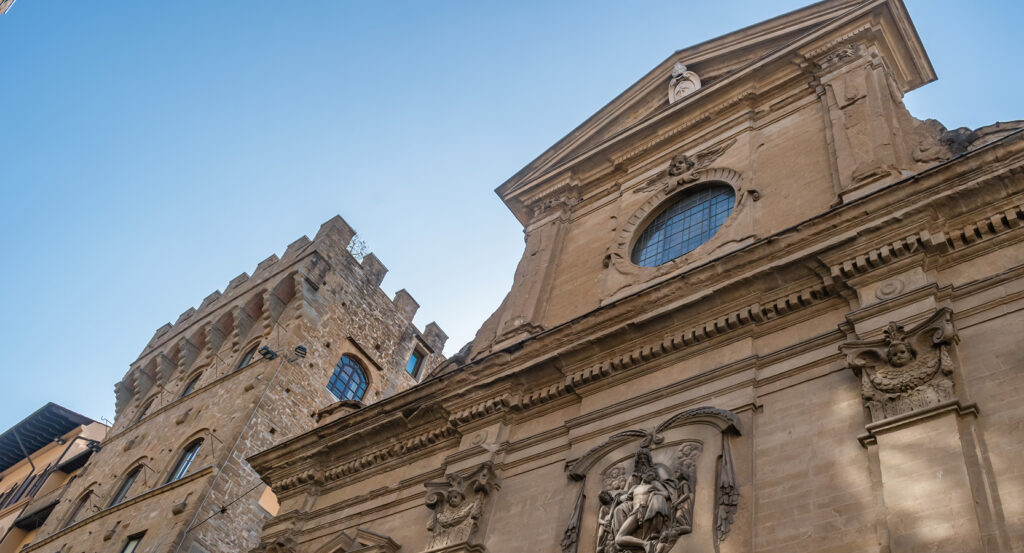
Why you should experience the Bartolini Salimbeni Chapel at Santa Trinita in Florence.
The Bartolini Salimbeni Chapel at Santa Trinita in Florence is a jewel box of Late Gothic splendor, an intimate space where elegance, light, and mysticism converge.
Conceived in the early 15th century for one of Florence’s oldest merchant families, the chapel’s frescoes by Lorenzo Monaco shimmer with ethereal grace. Step inside, and you’re greeted by a vision of gold and azure, slender figures wrapped in flowing robes, halos radiant with celestial glow. The chapel’s theme centers on the life of the Virgin Mary, whose purity and humility are rendered with a lyricism unique to Monaco’s delicate hand. Though small in scale, the space feels infinite, filled with an atmosphere of stillness and devotion that transcends centuries. Standing beneath its ribbed vaults, you sense the transition between Gothic spirituality and the dawning Renaissance, that moment when human tenderness began to shape divine beauty.
What you didn’t know about the Bartolini Salimbeni Chapel.
The Bartolini Salimbeni Chapel marks one of the final masterpieces of Florence’s Gothic imagination, a farewell to the medieval world just as the Renaissance rose around it.
Lorenzo Monaco, a Camaldolese monk as well as an artist, completed the frescoes around 1420, weaving theology and artistry into a seamless visual hymn. His Scenes from the Life of the Virgin, the Annunciation, Visitation, and Presentation in the Temple, glow with otherworldly serenity. The figures, elongated and weightless, move through gilded spaces where perspective dissolves into light, a contrast to the geometric realism that soon defined Florentine art. The chapel’s starry blue vault, flecked with gold, transforms the ceiling into a miniature cosmos, a divine canopy over the Virgin’s story. The altarpiece, also by Monaco, completes the cycle: The Coronation of the Virgin, its luminous gold leaf shimmering like sunlight through incense. The Bartolini Salimbeni family commissioned the chapel as both a devotional act and a declaration of prestige, its refined opulence reflecting the taste of a city poised between mysticism and modernity.
How to fold the Bartolini Salimbeni Chapel into your trip.
When visiting Santa Trinita, make the Bartolini Salimbeni Chapel your quiet counterpoint to the human drama of the Sassetti Chapel nearby.
Located to the left of the high altar, this space rewards slow observation and gentle light. Step inside and allow your eyes to adjust, the gold leaf and soft blues reveal themselves gradually, like dawn breaking over a dream. Begin with the Annunciation, where the Virgin’s gesture is tender, almost hesitant, as Gabriel’s wings shimmer in motionless flight. Move along the narrative cycle, watching Monaco’s graceful lines guide your gaze upward toward the vaulted ceiling of stars. Visit during late afternoon, when the chapel’s gilded surfaces reflect the warm hues of the setting sun, amplifying their inner glow. Sit or stand in silence for a moment, the acoustics carry the faint hum of the city outside, merging the sacred and the everyday. Before leaving, take one last look toward the Coronation of the Virgin, it’s not merely a painting but a vision of spiritual ascent. The Bartolini Salimbeni Chapel is Florence’s gentle whisper from the Gothic age, a sacred pause between heaven and history.
Hear it from the Foresyte community.
Everyone’s chasing the Duomo but this is where you get real Florence. No lines, no chaos, just art and old walls that breathe.
Where meaningful travel begins.
Start your journey with Foresyte, where the planning is part of the magic.
Discover the experiences that matter most.