Why you should experience Mosque-Madrasa of Sultan Barquq in Cairo, Egypt.
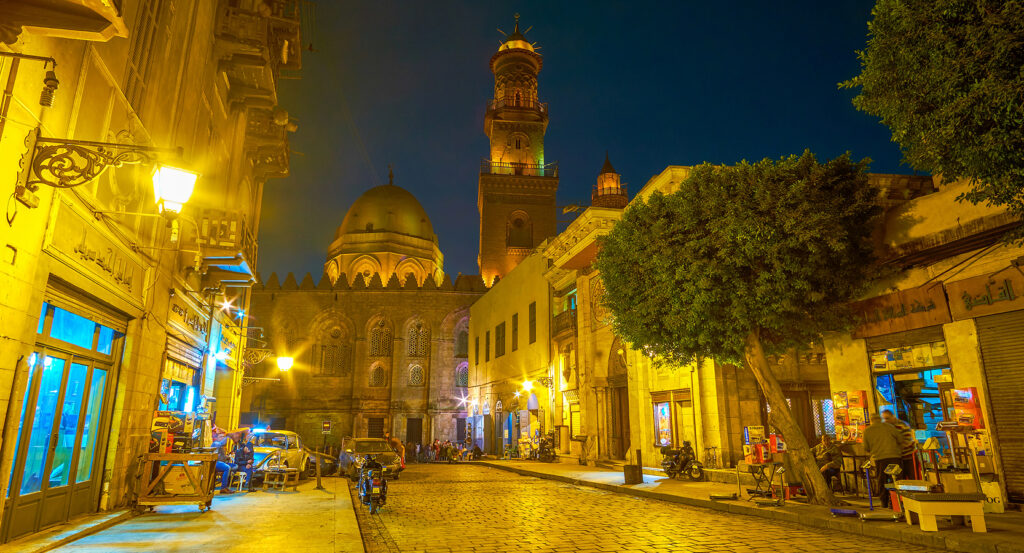
Mosque-Madrasa of Sultan Barquq in Cairo is the Mamluk Dynasty at its most poetic, a harmony of geometry, devotion, and power that still hums softly along the stones of Al-Muizz Street.
Step through its grand entrance, and the chaos of Cairo dissolves into calm. Light filters through stained glass in shafts of gold and violet, washing over walls carved with marble and inlaid wood. The scent of incense drifts through the air, mingling with the faint echo of footsteps on centuries-old stone. Inside, every surface feels alive with purpose, Kufic calligraphy tracing verses of unity, arabesque panels blooming like stars, muqarnas vaults cascading like frozen waterfalls. The mosque radiates both majesty and restraint; it is less a display of power than a meditation on permanence. To stand within the Mosque-Madrasa of Sultan Barquq is to feel the Mamluks' vision of beauty as faith made visible, precise, luminous, and eternal.
What you should know about Mosque-Madrasa of Sultan Barquq.
The Mosque-Madrasa-Khanqah of Sultan Barquq, completed in 1386 CE, marked the beginning of Cairo's Circassian Mamluk period, an era defined by refined architecture and intellectual ambition.
Commissioned by Sultan Al-Zahir Barquq, the first Circassian to rule Egypt, the complex combined a mosque, madrasa, and Sufi lodge (khanqah) within one symmetrical design, a rare feat of both engineering and symbolism. Its architect, Ahmad al-Tuluni, blended vertical Gothic influences with traditional Cairene forms, creating a structure that rises in elegant proportion. The mosque's entrance portal is among the finest in Cairo: an arched recess framed by marble panels and crowned with a honeycombed half-dome that seems to drip light. Inside, the central courtyard opens to four iwans representing the major Sunni schools of thought, their carved stucco inscriptions still crisp after six centuries. The mihrab, made of inlaid marble and glass mosaics, gleams beneath a painted wooden dome that once echoed with Qur'anic recitation. One of the most remarkable aspects of the mosque is its connection to Sufism, the khanqah quarters were built to house mystics and scholars who devoted their lives to study and prayer, making Barquq's foundation not only a religious institution but a living campus of spiritual learning. The mosque's layout directly faces the Qalawun Complex, intentionally mirroring its composition as a gesture of continuity between two dynasties. Even today, the building remains a cornerstone of Mamluk urban planning, influencing structures from Damascus to Istanbul. Its restoration in the early 2000s revealed original pigments and cedar beams that glowed once more beneath the lanterns, proving that even after centuries, the Mamluk mastery of light and pattern endures unchallenged.
How to fold Mosque-Madrasa of Sultan Barquq into your trip.
Visiting Mosque-Madrasa of Sultan Barquq offers one of the most intimate glimpses into Cairo's medieval splendor, a perfect continuation of any walk along Al-Muizz Street.
Begin at the Qalawun Complex, then follow the street a short distance south until the Barquq façade appears, its marble bands glowing softly in the morning light. The best times to visit are early morning or just before sunset, when light angles through the stained-glass windows and paints the floor in warm color. Enter quietly through the wooden doors, allowing your eyes to adjust to the dim serenity inside. Start in the main iwan, whose domed ceiling amplifies even the faintest whisper, and notice how the decorative program subtly shifts from geometric to floral, a visual discussion between intellect and mysticism. Allocate 45-60 minutes to explore, taking time to sit beneath the dome and feel how sound and silence intertwine. If visiting with a guide, ask to access the upper gallery, where the perspective reveals the harmony of the mosque's proportions and the way sunlight grazes the arches. Afterward, step back into Al-Muizz Street, where the muezzin's call overlaps with the murmur of the market, a moment where the sacred and the ordinary blend seamlessly, just as they did in Barquq's time. Before leaving, turn once more toward the entrance and trace the Arabic inscription above the portal, its words still declaring what every visitor feels: that beauty, when born of faith, never fades.
Where your story begins.
Foresyte Travel reveals places that feel extraordinary long before you arrive.
Experience premium editorial crafted for luxury travelers.