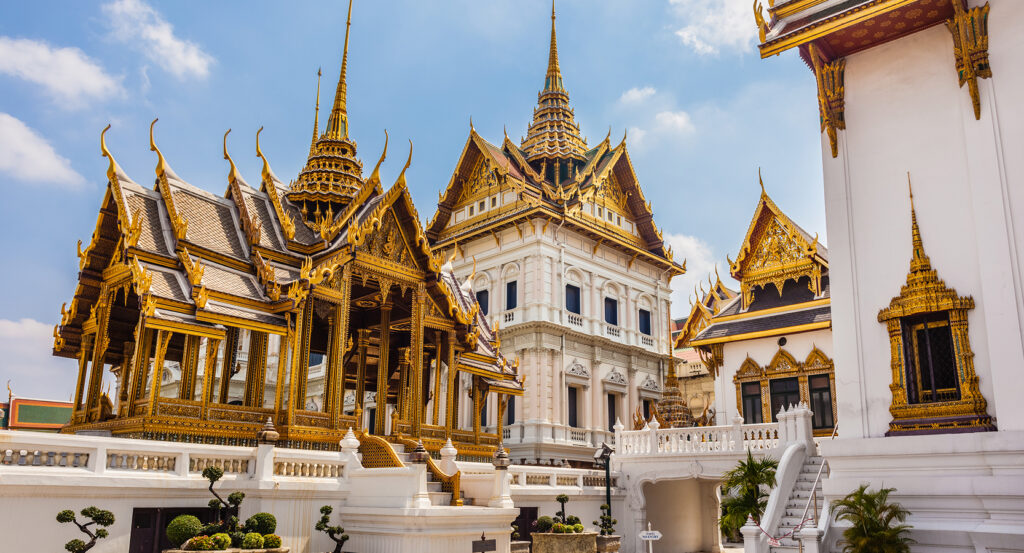
Why The Ananta Samakhom Throne Hall matters.
The Ananta Samakhom Throne Hall is a grand royal reception hall where early 20th-century Siamese state modernization, European Neo-Renaissance and Neoclassical architectural influence, the patronage of King Chulalongkorn (Rama V), and Italian Renaissance engineering traditions converge within one of Bangkok's most formally significant palace structures.
Commissioned by King Chulalongkorn in 1908 and completed in 1915 during the reign of King Vajiravudh (Rama VI), the building was designed primarily by Italian architect Mario Tamagno with contributions from Annibale Rigotti and structural engineers Carlo Allegri and G.E. Gollo. Constructed as part of the Dusit Palace complex, the hall was intended as a grand ceremonial space reflecting Siam's engagement with European architectural models during a period of rapid institutional modernization. Built at a reported cost of 15 million Siamese baht, the structure is faced in Carrara marble and features a central dome flanked by six smaller domes, with interior frescoes executed by Italian artists Galileo Chini and Carlo Rigoli depicting scenes from the Chakri dynasty. The building later played a pivotal constitutional role in Thai political history, including its use by the National Assembly following the 1932 revolution. The result is a landmark defined by royal commissioning, cross-cultural architectural synthesis, and institutional transformation across monarchy and parliamentary governance.
What defines The Ananta Samakhom Throne Hall.
The Ananta Samakhom Throne Hall is best known for being commissioned in 1908 by King Chulalongkorn (Rama V) as a European-style ceremonial hall for Dusit Palace and completed in 1915 under King Vajiravudh (Rama VI), following an eight-year construction period that engaged Italian architect Mario Tamagno along with Annibale Rigotti, Carlo Allegri, and G.E. Gollo, marking one of the most significant imported architectural commissions of the early Thai modernization era. The structure was conceived during a period of intense state reform in Siam, when the Chakri dynasty actively adopted Western administrative and architectural models to assert diplomatic parity with European powers, resulting in a Neo-Renaissance and Neoclassical palace hall constructed with imported Carrara marble and advanced European engineering techniques.
The interior program is defined by large-scale fresco cycles by Galileo Chini and Carlo Rigoli, which depict key historical narratives of the Chakri dynasty across domed ceilings and wall surfaces, embedding royal ideology into the architectural fabric of the building. The hall later assumed major political significance after the 1932 Siamese revolution, when it was used as the headquarters of the Khana Ratsadon and subsequently hosted the first National People's Assembly of Siam, serving as the seat of Thailand's legislature until 1974. Its layered history spans royal ceremonial function, revolutionary political transition, and constitutional governance, making it among the most historically multi-functional civic buildings in Thailand.
How The Ananta Samakhom Throne Hall fits.
The Ananta Samakhom Throne Hall works as the centerpiece of a Dusit Palace and Ratchadamnoen civic heritage circuit that highlights Bangkok's royal architecture, political history, and grand urban planning.
Begin at Dusit Zoo site and the surrounding Dusit Palace grounds, where late-Rattanakosin royal expansion established a new European-influenced district under King Chulalongkorn's modernization agenda before approaching the Ananta Samakhom Throne Hall to study its marble-clad Neo-Classical composition and domed Italian Renaissance form. Continue to Vimanmek Mansion, where teakwood royal residential architecture contrasts the formal European ceremonial language of the Throne Hall while reinforcing the broader Dusit Palace design philosophy. Conclude at Royal Plaza and the equestrian statue of King Rama V, where grand civic space, nationalist memory, and royal commemoration intersect within one of Bangkok's most symbolically charged urban ensembles. The progression moves from landscaped palace precinct to ceremonial marble hall to public commemorative space, revealing why the Ananta Samakhom Throne Hall remains one of Thailand's most significant intersections of architecture and political history.
Where your story begins.
Foresyte Travel reveals places that feel extraordinary long before you arrive.
Enjoy editorial crafted for luxury travelers.
Foresyte may earn a commission when you book.