Why Asian Civilisations Museum matters.
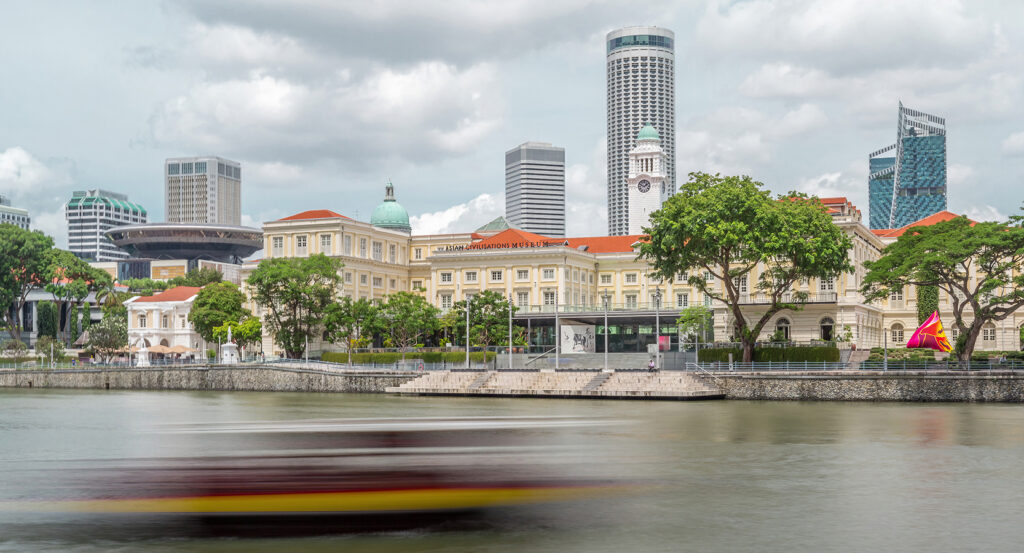
Asian Civilisations Museum is a distinguished history museum where Singapore River's maritime heritage, Asia's interconnected civilizations, centuries of global exchange, and the cultural currents that shaped modern Singapore come together beneath one historic roof.
Set along Empress Place near St. Andrew's Road and just steps from Cavenagh Bridge, this elegant museum leads visitors through beautifully curated galleries where ancient ceramics, sacred sculptures, maritime treasures, imperial masterpieces, and exceptional decorative arts reveal the extraordinary networks that connected Asia long before the modern world emerged. Refined neoclassical architecture frames immersive exhibitions exploring commerce, migration, religion, craftsmanship, and cultural exchange across continents as priceless artifacts illuminate the stories behind Singapore's evolution into one of the world's great trading ports. Carefully choreographed galleries encourage visitors to see Asia not as isolated civilizations but as an interconnected mosaic shaped by movement, curiosity, and innovation. The experience ultimately transforms thousands of years of history into a compelling journey through the ideas, objects, and people that connected the continent.
What defines Asian Civilisations Museum.
Asian Civilisations Museum is best known for becoming Asia's only museum devoted to presenting the artistic and cultural connections between civilizations across the continent through the view of Singapore's history as a global port city, establishing its flagship home inside the restored Empress Place Building in 2003 after first opening in 1997 while preserving internationally significant collections spanning China, Southeast Asia, South Asia, and the Islamic world. The museum occupies the Former Empress Place Building, completed in 1867 after construction began in 1864 under Public Works Department engineer Major J. F. A. McNair, originally intended as a courthouse before serving for more than a century as Singapore's colonial Government Offices and later receiving National Monument status in 1992 prior to its meticulous restoration as a museum. Among its greatest treasures is the internationally celebrated Tang Shipwreck collection, comprising more than 60,000 ceramics together with exquisite gold and silver objects recovered from a ninth-century trading vessel discovered near Belitung Island in 1998, providing one of the most important archaeological records of maritime trade between Tang China, Southeast Asia, and the Middle East. Permanent galleries also preserve exceptional Buddhist and Hindu sculpture, Chinese export porcelain, Peranakan gold, Khmer stone carving, Islamic calligraphy, ceremonial textiles, lacquerware, jade, bronzes, and masterpieces illustrating centuries of artistic exchange across Asia's trading networks. Rather than presenting civilizations in isolation, the museum organizes its collections around the movement of people, beliefs, technologies, luxury goods, and artistic traditions that flowed through Singapore and the wider maritime world, reflecting the institution's pioneering pan-Asian mission and reinforcing Singapore's historical character as one of Asia's great crossroads. Today the museum continues to expand scholarship through internationally acclaimed exhibitions, conservation, archaeological research, and collaborative partnerships while remaining one of the continent's foremost institutions dedicated to understanding Asia through cultural exchange.
Elegant neoclassical galleries overlooking the Singapore River create a fitting setting for collections that continually demonstrate how merchants, pilgrims, diplomats, craftsmen, and explorers carried artistic ideas across thousands of kilometers over many centuries. Sculptures, ceramics, precious metals, shipwreck cargoes, religious masterpieces, and luxury goods collectively reveal the astonishing sophistication of the trade networks that connected China, India, Southeast Asia, the Middle East, and beyond long before the modern era. Thoughtful interpretation, meticulous conservation, and continually evolving exhibitions preserve these extraordinary collections while encouraging visitors to view Singapore as the natural meeting point of countless civilizations. History, archaeology, artistry, and maritime exchange ultimately combine to create one of Asia's most intellectually rewarding museum experiences.
How Asian Civilisations Museum fits.
Asian Civilisations Museum works as the centerpiece of an exploration through Singapore River's historic civic waterfront.
Begin at Cavenagh Bridge, where Singapore's oldest surviving suspension bridge introduces the city's colonial waterfront before continuing into Asian Civilisations Museum to explore the civilizations that shaped the region through centuries of maritime exchange. Continue to Victoria Theatre and Concert Hall, whose distinguished civic architecture deepens appreciation for Singapore's historic cultural district. Conclude at The Fullerton Hotel Singapore, where the former General Post Office provides a memorable finale overlooking the river that transformed Singapore into one of the world's great trading ports. The progression moves naturally from historic river crossing to pan-Asian cultural discovery before concluding through one of the city's finest heritage buildings, revealing why Singapore River remains the birthplace of modern Singapore.
Where your story begins.
Foresyte Travel reveals places that feel extraordinary long before you arrive.
Enjoy editorial crafted for luxury travelers.
Foresyte may earn a commission when you book.