Why Empress Place Building matters.
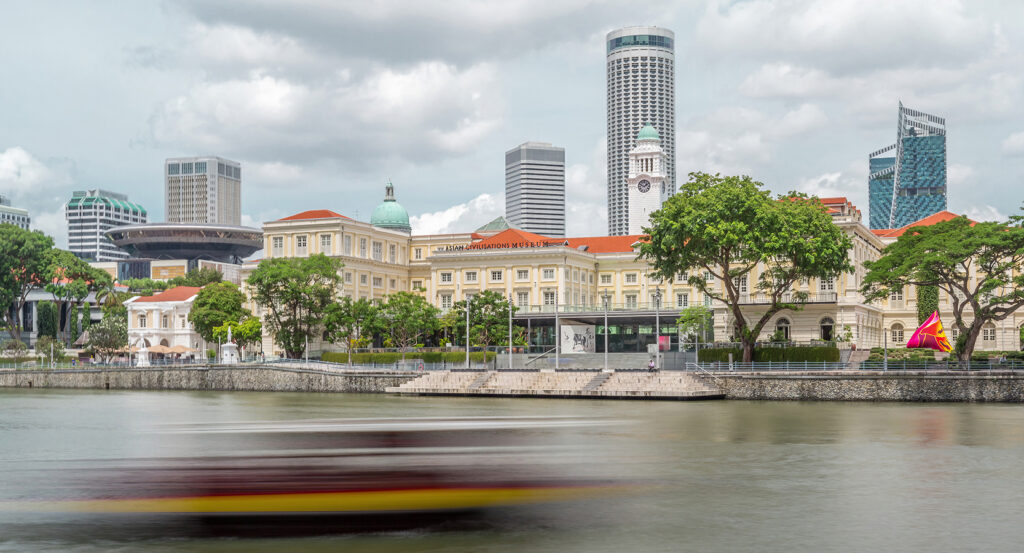
Empress Place Building is a stately civic building where Singapore's historic riverfront meets nineteenth-century colonial administration, Palladian architecture and the transformation of government offices into the Asian Civilisations Museum.
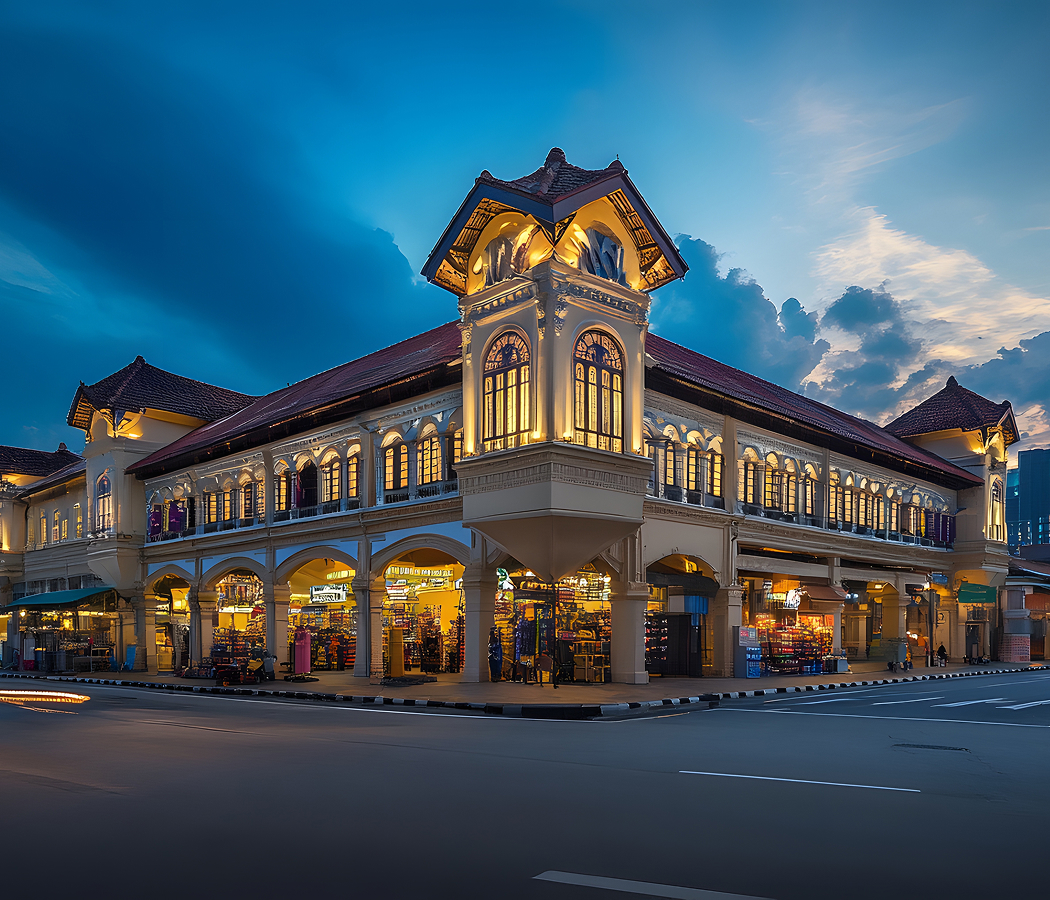
Set along the north bank of the Singapore River near Cavenagh Bridge and just steps from Victoria Theatre and Concert Hall, the building occupies the Civic District at the historic divide between the governmental quarter and the commercial center that developed across the water at Raffles Place. Its river-facing elevations extend through long arcaded verandahs above a rusticated ground floor, with repeated openings giving the substantial structure a disciplined horizontal order. Roman Doric columns define the principal storey as French windows and high ceilings adapt the European architectural language to Singapore's tropical climate. Successive extensions enlarged the original block without erasing the symmetrical composition that distinguishes the nineteenth-century core. The result is a riverfront civic monument whose arcades, classical proportions and commanding position preserve the architectural authority once attached to the administrative center of colonial Singapore.
What defines Empress Place Building.
Empress Place Building is best known for serving as one of Singapore's principal government buildings for more than a century before becoming the home of the Asian Civilisations Museum. The project received approval in 1855, but military spending delayed construction until June 1864, when Colonial Engineer Major John F. A. McNair directed work carried out by Indian convict labor. Completion followed in December 1867, and government departments moved from Maxwell's House into a complex containing the Secretariat, Treasury, Stamp Office, Public Works and Medical Departments, Colonial Engineer and Inspector General of Police. The concentration of administrative functions gave the property its original name, Government Offices, during the same year that the Straits Settlements became a Crown Colony under direct Colonial Office authority in London. Its familiar name emerged after the adjoining public space became Empress Place in 1907 in memory of Queen Victoria. Singapore's post-independence government retained the building for functions including the Citizenship Registry, Immigration Department and Registry of Births and Deaths until those offices departed during the 1980s. Restoration then converted the former administrative complex into Empress Place Museum, which opened in 1989, and Singapore preserved the building as a National Monument on 14 February 1992.
Five years of conversion work preceded the Asian Civilisations Museum's move into the building in 2003, beginning a new institutional life centered on Asian art and material culture. Asian Civilisations Museum developed galleries spanning China, Southeast Asia, South Asia and West Asia inside rooms once occupied by the machinery of government, including an upper-floor chamber formerly used by the legislature. A comprehensive renewal beginning in 2014 expanded that transformation through GreenHilLi architects Nigel Greenhill and Li Sau Kei, who introduced warm-toned titanium and glass beside McNair's nineteenth-century masonry. The three-storey Kwek Hong Png Wing added 869 square metres in a contemporary cube projecting toward Empress Place, establishing a deliberate architectural contrast with the arcaded historic elevations. Original plaster mouldings, architraves, cornices and Doric columns survived within the older building as the new intervention increased exhibition capacity. The completed work received the Urban Redevelopment Authority's 2018 Architectural Heritage Award for New Design in Heritage Contexts, fifteen years after the earlier museum conversion received a Category A Architectural Heritage Award.
How Empress Place Building fits.
Empress Place Building works as the anchor for an outing connecting the engineering that joined Singapore's colonial administrative and commercial quarters with the performance complex that witnessed major episodes of national history and the former legislature where self-government and independence were debated.
Begin at Cavenagh Bridge, completed in 1869 to replace reliance on ferries and a temporary footbridge between the government quarter and Commercial Square. George C. Collyer and Rowland Mason Ordish were connected with its design, and Municipal Engineer A. H. De Wind supervised completion of the project. P. amp; W. MacLellan manufactured the cast-iron structure in Glasgow before its components reached Singapore for assembly, and Indian convict labor contributed to the work. Its 200-foot span used the Ordish-Lefeuvre system, and testing included a load four times the bridge's own weight before shipment and marching sepoys after installation. Old restrictions on cattle, horses and vehicles exceeding three hundredweight remain posted at its ends, surviving from the period before the bridge became pedestrian infrastructure. Continue to Victoria Theatre and Concert Hall, whose oldest component began as John Bennett's Town Hall, constructed between 1855 and 1862 with municipal offices below and a social hall above. Regent A. J. Bidwell designed the adjoining Victoria Memorial Hall after Queen Victoria's death, and the building opened in 1905 beside a 54-metre clock tower before alterations unified the older Town Hall with the new memorial complex. The halls subsequently became a wartime hospital, a site of postwar war-crimes trials, a meeting place for the Rendel Commission and the setting for the first public performance of Zubir Said's Majulah Singapura in 1958. The Singapore Symphony Orchestra made the concert hall its home after refurbishment completed in 1980. Conclude at The Arts House, the 1827 George D. Coleman building commissioned as a private residence for Scottish merchant John A. Maxwell. An administrative conflict over land reserved for public purposes prevented Maxwell from occupying his new house, and he leased it to the British administration for 500 rupees per month. The building became a courthouse, gained an additional wing in 1875 and was converted into a legislative chamber before Singapore achieved partial internal self-government in 1955. It became Parliament House after independence in 1965 and retained that role until Parliament moved in 1999; a bronze elephant outside commemorates King Chulalongkorn of Siam's 1871 visit. The progression moves from the iron crossing that physically connected commerce with government through a performance complex entwined with war, constitutional change and national culture and culminates inside the chamber where Singapore's transition from colony to independent state entered political life.
Where your story begins.
Foresyte Travel reveals places that feel extraordinary long before you arrive.
Enjoy editorial crafted for luxury travelers.
Foresyte may earn a commission when you book.