
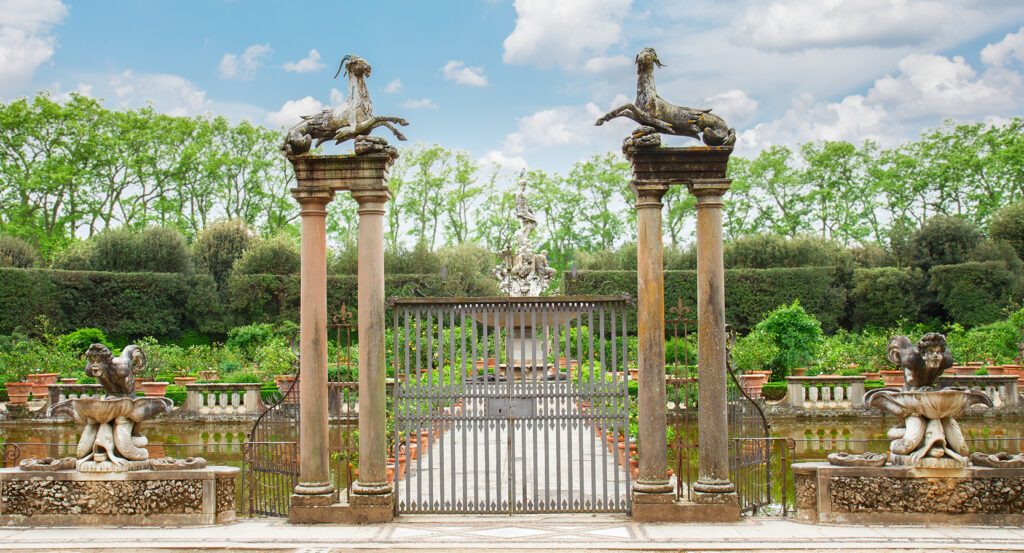
Why you should experience The Isolotto at Boboli Gardens in Florence, Italy.
The Isolotto Basin at the Boboli Gardens in Florence is the grand crescendo of the garden's design, a serene, symbolic island where art and water converge in perfect harmony.
Located at the end of the Viottolone Avenue, the Isolotto (“small island”) feels like a hidden sanctuary within the vastness of the gardens. Surrounded by a moat-like pool and framed by arching trees, it centers on the grand Fountain of the Ocean by Giambologna, a sculptural masterpiece symbolizing the Medici family's dominion over land and sea. The composition is breathtaking: Ocean himself rises from the water, encircled by figures representing the world's great rivers, their forms reflected in the rippling surface. The sound of trickling water, the shifting light on bronze, and the distant view of Florence beyond the greenery create an atmosphere of timeless balance. The Isolotto isn't just a decorative finale, it's a meditation on humanity's relationship with the natural world, rendered with Renaissance precision and poetic restraint.
What you should know about The Isolotto at Boboli Gardens.
The Isolotto Basin was constructed in the 17th century as part of the Boboli Gardens' Baroque expansion under architect Alfonso Parigi the Younger, yet its spirit is deeply rooted in Renaissance symbolism.
The fountain's central figure, the Ocean, represents both power and continuity, echoing the Medici's role as cultural patrons and navigators of political influence. Originally, the basin served as a hydraulic marvel, fed by an underground aqueduct system engineered to keep its water circulating year-round, a rare feat in its era. The surrounding statues and balustrades were arranged to create a visual illusion: as visitors descended the Viottolone, the glimmering water and fountain appeared to rise toward them, amplifying the sense of discovery. For centuries, the Isolotto was also a site for private festivities, with floating stage sets and music drifting across the water under torchlight. Many of these events were recorded in court diaries, describing the basin as a “mirror of paradise.” Its design later inspired similar features in the royal gardens of Versailles and Caserta, cementing its place as a model of Italian garden architecture.
How to fold The Isolotto at Boboli Gardens into your trip.
To fully appreciate the Isolotto Basin, approach it as the grand finale of your walk through the Boboli Gardens.
Follow the Viottolone Avenue downhill from the palace, letting the path's symmetry lead your eye toward the water ahead. Visit in the late afternoon, when the sun casts golden light across the statues and the reflections deepen to bronze and green. The area is quieter than the upper terraces, a perfect place to sit on a bench, listen to the breeze, and watch the blend of light and water that defines the garden's rhythm. Bring a camera, but don't rush; the beauty of the Isolotto lies in its stillness. If time allows, explore the nearby side paths leading toward hidden fountains and groves, they offer intimate views of the basin framed by cypress and laurel. When you look back up toward the palace, you'll understand why this space was designed as the garden's visual and resonant anchor. The Isolotto Basin isn't merely an endpoint, it's the soul of Boboli's design, where water, art, and geometry meet in eternal equilibrium.
Where your story begins.
Foresyte Travel reveals places that feel extraordinary long before you arrive.
Experience premium editorial crafted for luxury travelers.




















































































































