Why Jumeirah Burj Al Arab matters.
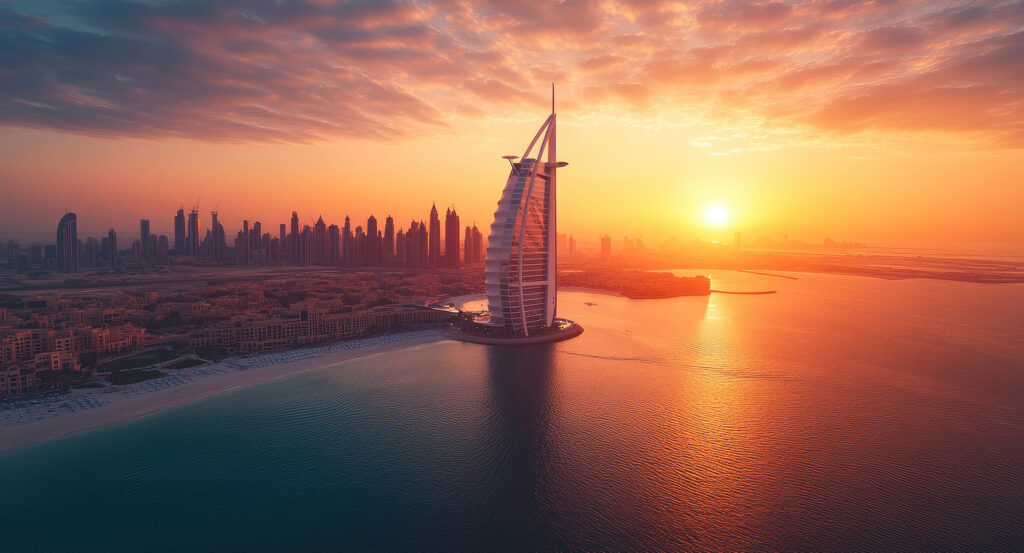
Jumeirah Burj Al Arab is where luxury stops being a concept and becomes a living, breathing force, where the Arabian Gulf rises around you like a shimmering stage, and the hotel itself feels less like a building and more like a myth made visible in steel, glass, and impossible confidence.
Perched on its own man-made island and soaring upward in a perfect sail-shaped arc, the Burj Al Arab doesn't just command attention, it orchestrates it. From the moment you cross the private bridge, the world outside dissolves and the interior hits you with a physical crescendo: a lobby that rises 600 feet in a mirror of gold, marble, and color; fountains spiraling and dancing upward in impossible arcs; and atrium balconies illuminated in shifting jewel tones that move like breath. The suites, all duplex, all dramatic, feel like private palaces floating above the sea, each wrapped in bold curves, sweeping staircases, and panoramic windows that catch the water in brilliant shades of turquoise and cobalt. Every detail feels heightened: carpets thick enough to swallow footsteps, linens that glide against skin, lighting calibrated to glow like candle flame. Even the hallways feel cinematic, lined in rich patterns and gilded symmetry that make simply walking to your suite feel like entering the next act of a grand production. Outside, the sea glitters in kinetic blues, shifting throughout the day from soft morning aquamarine to blazing afternoon turquoise to deep, molten indigo after sunset. And the service, the renowned, whispered-about service, moves with a precision so unobtrusive it feels almost telepathic, anticipating needs, orchestrating moments, and creating a suspended world where everything feels elevated beyond reality. Burj Al Arab isn't subtle. It's not meant to be. It's a staggering expression of Dubai's distinctive ambition: an icon designed to make you feel larger than life, wrapped in opulence that's theatrical, unapologetic, and unforgettable.
What defines Jumeirah Burj Al Arab.
Burj Al Arab is more than an icon, it is among the most technically complex structures ever created, a building shaped by physics, wind science, marine engineering, and illusion-level design choices that most guests never realize they're experiencing.
The island itself had to be constructed on the open Gulf, requiring a foundation of massive concrete honeycomb blocks designed to break waves before they hit the shore, creating a calm perimeter around the tower. This engineering protects not only the structure but also the lobby's soaring atrium, the tallest in the world, which relies on perfect internal pressure balance to achieve its vast, uninterrupted vertical expanse. The exterior “sail” façade is made of a Teflon-coated glass fiber weave that reflects the sun in a way that keeps temperatures stable inside, while also turning the entire building into a luminous lantern after sunset. The two massive steel “wings” on either side of the structure create the iconic silhouette, but they also serve as giant stabilizers, counteracting wind loads and distributing pressure downward like the ribs of a ship. The geometry of the duplex suites is intentional too: the double-height windows are angled to maximize horizon visibility, creating the optical illusion that the sea is rising toward your room. Even the interior opulence hides technical mastery, the gold-leaf surfaces are applied using micro-layering so thin that they conduct heat efficiently, preventing hot spots despite Dubai's intense sun exposure. The dancing fountains in the lobby use overlapping air-pressure jets instead of traditional water propulsion, allowing the arcs to rise in perfectly silent, synchronized patterns without disturbing the building's acoustics. And the Skyview cantilever bar, projected precariously over open water, is supported by a tension structure so intricately calibrated that its margin of flex is measured in millimeters. Guests often feel a heightened sense of presence or clarity inside the Burj without understanding why, it's the result of calculated airflow patterns, the rhythmic sound-softening of the sea surrounding the island, and the precise lighting temperatures designed to mirror natural firelight. Burj Al Arab isn't just iconic because of its silhouette, it is a living study in how engineering, physical psychology, and architectural theater can merge to create an environment that bends reality.
How Jumeirah Burj Al Arab fits.
Jumeirah Burj Al Arab becomes the epicenter of your Dubai journey, a blazing, larger-than-life sanctuary where each day unfolds with cinematic grandeur, aquatic stillness, and a sense of luxury so immersive it recalibrates your entire understanding of indulgence.
Begin your morning by stepping onto your suite's sweeping staircase, watching sunlight spill across the Arabian Gulf in soft gold, and letting breakfast arrive as a quiet ritual: pastries still warm, tropical fruit arranged like art, and coffee served at the perfect temperature. Move down to the private terrace pools suspended over the water, where the breeze carries the scent of the sea and the world feels im distant. Late morning is for exploration: glide down to the hotel's private beach where the water laps the shore in gentle, crystalline ripples, or wander the exclusive pools framed by cabanas, palm shadows, and the soft percussion of distant waves. When the midday sun peaks, retreat into the Talise Spa, suspended 500 feet above the sea, where the glass panels wrap you in panoramic ocean light and the treatments blend deep relaxation with the surreal sensation of floating between sky and water. In the afternoon, take the hotel's private bridge into Jumeirah's coastline or arrange a yacht charter that circles the tower from the sea, giving you the rare chance to experience the Burj Al Arab as it was meant to be seen: rising like a sculpted flame from the water. Return before sunset, because sunset is a performance here, the sea turning molten, the sky deepening into rose and amethyst, and the exterior sail glowing white-gold against the fading light. Dinner at Al Muntaha becomes a suspended moment above the Gulf, where the floor-to-ceiling windows frame Dubai's skyline like living artwork, and each course arrives with a flourish that feels almost theatrical. After dinner, wander the softly lit corridors back to your suite, hearing only the hush of air and the faint echo of the sea outside your windows. Before sleep, take one last look at the city shimmering beyond the glass, a reminder that you are not simply staying in a hotel but inhabiting a global landmark carved into memory and myth. When your journey continues, Burj Al Arab will stay with you: not as a place you visited, but as a world you briefly lived inside, lavish, surreal, and unmatched anywhere on Earth.
Where your story begins.
Foresyte Travel reveals places that feel extraordinary long before you arrive.
Enjoy editorial crafted for luxury travelers.
Foresyte may earn a commission when you book.