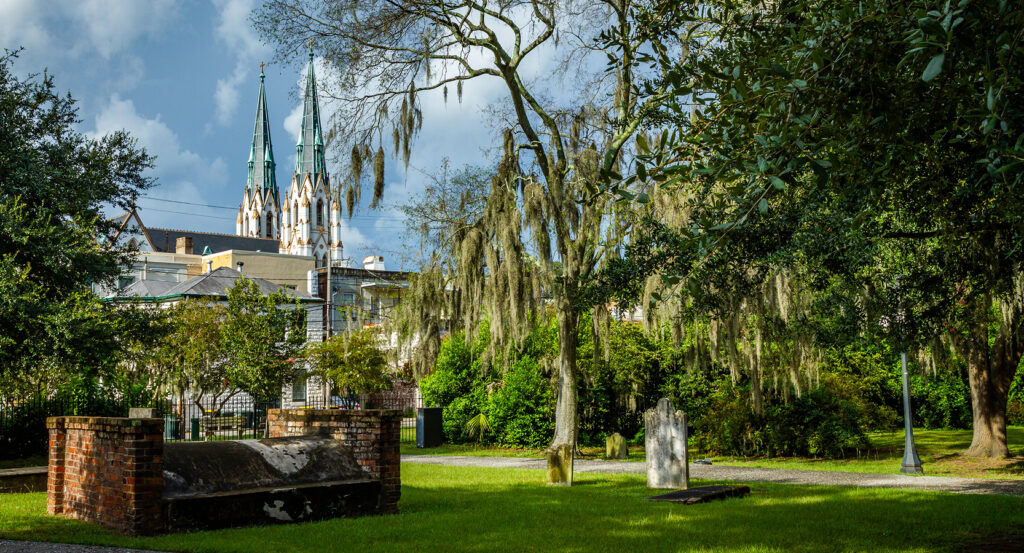
Why you should experience Button Gwinnett Grave in Savannah, Georgia.
Button Gwinnett Grave is a profound Revolutionary memorial where the Historic District's founding legacy, colonial history, civic remembrance, and national heritage preserve the memory of one of America's rarest Founding Fathers.
Located within Colonial Park Cemetery along Abercorn Street near Oglethorpe Avenue and just steps from the Tombstone Wall, this historic memorial invites visitors to reflect on the extraordinary life of a Declaration of Independence signer whose brief political career profoundly shaped Georgia's role in the American Revolution. Moss-draped oaks, weathered headstones, and centuries-old brick pathways create an atmosphere where the nation's founding story feels remarkably immediate. Every visit reveals another chapter in Savannah's Revolutionary past. The result is an experience defined by historical significance, civic remembrance, and one of Georgia's most meaningful colonial sites.
What you should know about Button Gwinnett Grave.
Button Gwinnett Grave is best known for commemorating Button Gwinnett, among Georgia's three signers of the Declaration of Independence, who died on May 19, 1777, three days after his famous pistol duel with Brigadier General Lachlan McIntosh. Although Gwinnett is widely believed to have been buried in Colonial Park Cemetery, the precise location of his remains has never been conclusively identified, making the existing grave marker a memorial. Historians believe his original grave was lost through centuries of deteriorating records, altered monuments, cemetery expansion, and later damage to Colonial Park Cemetery, including vandalism during the Civil War. Gwinnett's brief but influential political career included service in the Continental Congress, signing the Declaration of Independence in 1776, and serving as Georgia's provisional president in 1777 before his fatal rivalry with McIntosh ended his life at just forty-two years of age. Today, the memorial stands as the principal place where visitors honor one of the nation's rarest Founding Fathers, whose autograph is considered among the most valuable and elusive of all fifty-six Declaration signers because so few authenticated examples survive.
Beyond its historical importance, Button Gwinnett Grave demonstrates how public memory can endure even when exact archaeological certainty is lost. The memorial connects visitors with Savannah's Revolutionary landscape while highlighting the continuing efforts of historians to preserve the stories of America's founding generation. Revolutionary history, historic preservation, civic remembrance, documentary scholarship, and national character combine to create one of Georgia's most compelling historical experiences.
How to fold Button Gwinnett Grave into your trip.
Button Gwinnett Grave works as part of an exploration through Savannah's Historic District.
Begin at Colonial Park Cemetery, where Savannah's oldest municipal burial ground introduces the extraordinary historical setting surrounding Button Gwinnett Grave. Continue to the Dueling Grounds at Colonial Park Cemetery, whose association with Gwinnett's fatal 1777 duel deepens the Revolutionary story. Conclude at Johnson Square, where monuments honoring Georgia's colonial leadership provide a memorable finale celebrating the relationship between civic leadership, independence, and public remembrance that defines historic Savannah. The progression moves naturally from burial ground to Revolutionary history before concluding through one of Savannah's defining public squares, revealing why Button Gwinnett Grave remains one of Georgia's essential historical experiences.
Where your story begins.
Foresyte Travel reveals places that feel extraordinary long before you arrive.
Experience premium editorial crafted for luxury travelers.