
Why Fontaine des Mers matters.
Fontaine des Mers is an opulent maritime fountain where Quartier de la Place-Vendôme's ceremonial character meets Jacques-Ignace Hittorff's transformation of Place de la Concorde, an elaborate sculptural program devoted to France's relationship with the sea and the immense urban axis extending between the Tuileries and Champs-Élysées.
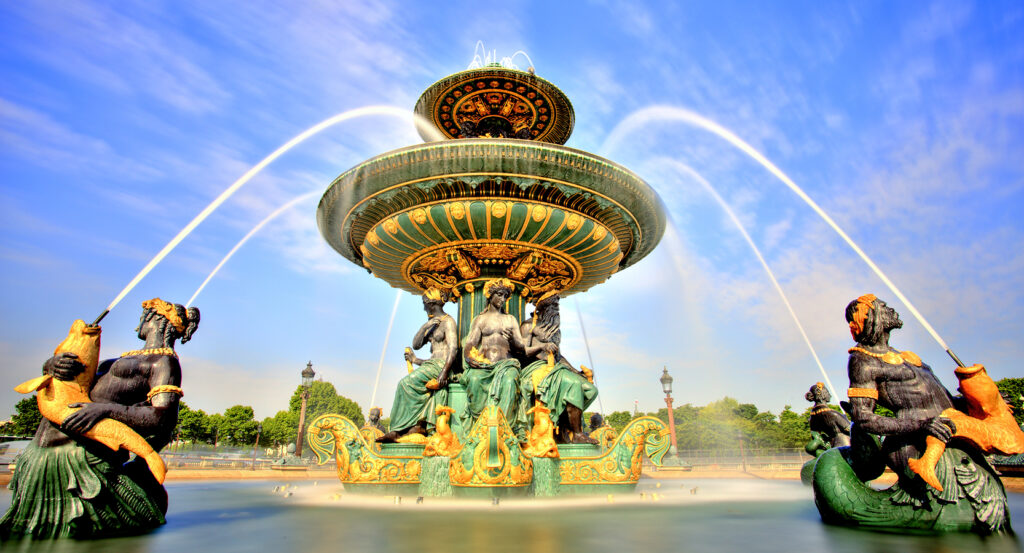
Set within Place de la Concorde near Quai des Tuileries and just steps from Pont de la Concorde, the fountain occupies the southern half of an immense octagonal enclosure where the Seine, Jardin des Tuileries, Champs-Élysées and Ange-Jacques Gabriel's northern palaces create long open sightlines around the Luxor Obelisk. Two superimposed basins rise from the broad circular pool through tiers crowded with seated figures, marine creatures, gilded ornament and water jets. The Seine opens immediately south beyond the balustrades as the obelisk rises to the north, placing the fountain within a powerful cross-axis connecting the river with Rue Royale and the Madeleine. Hittorff's companion Fontaine des Fleuves, rostral columns and ornate lamps extend the same decorative scheme across ground whose immense scale keeps the fountain visible from multiple approaches. The result is a theatrical southern centerpiece whose water, sculpture and maritime symbolism give human and artistic scale to one of Paris's largest public spaces.
What defines Fontaine des Mers.
Fontaine des Mers is best known for forming the maritime half of Jacques-Ignace Hittorff's redesign of Place de la Concorde under the July Monarchy, when an urban space burdened by revolutionary associations acquired a new decorative scheme centered on navigation, commerce and French cities. Ange-Jacques Gabriel had incorporated paired fountains into the eighteenth-century conception of Place Louis XV, yet they remained unrealized when political upheaval repeatedly changed the square's name and purpose. Hittorff received responsibility for a new scheme during the 1830s as Louis-Philippe's government sought imagery detached from a single ruling dynasty. Installation of the Luxor Obelisk in 1836 established the central vertical element, and Hittorff placed two fountains on its north-south axis to balance the Egyptian monument. Fontaine des Mers occupied the Seine side, with Fontaine des Fleuves positioned toward Rue Royale. The southern composition centered its sculptural program on maritime navigation and the economic worlds connected with the sea, complementing the Ministry of the Navy housed in Gabriel's eastern palace on the northern edge of the square. Hittorff distributed the sculptural work among a large group of artists, turning the fountain into a coordinated commission under a single architectural design. Auguste-Hyacinthe Debay created the Ocean and Mediterranean figures, and Antoine Desboeufs contributed allegories associated with fishing and marine harvests. Nicolas Brion developed three upper figures devoted to maritime navigation, commerce and astronomy, connecting ocean travel with trade and scientific knowledge. Antonin Moine, Carle Elshoecht and Louis-Parfait Merlieux supplied tritons and nereids around the lower basin. Fontaine des Mers and its northern counterpart were inaugurated on May 1, 1840 by Prefect Rambuteau, completing a central ensemble in which Hittorff used maritime imagery to give the former revolutionary square a new nineteenth-century civic program.
The fountain's technical history centers on Hittorff's ambitious use of cast iron for an extensive sculptural ensemble exposed continuously to moving water. Its principal sculptures were produced in 1837 and 1838, with the Fonderie de Tusey at Vaucouleurs responsible for casting components designed for the Place de la Concorde fountains. Cast iron offered Hittorff a means of producing large, complex figures across a coordinated public scheme, and selected elements received gilding that heightened the contrast between dark statuary, reflective water and metallic ornament. Contact with water exposed weaknesses early, prompting intervention in 1861 only two decades after inauguration. Further repairs altered portions of the original treatment, and damaged tritons and nereids later received bronze replacements during work in 1932. A major conservation campaign in 2000 and 2001 addressed the fountain again as specialists sought to recover aspects of Hittorff's nineteenth-century finish. The Ville de Paris undertook another restoration in 2023 ahead of the Paris 2024 Olympic and Paralympic Games, cleaning the cast-iron sculpture, renewing its surface treatment, adding protective wax and refurbishing technical installations beneath the basin. That campaign returned the fountain to service as a working hydraulic sculpture 183 years after its inauguration, preserving an unusually complex union of nineteenth-century casting, sculpture, gilding and water engineering.
How Fontaine des Mers fits.
Fontaine des Mers works as the anchor for a daytime exploration across the western Tuileries using three nearby sites that move from an eighteenth-century royal repository through a Second Empire sporting pavilion into Claude Monet's purpose-built installation of the Nymphéas.
Begin at Hôtel de la Marine, part of the pair of classical palaces Ange-Jacques Gabriel designed along the northern edge of the original Place Louis XV. The eastern building was assigned to the Garde-Meuble de la Couronne in 1765, and the institution occupied the entire palace by 1767 under intendant Pierre-Élisabeth de Fontanieu, who organized storage areas, workshops, official apartments, exhibition galleries and a chapel around its royal administrative purpose. Revolutionaries seized weapons from its armory on July 13, 1789 before proceeding to the Bastille the following day, and thieves removed the Crown Jewels from the palace in September 1792. Naval administration subsequently occupied the building for more than two centuries, establishing the institutional presence that later supplied Hittorff with a central theme for the square. Continue to Jeu de Paume, created after construction of Charles Garnier's opera required demolition of a racquet court in Passage Sandrié in 1861. Napoleon III authorized the displaced club to occupy the northwest corner of the Jardin des Tuileries, where Melchior Viraut designed a new building opened on January 29, 1862. Viraut deliberately echoed the decorative principles of the Orangerie standing opposite on the garden's southwest corner, using the paired structures to strengthen the architectural symmetry of the western Tuileries. Sporting use later yielded to museum functions, and the building developed into an institution devoted to modern and contemporary image culture and photography. Conclude at Musée de l'Orangerie, constructed in 1852 under Napoleon III to shelter the Tuileries' orange trees during winter. Architect Firmin Bourgeois gave the long building a glazed southern facade facing the Seine and an almost blind northern wall for protection from cold winds, with Louis Visconti designing the principal entrance decoration. Georges Clemenceau later proposed the building for Claude Monet's Nymphéas, which the painter gave to the French state through a donation formalized in 1922. Monet worked with architect Camille Lefèvre on two oval rooms arranged east-west, where eight panels extending 91 meters surround the viewer beneath natural overhead light; Clemenceau inaugurated the installation on May 17, 1927. The progression moves from Gabriel and Fontanieu's royal repository through Viraut's Second Empire racquet pavilion into Bourgeois, Lefèvre, Clemenceau and Monet's conversion of an orangery into a permanent artistic installation, building a compact route through three institutions that transformed the western edge of the Tuileries across successive political and cultural eras.
Where your story begins.
Foresyte Travel reveals places that feel extraordinary long before you arrive.
Enjoy editorial crafted for luxury travelers.
Foresyte may earn a commission when you book.














































































































