
Why Fontaine des Fleuves matters.
Fontaine des Fleuves is an opulent sculptural fountain where Champs-Élysées's ceremonial character meets Jacques-Ignace Hittorff's transformation of Place de la Concorde, grand cast-iron sculpture and an allegorical program devoted to France's great rivers and agricultural wealth.
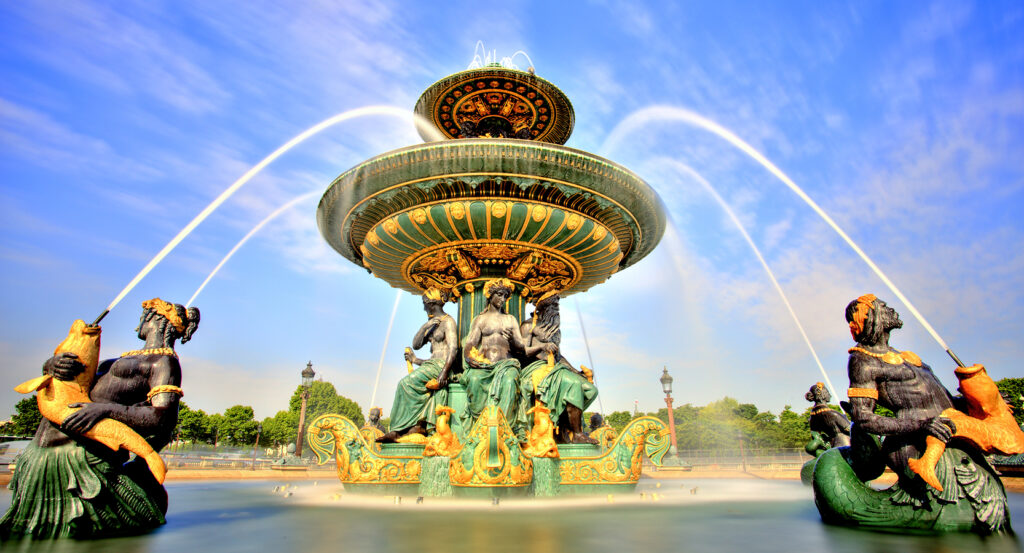
Set within Place de la Concorde near Rue Royale and just steps from the Luxor Obelisk, the fountain occupies the northern half of an immense open composition bounded by the Champs-Élysées, Jardin des Tuileries and the eighteenth-century palaces lining the square's northern edge. Two stacked basins rise beneath a dense assembly of seated figures, tritons, nereids and water jets, with dark metal sculpture standing sharply against pale paving and the gilded details distributed across Hittorff's surrounding street furniture. The Luxor Obelisk establishes the central vertical axis immediately south as Fontaine des Mers answers from the opposite side, making the fountain one component of a larger symmetrical composition. Rue Royale opens directly behind it toward the Madeleine, extending a powerful north-south sightline across architecture, sculpture and open sky. The result is a fountain experienced simultaneously as intricate sculpture and urban architecture, with its figures, water and grand scale inseparable from Hittorff's ordering of Place de la Concorde.
What defines Fontaine des Fleuves.
Fontaine des Fleuves is best known for forming the northern half of Jacques-Ignace Hittorff's grand fountain pair created during the nineteenth-century reconstruction of Place de la Concorde. Ange-Jacques Gabriel had incorporated fountains into earlier thinking for the royal square, yet the idea remained unrealized when political upheaval repeatedly altered the site's commemorative purpose. Hittorff received responsibility for reshaping the square during the reign of Louis-Philippe and organized his intervention around the Luxor Obelisk, erected in 1836 under engineer Apollinaire Lebas. He placed Fontaine des Fleuves north of the obelisk toward Rue Royale and Fontaine des Mers south toward the Seine, creating a symmetrical composition devoted respectively to inland waterways and maritime power. Both fountains were produced during 1837 and 1838 before their inauguration by Prefect Claude-Philibert de Rambuteau on May 1, 1840. Hittorff extended their aquatic theme through rostral columns carrying ship prows and other nautical ornament distributed around the square, connecting the fountains with the former Garde-Meuble building then occupied by the Ministry of the Navy. Eight statues representing Brest, Rouen, Lille, Strasbourg, Lyon, Marseille, Bordeaux and Nantes occupied the perimeter pavilions, broadening the program from waterways into a geographic representation of France. The fountain pair belonged to an integrated urban commission in which the Egyptian obelisk, French cities, navigation, agriculture, commerce and naval imagery reorganized a square still carrying the political memory of the Revolution.
The sculptural program concentrates that national geography into figures representing rivers, cultivation and productive activity. Jean-François Gechter created the seated personifications of the Rhône and Rhine, placing two major European waterways among the colossal figures surrounding the upper basin. Honoré Jean Aristide Husson supplied La Moisson and La Vendange, connecting grain and wine production with the river systems supporting inland agriculture. François Lanno extended the sequence through La Récolte des fleurs and La Récolte des fruits, giving cultivated products an equal position within the principal sculptural register. Jean-Jacques Feuchère contributed allegories associated with river navigation, agriculture and industry beneath the upper basin, tightening the connection between waterways and economic activity. Tritons and nereids occupy the lower basin with fish projecting streams of water toward the central composition. Cast iron used for the sculptures during 1837 and 1838 represented an innovative choice, yet sustained contact with water exposed weaknesses that required intervention as early as 1861 and another campaign in 2000 and 2001. A comprehensive restoration in 2023 cleaned and recolored the figures, added protective wax and renewed technical installations beneath the fountain, recovering the nineteenth-century appearance of a sculptural ensemble whose fabrication history proved as consequential as its allegorical design.
How Fontaine des Fleuves fits.
Fontaine des Fleuves works as the anchor for a daytime exploration across the architectural territory surrounding Place de la Concorde using three nearby sites that move from a church repeatedly reconceived across three political regimes through Claude Monet's purpose-built cycle of paintings into a princely palace converted for national legislative government.
Begin at Église de la Madeleine, reached along the axial extension of Rue Royale and shaped by a construction history spanning close to eighty years. Louis XV laid the first stone in 1764 for an earlier church project, but the Revolution interrupted construction and generated proposals for uses ranging from a library to an opera. Napoleon redirected the project in 1806 toward a temple dedicated to the Grande Armée and entrusted Pierre-Alexandre Vignon with the severe Corinthian composition that survives. Jean-Jacques Huvé continued the undertaking after Vignon's death in 1828, and the building returned to its religious purpose under the Restoration before consecration in 1842. Fifty-two Corinthian columns surround the exterior, giving the church the form of an ancient temple and closing the northern vista from Place de la Concorde with one of nineteenth-century Paris's most emphatic Neoclassical compositions. Continue to Musée de l'Orangerie, where Claude Monet's late Nymphéas transformed a former Tuileries service building into an installation conceived around painting, architecture and natural light. Monet offered two decorative panels to the French state on November 12, 1918 as a peace memorial following the Armistice, and Georges Clemenceau persuaded his friend to enlarge the gift. An agreement with Beaux-Arts director Paul Léon followed in 1920, and the formal donation of nineteen panels was signed on April 12, 1922. Monet worked with architect Camille Lefèvre on their installation, producing two oval rooms arranged as an infinity symbol and oriented east-west. Eight paintings measuring two meters high extend for 91 meters through the completed rooms, which opened under Clemenceau on May 17, 1927, months after Monet's death. Conclude across the Seine at Palais Bourbon, commissioned after Louise-Françoise de Bourbon acquired the site in 1720. Giardini, Lassurance, Jacques Gabriel and Jean Aubert successively directed construction between 1722 and 1728, creating a low residence between court and garden whose design recalled the Grand Trianon. Revolutionary confiscation converted the palace into national property in 1791, and the Conseil des Cinq-Cents received it in 1795 before the first legislative chamber opened there in 1798. Bernard Poyet added the Seine-facing colonnade between 1806 and 1810, giving the former aristocratic residence the grand front aligned across Pont de la Concorde. The progression moves from Vignon's Napoleonic temple recast as a church through Monet and Clemenceau's memorial to peace into a Bourbon residence converted for parliamentary government, carrying the political and artistic transformations surrounding Place de la Concorde across the eighteenth, nineteenth and twentieth centuries.
Where your story begins.
Foresyte Travel reveals places that feel extraordinary long before you arrive.
Enjoy editorial crafted for luxury travelers.
Foresyte may earn a commission when you book.














































































































