
Why Dahl & Di Luca Ristorante Italiano matters.
Dahl & Di Luca Ristorante Italiano is a celebrated Italian restaurant where West Sedona's independent hospitality culture meets Lisa Dahl's pioneering fine-dining legacy, personal reinvention and three decades of culinary achievement rooted in the regional traditions of Italy.
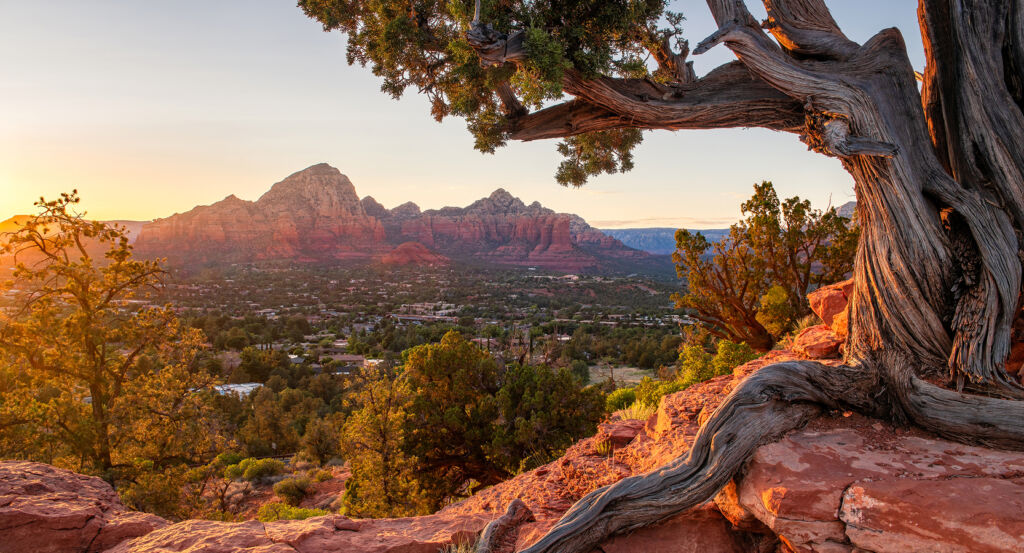
Set along West State Route 89A near Andante Drive and a short drive from Amitabha Stupa and Peace Park, the restaurant occupies West Sedona's established commercial corridor beneath Thunder Mountain, between the residential streets extending north toward Pueblo Drive and the sandstone foothills overlooking the highway. The freestanding building retains the intimate scale of its original roadside setting, with a formal dining room distinguished by silk draperies, crystal chandeliers, candlelit tables and carefully arranged seating. A secluded garden terrace extends the restaurant outdoors, bringing wrought-iron furnishings, ornamental planting and soft evening lighting into a setting influenced by traditional Italian courtyards. Live piano and jazz performances contribute to the dining room's supper-club character, connecting the restaurant's physical intimacy with its longstanding tradition of celebratory dining. The result is a restaurant whose modest roadside footprint conceals an elaborately appointed interior that has become closely associated with Sedona's development as a destination for independent fine dining.
What defines Dahl & Di Luca Ristorante Italiano.
Dahl & Di Luca Ristorante Italiano is best known for establishing Lisa Dahl's distinctive interpretation of traditional Italian fine dining in Sedona, providing the foundation for one of Northern Arizona's most influential independent restaurant groups. Raised in Indianapolis, Dahl grew up in a family connected with fashion and design, with her mother graduating from the Fashion Institute of Technology before establishing a collection of clothing boutiques. Dahl followed that professional direction into the fashion industry in San Francisco, developing an appreciation for visual presentation and craftsmanship that subsequently shaped her restaurants. Her life changed profoundly in March 1994 when her twenty-three-year-old son Justin was fatally stabbed after attempting to assist a robbery victim. The tragedy prompted Dahl to leave California and relocate to Sedona, where cooking became central to her personal recovery and the pursuit of a restaurant business she had envisioned with her son. A self-taught chef, she traveled through Italy to deepen her understanding of regional preparations, developing an approach centered on delicate pasta, carefully prepared vegetables and traditional seafood dishes. Dahl partnered with Andrea Di Luca to transform a shuttered drive-through establishment into an intimate Italian dining room, opening Dahl & Di Luca in November 1995. The partners began with limited financial resources, gradually reinvesting earnings into the restaurant's interior and culinary program. Dahl's design background contributed directly to the transformation, bringing silk fabrics, decorative lighting and carefully composed table settings into a building constructed for an entirely different commercial purpose. Her ambition centered on the character of traditional Italian supper clubs, where attentive service, live music and extended meals formed an integral part of the dining occasion. The restaurant's success provided the foundation for Cucina Rustica in 2003, followed by Pisa Lisa in 2012, Mariposa Latin Inspired Grill in 2015 and Butterfly Burger in 2019, extending Dahl's hospitality enterprise across Mediterranean, South American and contemporary American cooking. She published The Elixir of Life: Finding Love and Joy in the Passionate Pursuit of Food in 2010, combining recipes with an autobiographical account of her transition from fashion to professional cooking. Dahl & Di Luca developed a particularly distinguished wine program, earning Wine Spectator's Award of Excellence for fifteen consecutive years through 2020 and strengthening its reputation for traditional European dining. Its twenty-fifth anniversary celebration featured a retrospective four-course menu highlighting preparations associated with the restaurant's earlier decades. Dahl's wider professional recognition included appearances at the James Beard House and national coverage of her contribution to Sedona's restaurant industry. Throughout the expansion of her restaurant group, Dahl & Di Luca retained its position as the original establishment and the foundation of her professional reputation. Its significance rests on this transformation from a modest roadside conversion into a respected Italian restaurant, connecting Dahl's personal history with the growth of an independent hospitality enterprise that helped shape Sedona's culinary ambitions.
Lisa Dahl's cooking develops through the relationship between delicate pasta, classical sauces and carefully selected ingredients, drawing principally upon the regional traditions of northern and Central Italy. Her approach places particular importance on balancing richness and acidity, allowing familiar preparations to develop depth through precise cooking and restrained seasoning. Ravioli Romana demonstrates this relationship through four-cheese pasta accompanied by sautéed crimini and champignon mushrooms and a white truffle cream sauce, combining tender pasta with the earthiness of mushrooms and the concentrated aroma of truffle. Vitello Piccata follows the classical Italian practice of preparing thin veal scaloppine through brief cooking, with lemon, capers and Chardonnay contributing acidity and aromatic depth to the delicate meat. Orzo pilaf and green vegetables provide contrasting textures, extending the preparation beyond the familiar combination of veal and lemon. Seafood introduces another dimension through preparations grounded in Italy's coastal traditions, where prawns and fish receive careful treatment with olive oil, garlic, herbs and wine. Prawns Fiorentina develops this approach through tender seafood and spinach, bringing the classical Florentine association between vegetables and creamy accompaniments into a substantial main course. Dahl's emphasis on vegetables extends into Eggplant Parmigiana, whose carefully cooked slices of eggplant, tomato sauce and cheese develop a preparation grounded in southern Italian cooking. The dish demonstrates the importance of ingredient quality and controlled cooking in achieving depth through a relatively restrained combination. Across these preparations, the kitchen maintains a consistent relationship between traditional technique and carefully balanced sauces, allowing individual ingredients to retain their character. The wine program extends this approach through Italian regional varieties and established European producers, with selections chosen to complement the acidity, richness and herbal qualities of the food. Live music accompanies the evening service, preserving the supper-club tradition that shaped Dahl's original ambitions for the restaurant. Dahl & Di Luca's culinary distinction emerges from this sustained commitment to classical Italian preparations, bringing delicate pasta, carefully developed sauces and regional ingredients together within a dining tradition refined across three decades.
How Dahl & Di Luca Ristorante Italiano fits.
Dahl & Di Luca Ristorante Italiano works as the dining culmination of an exploration connecting West Sedona's Tibetan Buddhist heritage, sandstone trail system and community-supported civic institutions, placing the restaurant within the cultural and geographic development of the city's western neighborhoods.
Begin at Amitabha Stupa and Peace Park, the Tibetan Buddhist sanctuary established beneath Thunder Mountain through the work of Kunzang Palyul Chöling, a religious community associated with the Nyingma tradition of Tibetan Buddhism. Its principal monument, the thirty-six-foot Amitabha Stupa, was consecrated in 2004 and incorporates the symbolic architectural forms associated with traditional Buddhist stupas. The surrounding grounds contain a smaller White Tara Stupa, prayer flags, devotional sculptures and walking paths extending through juniper woodland. The sanctuary occupies fourteen acres, preserving a substantial area of undeveloped desert terrain within West Sedona's residential district. Its public accessibility connects the neighborhood with a religious tradition whose monuments and devotional practices originated far beyond the American Southwest. Continue to Sugarloaf Trailhead, the access point connecting West Sedona's residential streets with the sandstone formations surrounding Sugarloaf Mountain and Chimney Rock. The trail system crosses exposed sedimentary formations whose red coloration derives from iron oxide within the sandstone. Its principal summit route ascends toward an elevated viewpoint overlooking the surrounding neighborhoods and the formations extending north toward the Coconino National Forest. Connections with the Teacup Trail extend the route through additional areas of juniper woodland and exposed rock, revealing the close relationship between the city's developed streets and its surrounding public lands. The terrain provides a direct introduction to the geological formations that have shaped Sedona's residential development and its reputation for outdoor recreation. Conclude at Sedona Public Library, the independent community institution founded through a volunteer initiative in 1958. Its original collection occupied donated space and consisted of three shelves of books and magazines, developing through contributions from local residents. Helen Ecker and Eugenia Wright subsequently donated land for a dedicated building on Jordan Road, which opened in 1969 through community fundraising. A major expansion followed Ethel M. Low's $326,000 contribution toward a larger site, supporting construction of the White Bear Road facility designed by The Design Group. The building was dedicated on October 1, 1994, following a community effort that included the symbolic transfer of thousands of books from the former library. The progression connects West Sedona's Buddhist sanctuary with the geological landscape of its western foothills and concludes at a civic institution whose development demonstrates the community's sustained investment in education and public life.
Where your story begins.
Foresyte Travel reveals places that feel extraordinary long before you arrive.
Enjoy editorial crafted for luxury travelers.
Foresyte may earn a commission when you book.


























































































































