Why Dewakan Restaurant matters.
Dewakan Restaurant is a pioneering two-MICHELIN-starred Malaysian restaurant where Kuala Lumpur City Centre's modern commercial skyline meets chef Darren Teoh's exploration of indigenous ingredients, traditional food preservation and the extraordinary biodiversity of Malaysia's tropical landscapes.
Persiaran KLCC curves through Platinum Park east of the Petronas Twin Towers, placing the restaurant near the junction with Jalan Binjai, where landscaped corporate plazas, high-rise residences and the surrounding commercial towers connect Kuala Lumpur's financial district with its principal metropolitan park. The restaurant occupies the 48th floor of Naza Tower, with floor-to-ceiling glazing establishing expansive views across the capital's densely developed skyline. Its contemporary dining room combines carefully arranged tables, subdued lighting and restrained furnishings, allowing the surrounding architecture and changing evening light to contribute to the interior's character. Locally crafted tableware and custom dining furniture establish a material connection with Malaysian artisans, complementing the kitchen's emphasis on ingredients cultivated and harvested throughout the country. The result is an intimate elevated dining room whose panoramic urban setting provides a striking architectural counterpart to the restaurant's investigation of Malaysia's forests, farms and coastal environments.
What defines Dewakan Restaurant.
Dewakan Restaurant is best known for establishing indigenous Malaysian ingredients as the foundation of an internationally recognized fine-dining institution, bringing the country's botanical diversity and traditional food practices into the highest levels of contemporary gastronomy. Chef Darren Teoh developed the restaurant through his work in culinary education, combining professional cooking with an interest in Malaysia's agricultural heritage and lesser-known edible species. The project began at KDU University College in Shah Alam, where Teoh worked as a culinary lecturer and developed a restaurant that provided practical training for students. Dewakan opened in 2015, introducing a tasting-menu format centered on ingredients sourced from Malaysian farms, forests, rivers and coastal communities. Its name combines the Malay words dewa, meaning god, and makan, meaning eat, expressing gratitude for the natural resources supporting the country's food traditions. Teoh developed relationships with growers and foragers whose knowledge of native plants introduced the kitchen to ingredients seldom encountered in conventional restaurant supply chains. His work expanded the culinary possibilities of fruits, seeds, leaves and roots associated with different Malaysian ecological regions. The restaurant attracted national attention through its technically demanding preparations and its commitment to building an independent Malaysian approach to fine dining. In 2019, Dewakan entered Asia's 50 Best Restaurants, becoming the first Malaysian establishment to appear on the main list and placing 46th. This achievement brought international attention to a restaurant whose cooking drew directly upon the country's agricultural and botanical resources. Dewakan subsequently relocated from its educational-campus origins to Naza Tower in Central Kuala Lumpur, establishing a larger independent operation within the capital's principal commercial district. The relocation strengthened its ability to develop an extensive tasting menu supported by specialized preparation facilities and an established professional kitchen. Teoh continued expanding the restaurant's preservation techniques, incorporating dry aging, fermentation and the careful utilization of animal and vegetable ingredients. The inaugural MICHELIN Guide Kuala Lumpur and Penang awarded Dewakan one star in its 2023 edition, recognizing the significance of its contemporary Malaysian cooking. The following edition elevated the restaurant to two MICHELIN stars, making Dewakan the first Malaysian restaurant to receive that distinction. The achievement placed Teoh's work within a small international group of restaurants recognized for exceptional technical cooking and distinctive culinary authorship. MICHELIN subsequently awarded Dewakan Malaysia's first Green Star in its 2025 guide, recognizing the restaurant's commitment to sustainable sourcing and resource conservation. Its practices included the use of indigenous ingredients, the development of relationships with local producers and the transformation of kitchen byproducts into fermented seasonings. The kitchen's nose-to-tail approach extended the culinary use of animal ingredients, complementing its treatment of native plants and agricultural produce. Teoh also emphasized the importance of Malaysian craftsmanship through tableware produced by local artists, connecting the restaurant's hospitality program with the country's creative communities. Dewakan's development established a significant chapter in Malaysian gastronomy, demonstrating how indigenous agricultural knowledge and advanced professional cooking could support an internationally distinguished restaurant.
Darren Teoh's cooking begins with the botanical diversity of Malaysia, drawing upon ingredients cultivated in agricultural regions and gathered from the country's tropical forests. His approach concentrates on the natural properties of individual plants and animals, developing their flavors through controlled fermentation, drying, aging and carefully managed heat. Indigenous fruits provide an important foundation through their contrasting acidity, sweetness and aromatic character. Bambangan, a wild mango associated with Sabah, contributes a pronounced fruity acidity that supports preparations involving seafood, preserved ingredients and desserts. Dabai, a dark-skinned fruit native to Borneo, introduces a rich, creamy character that develops further through careful preparation. The kitchen explores these properties through combinations that connect unfamiliar tropical ingredients with recognizable culinary textures. Fermentation provides another essential discipline, allowing the natural sugars and proteins of agricultural products to develop concentrated savory flavors. Fermented sauces produced from kitchen byproducts contribute seasoning to preparations involving vegetables, fish and meat, extending the useful life of ingredients through controlled microbial activity. Dry aging supports the treatment of selected seafood and animal proteins, reducing moisture and developing a firmer texture with concentrated flavor. The kitchen applies these techniques to Malaysian fish and shellfish, preserving their distinctive natural sweetness through precise cooking. Slipper lobster provides a substantial example through charcoal grilling, which develops a lightly browned exterior and concentrates the crustacean's flavor. Noni, a tropical fruit associated with traditional medicinal and food practices, contributes a pungent character that requires careful balancing through complementary ingredients. Bamboo shoots introduce a tender vegetable texture, and aromatic leaves provide fragrance associated with Malaysia's tropical vegetation. Breadfruit supplies a grain-like foundation through its starchy flesh, allowing the kitchen to develop flatbreads that complement concentrated seafood preparations. Native herbs contribute further complexity through their distinctive citrus, floral and peppery characteristics. The restaurant's use of edible leaves and flowers establishes a direct relationship between the menu and the country's botanical resources. Animal preparations extend this approach through the utilization of cuts and organs that require specialized handling, connecting resource conservation with classical butchery techniques. Carefully developed broths extract flavor from bones and connective tissue, creating concentrated liquids that support the kitchen's seasonal ingredients. Desserts preserve the emphasis on indigenous produce through tropical fruit, coconut and preparations incorporating native seeds. Coconut jelly provides a delicate textural foundation, complemented by the acidity of preserved fruit and the concentrated sweetness of regional ingredients. The tasting menu assembles these preparations into a carefully organized succession of courses, supported by wine and alcohol-free pairings. Locally produced ceramic vessels and serving pieces contribute to the presentation of ingredients whose cultivation and preparation connect the restaurant with different Malaysian communities. Teoh's contribution lies in the sustained development of a culinary program that treats Malaysia's biodiversity as a source of technical discovery, preserving the agricultural knowledge and distinctive flavors associated with the country's varied environments.
How Dewakan Restaurant fits.
Dewakan Restaurant works as the concluding destination for a Kuala Lumpur City Centre itinerary connecting Malaysia's petroleum-driven urban development, the landscape architecture of its principal metropolitan park and the contemporary pedestrian infrastructure linking the financial district with historic Kampung Baru.
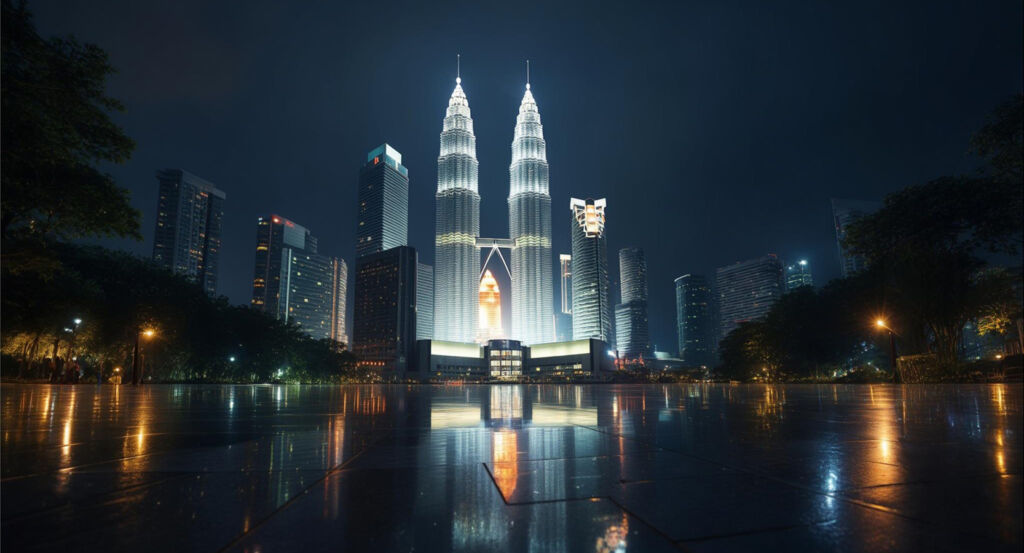
Begin at Petronas Twin Towers, the celebrated skyscrapers developed as the architectural centerpiece of the Kuala Lumpur City Centre project. Argentine-American architect César Pelli designed the towers, incorporating an eight-pointed geometric plan influenced by Islamic architectural traditions. Construction began in 1993, with separate construction teams responsible for the two towers and their coordinated structural development. The buildings were completed in 1996 and formally opened in 1999, establishing a defining feature of Malaysia's rapidly expanding capital. Their stainless-steel and glass façades rise 452 meters above the surrounding district, creating a composition whose repeated geometric forms establish a distinctive relationship between modern engineering and Islamic design. A double-deck skybridge connects the towers at the 41st and 42nd floors, providing structural flexibility and pedestrian circulation between the buildings. The complex became an important symbol of Malaysia's economic development and the international ambitions associated with the Kuala Lumpur City Centre redevelopment. Continue to KLCC Park, the landscaped public garden occupying the southern portion of the development. Brazilian landscape architect Roberto Burle Marx designed the park, bringing his experience in tropical planting and modernist landscape composition to the Malaysian capital. The grounds extend across 50 acres, incorporating mature trees, carefully arranged planting beds and pedestrian paths that connect the surrounding commercial buildings. Its design preserves areas of tropical vegetation within a densely developed metropolitan district, establishing a substantial public green space beneath the surrounding skyscrapers. Lake Symphony forms the principal water feature, with fountains and illuminated displays creating a prominent gathering place near the commercial center. The park also contains a children's playground, jogging paths and recreational facilities, supporting public use throughout the day. Its landscape composition establishes a significant relationship between the capital's modern architecture and the tropical environment of peninsular Malaysia. Conclude at Saloma Link, the pedestrian and cycling bridge connecting Kuala Lumpur City Centre with Kampung Baru across the Klang River and surrounding transport infrastructure. The bridge opened in February 2020, introducing a direct connection between the modern commercial district and one of Kuala Lumpur's oldest Malay residential communities. Its design draws upon the decorative geometry of the sirih junjung, a traditional arrangement of betel leaves associated with Malay ceremonial practices. The structure extends 69 meters across its principal span, with an illuminated canopy incorporating thousands of LED lights. Its geometric exterior creates a distinctive nighttime appearance, connecting contemporary engineering with decorative forms associated with Malaysian cultural traditions. The bridge commemorates singer Saloma, whose career contributed to the development of Malaysian popular music and cinema during the twentieth century. Its construction strengthened pedestrian access between the commercial towers and the traditional houses, restaurants and neighborhood streets of Kampung Baru. The progression moves from the architectural ambitions of Malaysia's petroleum economy through the tropical landscape of Kuala Lumpur's principal urban park and culminates at a contemporary bridge connecting the capital's modern commercial center with its historic Malay residential district.
Where your story begins.
Foresyte Travel reveals places that feel extraordinary long before you arrive.
Enjoy editorial crafted for luxury travelers.
Foresyte may earn a commission when you book.