Why you should experience Dhow Wharfage in Dubai, United Arab Emirates.
Along the salt-scented banks of Dubai Creek, where the city's glass skyline fades into the haze of history, Dhow Wharfage remains one of the last living portraits of old Dubai, a place where trade, toil, and tradition still move to the rhythm of the tides.
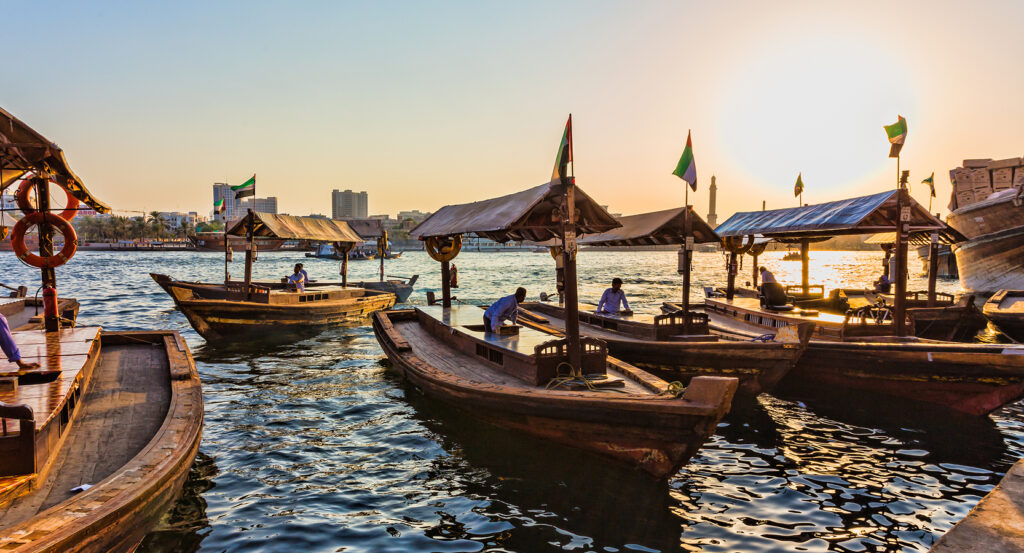
Here, wooden dhows, their hulls painted turquoise and cobalt, sit heavy with cargo from across the Gulf: air conditioners from Korea, spices from India, textiles from Iran, and electronics from Africa. The air hums with activity, the creak of ropes, the scrape of crates dragged across wood, the shouts of sailors echoing in a dozen languages. It's not a polished attraction but a working harbor, gritty and alive. The scent of diesel mingles with salt and cardamom, while gulls circle lazily overhead. As the sun sets, the water turns to molten gold, reflecting the silhouettes of these ancient vessels against the modern towers of Deira and Bur Dubai, a timeless tableau of commerce and endurance. In a city famed for performance, Dhow Wharfage is something rarer: authenticity unbent by time.
What you should know about Dhow Wharfage.
What most travelers never realize is that Dhow Wharfage is not a museum, it's one of the oldest continuously operating ports in the Arabian Gulf, a cornerstone of Dubai's evolution from fishing village to global powerhouse.
Located along Baniyas Road in Deira, the wharf stretches for nearly two kilometers, accommodating hundreds of dhows at any given time. Many of these vessels are hand-built from teak, following centuries-old craftsmanship techniques that trace back to Oman, Yemen, and India's Malabar Coast. Despite Dubai's rise into steel and skyline, the dhow trade remains astonishingly manual, no cranes, no mechanized systems, just muscle, trust, and the quiet dignity of labor. Crews live aboard for months, sleeping in bunks stacked above barrels of cargo, cooking on open decks as they navigate between Dubai, Muscat, Basra, and beyond. These are the same routes their ancestors sailed long before oil was discovered. While the Creek's modern extensions, like Al Seef and Dubai Creek Harbour, showcase innovation, Dhow Wharfage preserves the heartbeat of the city's original lifeline: trade, human and humble.
How to fold Dhow Wharfage into your trip.
To fold Dhow Wharfage into your Dubai journey, come.
Visit in the late afternoon, when the light softens and the dhows glow bronze against the setting sun. Walk along Baniyas Road, starting near the Al Ras metro station, where the scent of spices from the nearby Deira Souk drifts through the air. Approach quietly; this isn't a tourist performance, but a working community. You'll see crews mending nets, loading cargo, and sharing tea poured from dented kettles, gestures of hospitality as ancient as the vessels themselves. From certain vantage points near the Al Sabkha Abra Station, you can watch the dhows framed perfectly by the Burj Khalifa rising in the far distance, old and new Dubai in one breathtaking line of sight. As evening settles, take an abra across the Creek to Al Fahidi or Al Seef, watching the wharf's lights flicker across the water like fireflies. Few moments in Dubai feel this unfiltered, Dhow Wharfage is the city stripped bare, still trading, still dreaming, still sailing forward on memory and faith.
Where your story begins.
Foresyte Travel reveals places that feel extraordinary long before you arrive.
Experience premium editorial crafted for luxury travelers.