Why Domus Augustana matters.
Domus Augustana at Palatine Hill is Rome's silent chamber of empire, a palace of power turned to poetry.
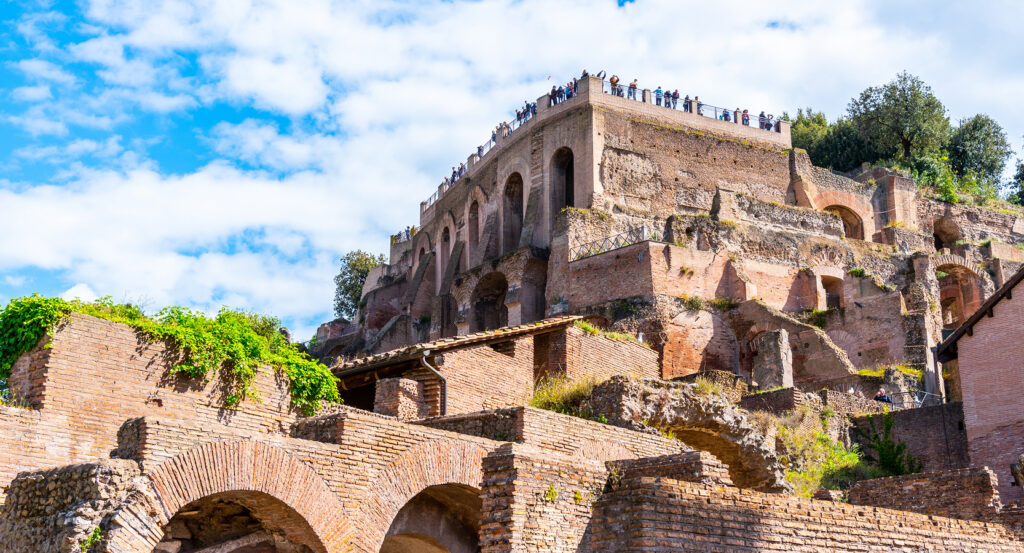
Here, beneath the cypress and olive trees, lie the remains of what was once the emperor's private residence, marble floors now softened by moss, broken columns tracing the outlines of vanished opulence. Yet even in ruin, Domus Augustana radiates grace. You can still sense the symmetry, the geometry, the deliberate quiet of its courtyards and fountains. Standing here feels like trespassing on the afterglow of greatness, a place built not merely to impress, but to endure. The wind moves through the open arches like breath through a memory.
What defines Domus Augustana.
Commissioned in the 1st century CE by Emperor Domitian, Domus Augustana formed the private wing of the Domus Flavia, together comprising one of antiquity's most sophisticated architectural complexes.
This was no simple palace, it was a city within a city, complete with gardens, libraries, and audience halls. The lower levels, facing the Circus Maximus, offered terraces where emperors could watch games in seclusion. Polished marble reflected pools of still water, creating illusions of infinity, a design that blended engineering and serenity. Few visitors realize the scale of the compound: Domus Augustana stretched across multiple terraces, with hidden corridors linking its courtyards to imperial service quarters and underground storerooms. Archaeologists have uncovered fragments of vivid frescoes, crimson, gold, and lapis, alongside delicate marble inlays that once gleamed beneath torchlight. Despite centuries of decay, its layout remains legible: symmetry, balance, restraint, the language of Roman power rendered in stone. The palace was not ostentation, but order, the emperor's philosophy turned into architecture.
How Domus Augustana fits.
Enter from Palatine Hill trail that passes through the Domus Flavia ruins, Domus Augustana lies just beyond, its lower terraces opening toward the Circus Maximus.
Visit in the late morning when sunlight pours across the ruins, warming the marble fragments to honey gold. Follow the paths through the central courtyard where fountains once shimmered, and pause near the arched niches that framed imperial statues. If you listen closely, you can almost hear the murmur of the court, senators awaiting audience, scribes walking softly through colonnades. Continue to the edge of the terrace for one of the most striking views in Rome: the city's ancient spine stretching from the Forum to the Aventine Hill. Visit near sunset for the most haunting light, the walls glowing amber, the ruins breathing stillness. Domus Augustana captures nobility in ruin, proof that even when empires fall, dignity remains in the stones that remember them.
Where your story begins.
Foresyte Travel reveals places that feel extraordinary long before you arrive.
Enjoy editorial crafted for luxury travelers.
Foresyte may earn a commission when you book.