
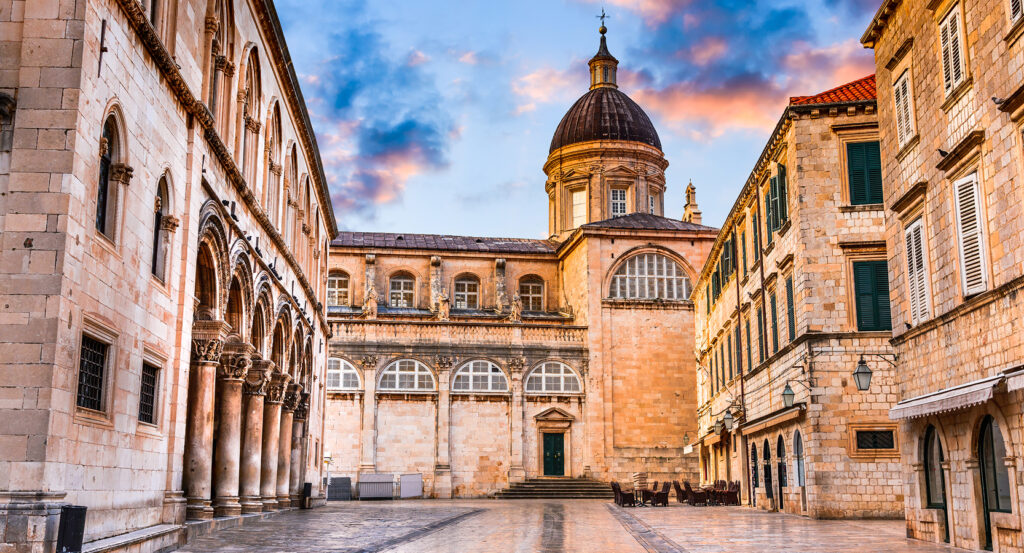
Why you should experience The Cathedral of the Assumption of the Virgin Mary in Croatia.
The Cathedral of the Assumption of the Virgin Mary, better known as Dubrovnik Cathedral, is a quiet crown at the heart of Croatia's most storied city, a masterpiece of Baroque devotion rising from the stone streets of the Old Town.
Framed by the Adriatic's dazzling blue and the honey-colored walls of Dubrovnik's fortifications, Dubrovnik Cathedral feels both timeless and alive. Its pale limestone façade gleams in the Mediterranean light, its dome rising above the terracotta rooftops like a soft echo of heaven itself. Step through its grand entrance, and the city's bustle fades into reverent silence. Inside, the space glows with restrained grandeur, arches draped in golden light, marble columns cool beneath your fingertips, and altars alive with centuries of faith and art. At its heart stands the Assumption painting by Titian, the Venetian master whose brush once bridged art and the divine. This cathedral, rebuilt after the devastating 1667 earthquake, was designed by Roman architect Andrea Buffalini, who blended Italian Baroque flourish with Dalmatian restraint. Every element seems to reflect Dubrovnik's identity, resilient, graceful, and deeply spiritual. It isn't just a relic of history; it's a living tribute to survival, artistry, and devotion. When the afternoon light filters through its high windows, the air itself seems to shimmer, as if the sea outside were somehow flowing through the sacred stone.
What you should know about The Cathedral of the Assumption of the Virgin Mary.
Beneath its tranquil beauty lies a story of rebirth, faith, and hidden landmark that stretches across a millennium.
The first cathedral on this site was built in the 7th century, though the version that once stood before today's was a Romanesque masterpiece funded, legend says, by King Richard the Lionheart. Shipwrecked off Lokrum Island in 1192 while returning from the Third Crusade, the English king vowed to build a church in gratitude for his survival, and thus began the earliest foundations of Dubrovnik's cathedral. The current structure rose from the rubble of disaster after the 1667 earthquake leveled much of the city, and what followed was nothing short of miraculous: a collaboration of Italy's finest architects and local artisans to rebuild it in radiant Baroque form. The interior houses an extraordinary treasury of relics, over 180 sacred artifacts, including gold and silver reliquaries crafted between the 11th and 18th centuries. Among them is the arm, leg, and skull of St. Blaise, Dubrovnik's patron saint, encased in intricately worked gold. The cathedral's dome, which defines the city skyline, was reconstructed with mathematical precision to capture both sunlight and sea breeze, creating an atmosphere that feels both ethereal and grounded. Its floor, made of smooth Istrian stone, reflects the glow of flickering candles during Mass, while its side chapels honor everything from maritime protection to the Virgin's intercession. Few visitors realize that the crypt beneath the altar holds archaeological remains from older cathedrals, mosaics, walls, and fragments that reveal how many times this site has been reborn. Every layer tells the story of Dubrovnik itself: battered by earthquakes, wars, and time, yet always rebuilt with beauty and faith intact.
How to fold The Cathedral of the Assumption of the Virgin Mary into your trip.
To experience Dubrovnik Cathedral fully, you must approach it as both a pilgrimage and a pause, a moment of quiet amid the cinematic splendor of the Old Town.
Begin at Luža Square, where the cathedral rises behind the city's stone palaces and bell towers, its dome gleaming under the Adriatic sun. Enter through the main doors and let your eyes adjust to the soft candlelight. Move slowly through the nave, admiring the subtle blend of marble and shadow, and stop before Titian's Assumption of the Virgin Mary, the altarpiece that gives the cathedral its soul. Its colors, deep crimson, celestial blue, radiant gold, seem to vibrate with life even after 500 years. Wander through the side chapels, each telling its own story of faith and resilience, then descend into the treasury for a glimpse of Dubrovnik's sacred past: gilded reliquaries, ancient manuscripts, and delicate icons that have survived centuries of siege and storm. Step outside again in the late afternoon, when the square is bathed in honeyed light, and look up at the dome framed by the city's medieval walls, a perfect discussion between heaven and earth. For the best view, climb the nearby city ramparts or the Jesuit Staircase; from above, the cathedral's symmetry and the sea beyond form a tableau of peace. Pair your visit with a stroll through the nearby Rector's Palace and the Church of St. Blaise to complete your understanding of Dubrovnik's golden age. And when evening comes, return once more, as the bells toll across the old city and the sound mingles with the hush of waves beyond the harbor. Dubrovnik Cathedral isn't just a monument of stone, it's a living hymn to endurance, beauty, and belief. Within its walls, faith and history converge into something timeless, and as you stand beneath its dome, gazing toward the light, you'll understand why this city, for all its battles and rebirths, continues to shine with an unshakable grace.
Where your story begins.
Foresyte Travel reveals places that feel extraordinary long before you arrive.
Experience premium editorial crafted for luxury travelers.




















































































































