Why The Royal Mummies Hall matters.
The Royal Mummies Hall is where history exhales, a room so still, you can hear the weight of time itself.
Beneath dim lights and hushed whispers, the rulers of ancient Egypt lie face to face with eternity. Within climate-controlled glass cases rest the preserved bodies of the pharaohs, Ramesses II, Seti I, Hatshepsut, Thutmose III, and others, each one a bridge between myth and flesh. Standing here, you realize these were not distant deities or symbols from dusty textbooks; they were people, their skin, hair, and hands surviving more than three thousand years. The air feels different in this room, charged with reverence. Every contour of each pharaoh's face tells a story of empire and devotion, ambition and divinity. The Royal Mummies Hall is not a display, it's a sacred encounter with immortality, where the gods of Egypt rest within arm's reach.
What defines The Royal Mummies Hall.
The Royal Mummies Hall houses the preserved remains of Egypt's greatest rulers, a collection that has redefined how the world understands both mummification and monarchy.
The practice of preserving the body for eternity reached its height during the New Kingdom (1550-1070 BCE), when embalmers developed sophisticated methods to desiccate, purify, and sanctify the body as a vessel for the soul's rebirth. The mummies now displayed were discovered in two extraordinary caches: the Deir el-Bahari cache (DB320) in 1881, where over 40 royal mummies were found hidden by priests during the 21st Dynasty to protect them from tomb robbers, and the Tomb of Amenhotep II in the Valley of the Kings, uncovered in 1898. These finds included some of the most renowned figures in world history, Ramesses II, known for his epic reign and expansive architecture; Seti I, whose tomb remains among the most beautifully decorated in Egypt; and Queen Hatshepsut, the female pharaoh who redefined kingship itself. Each mummy bears distinct characteristics, Ramesses II's aquiline nose and flowing hair, Thutmose II's delicate frame, and Hatshepsut's carefully wrapped linen shroud concealing the legacy of a woman who ruled as king. Scientific studies have revealed staggering detail: CT scans show signs of arthritis, dental abscesses, and even the embalmers' precise use of resins and amulets for protection in the afterlife. Many of the mummies once lay in ornate coffins and gilded shrines, now displayed separately to preserve their condition. The hall's layout emphasizes intimacy over performance, low lighting, minimal signage, and an almost monastic stillness designed to evoke both museum and mausoleum. When the Royal Mummies Parade ceremonially transferred these remains to the National Museum of Egyptian Civilization (NMEC) in 2021, the moment marked not a relocation, but a renewal, a declaration that even in the modern age, Egypt still knows how to honor its kings.
How The Royal Mummies Hall fits.
The Royal Mummies Hall is an experience best approached with quiet reverence, a pilgrimage, not a photo opportunity.
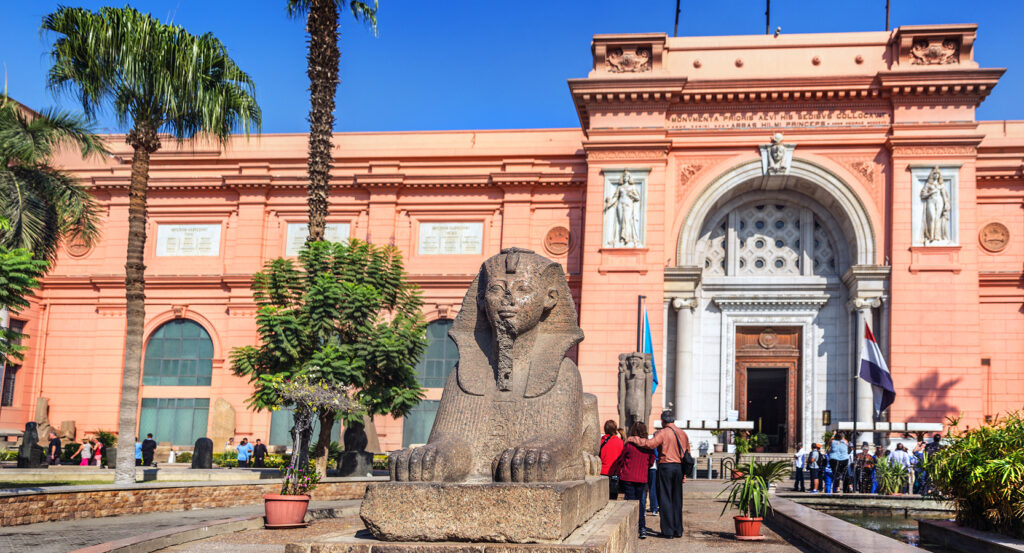
If you visit the Egyptian Museum in Tahrir Square, the hall remains one of its most solemn chambers, though the full collection now resides at the National Museum of Egyptian Civilization (NMEC) in Fustat, south of Central Cairo. The NMEC's new Mummies Hall recreates the atmosphere of a royal tomb, dark, reverent, and immersive, with each mummy displayed individually, accompanied by subtle projections and hieroglyphic inscriptions. The museum is open daily from 9:00 AM to 5:00 PM, easily reached by taxi or metro from Downtown Cairo ( 30 minutes). Begin your visit with the chronological galleries upstairs, which trace Egypt's dynastic history, before descending into the Mummies Hall, a descent both literal and symbolic. As you walk the softly lit corridors, you'll encounter the great rulers of the 18th to 20th Dynasties, each identified by name and reign. Move slowly, pausing to meet their gaze, Ramesses II's still-proud features, Ahmose's youthful intensity, Seqenenre Tao's battle wounds from the war of liberation. The atmosphere is meditative, aided by the controlled temperature and soundproofing that mimic the silence of the tombs. Plan to spend 45 minutes here, though many visitors linger longer, unable to turn away from the sheer gravity of the experience. Pair your visit with the nearby Fustat archaeological park or a stroll through Old Cairo, where millennia of faith coexist. The Royal Mummies Hall is Egypt's greatest act of remembrance, a place where gods lie human, and history sleeps with its eyes open.
Where your story begins.
Foresyte Travel reveals places that feel extraordinary long before you arrive.
Enjoy editorial crafted for luxury travelers.
Foresyte may earn a commission when you book.