Why El Five matters.
El Five is a cinematic Mediterranean restaurant where LoHi's elevated western edge meets Justin Cucci's theatrical approach to hospitality, Corey Ferguson's years immersed in Spanish cooking and a penthouse dining room framed by Downtown and the Rocky Mountains.
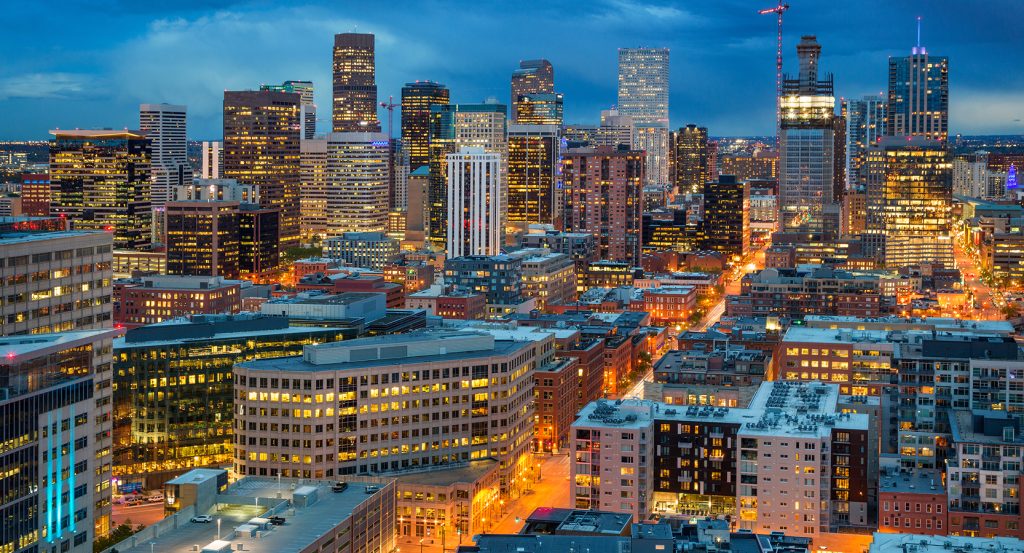
Set along Umatilla Street near West 30th Avenue and just steps from the former Olinger Mortuary, the restaurant occupies a hillside pocket where early North Denver buildings rise above the South Platte Valley beside successive generations of LoHi redevelopment. BOSS Architecture organized the 3,000-square-foot fifth-floor room around an open kitchen, dark surfaces, gold-toned details and broad glazing that places the city and mountains on opposite sides of the dining room. Vintage Arabic, Egyptian and Turkish cinema posters cover walls and ceilings, their saturated imagery joined by hundreds of hexagonal mirrors that fragment light across the interior. Two outdoor areas extend the room toward the surrounding horizon, turning Denver's pronounced elevation change into part of the physical composition. The result is a LoHi restaurant whose penthouse position, cinematic graphics and reflective surfaces create a deliberately theatrical stage for a long, shared dinner.
What defines El Five.
El Five is best known for becoming the fifth Denver concept created by chef-restaurateur Justin Cucci and Edible Beats, opening in May 2017 after Root Down, Linger, Ophelia's Electric Soapbox and Vital Root had established Cucci's preference for restaurants with strongly differentiated cultural and culinary premises. Its name works on two levels: the restaurant occupies the fifth floor, and Cucci conceived it as the fifth chapter in the Edible Beats collection. Executive chef Corey Ferguson gave that premise unusually relevant culinary depth. Before joining Cucci at Root Down in 2011, Ferguson spent time at a holistic-health institute in California studying connections between agriculture and cooking, then lived for a year in Spain, where regional pride in agricultural products altered his approach to food. He moved with Edible Beats through years of restaurant development and opened El Five as its chef in 2017, giving the new restaurant a kitchen leader whose Spanish experience directly supported Cucci's broader Gibraltar-inspired idea. Ferguson remained in charge eight years later, and his unusually long tenure allowed the restaurant's Spanish foundation to develop through repeated seasonal changes. That continuity earned another distinction as the organization itself changed: Edible Beats became a 100-percent employee-owned ESOP, placing El Five inside Denver's first restaurant group operating under that ownership structure. Eater Denver selected El Five as its 2017 Design of the Year, recognizing the same opening-year project in which Cucci, Ferguson and the architectural team fused food, cinema graphics and penthouse performance into a restaurant with an immediately distinct place in Denver dining.
Seafood paella concentrates the kitchen's Spanish technique in a broad steel pan where stock penetrates the rice before heat develops the prized crisp layer across the bottom. Carne and mushroom versions change the central ingredients without abandoning that communal format, with the latter combining seasonal vegetables, stracciatella, egg, paprika aioli and an Oloroso gastrique. Patatas bravas carry fried potato into chorizo, salsa brava, sherry gastrique and garlic aioli, moving between crisp edges, richness and acidity in a compact plate. Goat-cheese croquettes pair their molten center with Marcona almonds, frisée, bacon and mastic-chile honey, bringing eastern Mediterranean aromatics into a familiar Spanish form. Mezze broadens the geographic field through Turkish eggplant, peanut hummus, charred-carrot hummus, htipiti, artichokes and house-made pita before Moroccan lamb sausage moves the meal toward North Africa. Dessert preserves that geographic breadth through chocolate baklava with almonds, pistachio and honey-cardamom yogurt, malabi scented with orange blossom and sesame, and Basque cheesecake sharpened by cider reduction. Paella provides the Spanish structural center, and the surrounding tapas, mezze and desserts trace the Mediterranean routes that Ferguson and Cucci built around it.
How El Five fits.
El Five works as the dinner endpoint for an afternoon tracing North Denver through Italian immigration, the rise of a regional funeral empire and a twenty-first-century pedestrian connection that physically rejoined Highland with the central city.
Begin at Our Lady of Mount Carmel Catholic Church, whose origins reach to Father Mariano Felice Lepore's organization of Denver's Italian colony in 1891 and the parish founded three years later. After fire destroyed the first wooden church in 1898, architect Frederick William Paroth designed a Romanesque Revival replacement in brick and plaster; Bishop Nicholas Matz dedicated it in 1904, and the institution grew alongside an Italian population that exceeded 3,000 people in North Denver by 1900 before the church entered the National Register of Historic Places in 2017. Continue to Olinger Mortuary, developed from the undertaking business John and Emma Olinger established after reaching Denver from Santa Fe in 1890 and subsequently expanded by their son George W. Olinger. The family constructed its 2600 16th Street building in 1908 as the first purpose-built mortuary in the Rocky Mountain region; Buffalo Bill Cody's body remained there for six months after his 1917 death before burial on Lookout Mountain, and the operation occupied the site until 1999. Conclude at Highland Bridge, the final piece in a three-bridge pedestrian connection created between Highland and downtown across the rail corridor, South Platte River and Interstate 25. Its 325-foot span opened in December 2006 after a dramatic white arch was assembled over a temporarily closed interstate, completing a continuous pedestrian route toward the historic neighborhood from the 16th Street axis. The progression moves from an immigrant parish that anchored North Denver's Italian population through the Olinger family's purpose-built regional mortuary into Highland Bridge's reconnection of the elevated neighborhood with Central Denver, tracing more than a century of institutional growth and physical change around El Five.
Where your story begins.
Foresyte Travel reveals places that feel extraordinary long before you arrive.
Enjoy editorial crafted for luxury travelers.
Foresyte may earn a commission when you book.