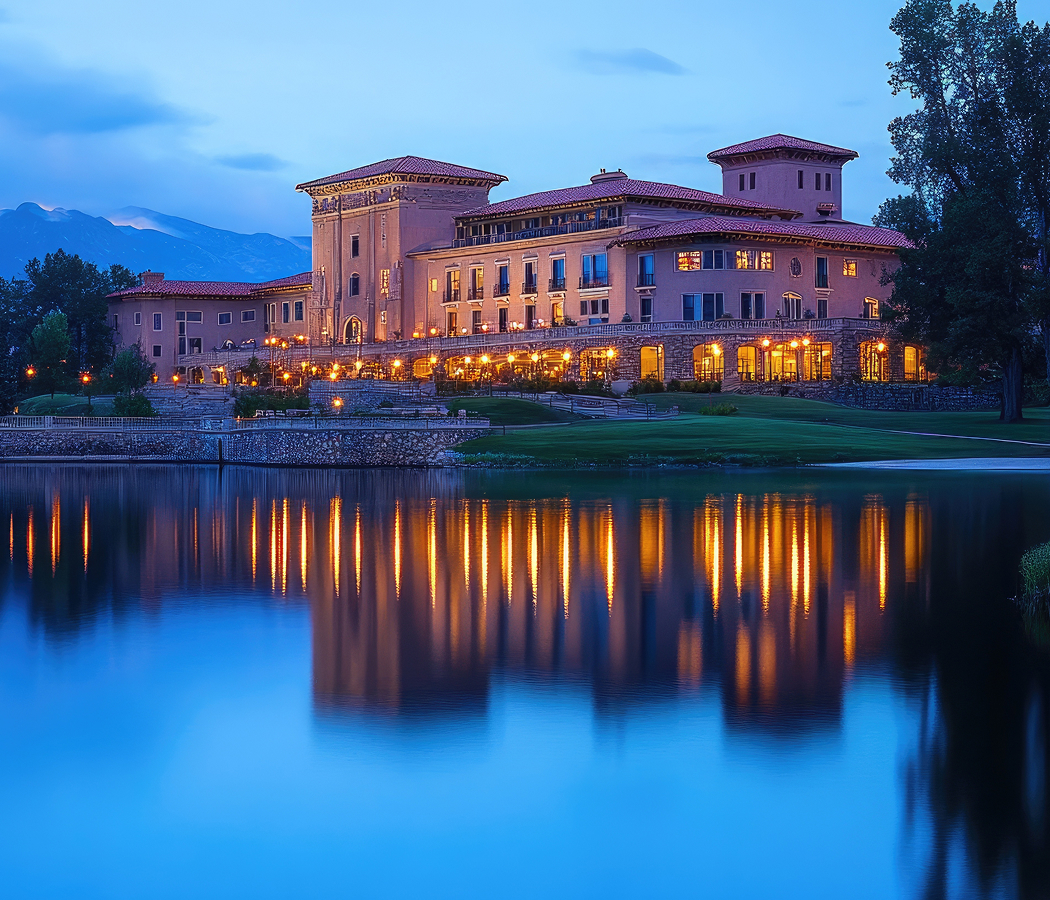
Why Evergreen matters.
Evergreen is a wooded mountain enclave where Jefferson County's Front Range character meets Bear Creek, historic ranch estates and a settlement transformed from nineteenth-century timber country into a year-round community in the foothills west of Denver.
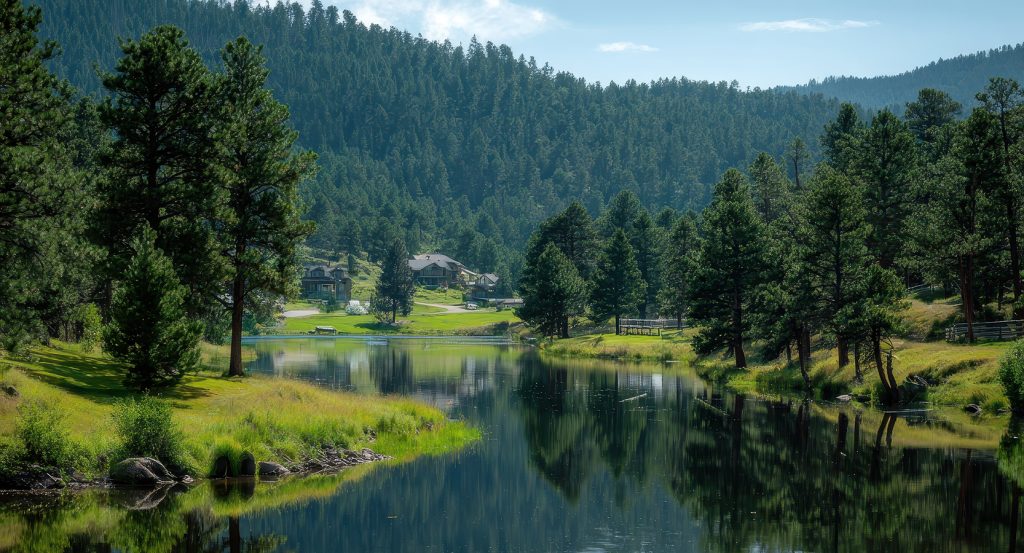
Positioned between Genesee, Kittredge and Conifer, the community occupies the Bear Creek drainage beneath forested ridges linking the Denver metropolitan edge with the higher Front Range. Bear Creek threads through the historic center before widening into Evergreen Lake, placing water, steep slopes and ponderosa-covered hillsides directly against the commercial core. Downtown follows the narrow creek corridor with buildings gathered close to the roadway and rising terrain immediately behind them. Residential roads subsequently climb outward through former ranch holdings, wooded subdivisions and the Upper Bear Creek landscape. The result is a mountain community whose compact creekside center opens rapidly into lakefront, forest and high-country residential terrain.
What defines Evergreen, Colorado.
Evergreen is best known for developing from a ranching and logging settlement established in 1859 into one of the Denver foothills' enduring mountain communities. Timber supplied growing Denver during the nineteenth century, and the establishment of a post office in 1875 formalized a settlement increasingly connected with the city below. John J. Clarke homesteaded 350 acres in 1878, raising cattle and cutting timber on land whose surviving cabin became the oldest portion of the later Humphrey property. Denver families simultaneously began treating Bear Creek and Upper Bear Creek as summer country, constructing hunting cabins, estates and substantial seasonal residences amid the cooler foothills. Mary Neosho Williams and her physician daughter Josepha acquired the property later known as Camp Neosho in 1893, commissioning Scottish craftsman John “Jock” Spence to expand a simple structure into an elaborate log residence over succeeding decades. Josepha married Episcopal clergyman and church-music scholar Charles Winfred Douglas, and Camp Neosho became connected with Evergreen's early religious, musical and cultural development. The construction of a dam and filling of Evergreen Lake in 1928 strengthened the community's recreational appeal, and Darst Buchanan's later Hiwan Ranch cattle empire introduced another consequential phase in the surrounding landscape.
The Buchanan era pushed Evergreen toward its modern residential form after Darst Buchanan and his family developed Hiwan Hills beginning in 1947. Custom mountain houses demonstrated demand for permanent foothills living beyond the community's earlier concentration of summer properties, and Hiwan Golf Club followed as another component of the expanding district. Water and sewer systems grew with the new residential population, shifting the former seasonal settlement toward continuous occupation. Interstate 70 reached the area in 1969 and substantially shortened the practical connection with employment in metropolitan Denver. Preservation moved alongside that growth after residents organized during the 1970s to protect surviving pieces of the earlier mountain community. Jefferson County acquired the historic Hiwan property with Open Space funds in 1974, and its museum opened the following year, preserving the Williams, Douglas and Buchanan periods within the same former estate.
How Evergreen, Colorado fits.
Evergreen works as the anchor for an outing connecting a preserved mountain estate with the lake that reshaped local recreation and a historic creekside center descended from the community's nineteenth-century settlement.
Begin at Hiwan Heritage Park & Museum, where Mary Neosho Williams and her daughter Josepha purchased their mountain retreat in 1893 and worked with craftsman John “Jock” Spence to develop Camp Neosho. Spence progressively enlarged the property with towers, detailed woodwork and outbuildings, completing the main residence in 1918. Josepha became one of Colorado's early female physicians, and her son Eric Douglas later became an influential Denver Art Museum curator associated with elevating Indigenous art within American museum practice. Darst Buchanan acquired the property after Josepha's 1938 death, renamed it Hiwan Ranch and expanded the operation beyond 15,000 acres around a nationally recognized Hereford herd. Continue to Evergreen Lake House beside the reservoir created when the dam was completed and the lake filled in 1928. The new body of water became a defining component of Evergreen's recreational landscape as the foothills settlement attracted increasing numbers of Denver residents. The present Lake House arrived in 1993 near earlier warming huts, adding a substantial lakeside structure to a recreational setting created more than six decades earlier. Conclude in Downtown Evergreen, where Bear Creek compresses the community between water, roadway and steep mountain terrain. Evergreen's origins reach to ranching families who settled the area in 1859, and its first post office followed in 1875. By the late nineteenth century, Denver residents were building summer houses and hunting cabins throughout the surrounding foothills, tying the small settlement to a recreational migration that preceded its later residential expansion. The surviving commercial center follows Main Street and Bear Creek between the lake and Meadow Drive, retaining the unusually narrow mountain geography from which the wider community spread. The progression moves from an estate carrying Evergreen's cultural and ranching history through the reservoir that strengthened its recreational appeal and culminates in the creekside center from which a nineteenth-century mountain settlement expanded into a permanent Front Range community.
Where your story begins.
Foresyte Travel reveals places that feel extraordinary long before you arrive.
Enjoy editorial crafted for luxury travelers.
Foresyte may earn a commission when you book.